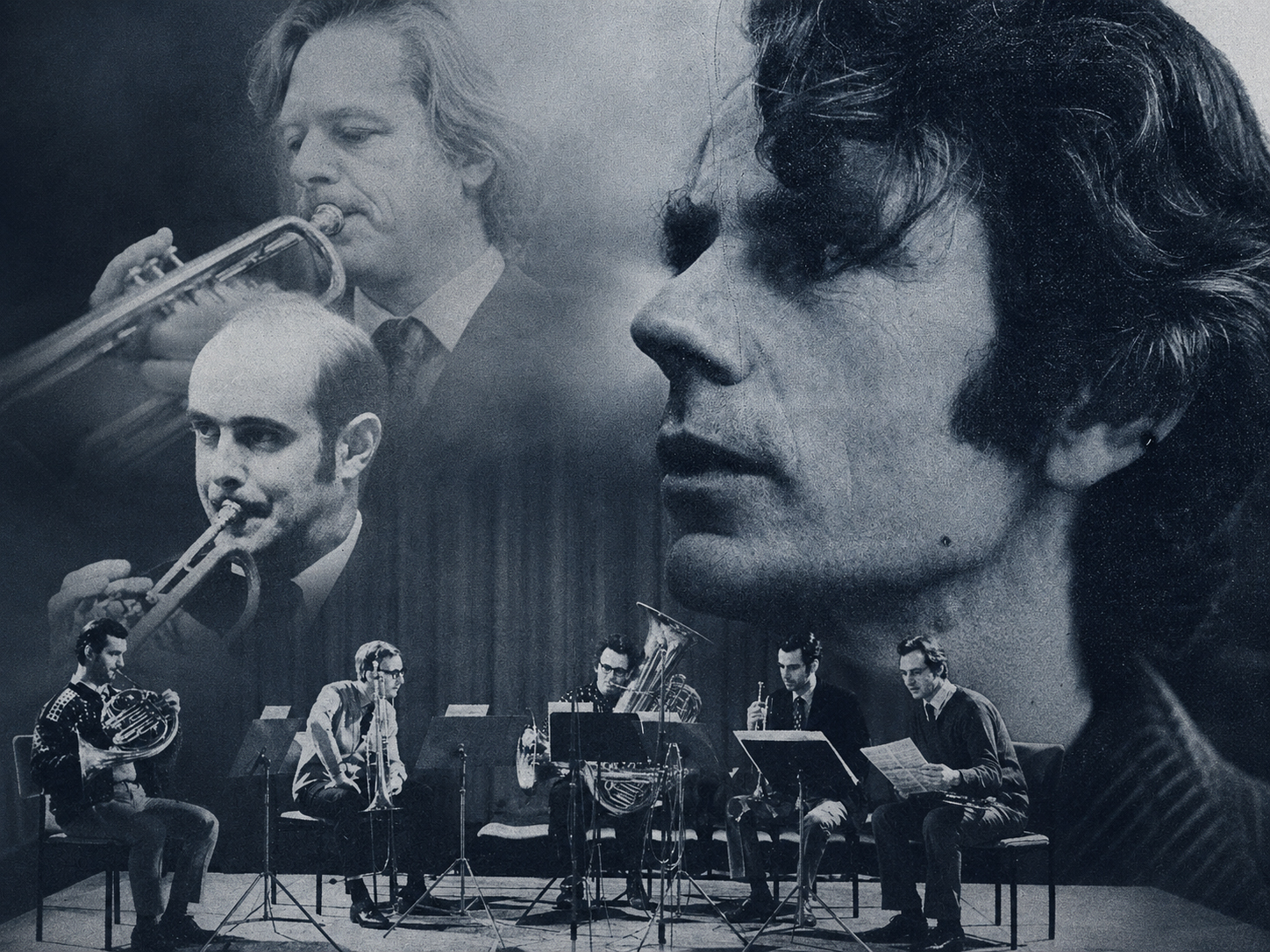
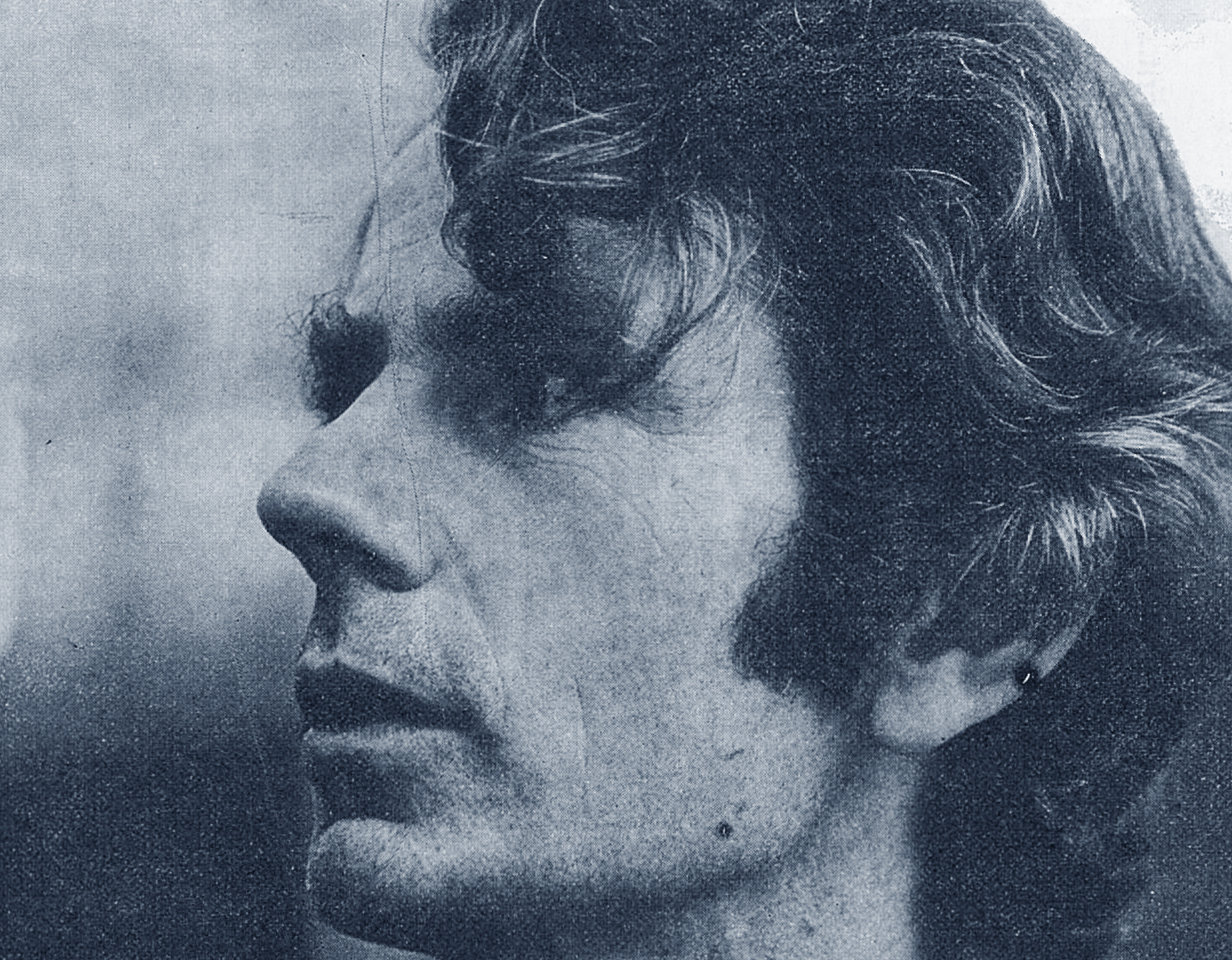
E. H. – After all, it's fairly rare in the brass world, because competition between brass players does seem to be specially strong, particularly among the young ones of course, who still have to make their way in the profession. So for all players to want to pool their musical experiences and come together to make music in this way is still a fairly rare thing. In America it's increasingly common, particularly in the Brass Quintet world, because they can get good teaching posts by playing together. But our brass group has no special reason for doing so. Philip Jones has been able to sponsor it himself, partly by the force of his own personality and partly by his feeling for music and encouraging other musicians to come together and make music in an enjoyable way. Michael Laird, from a slightly younger generation than Philip and I, has come into this group in the past five years or so and although he plays solos himself, he has become increasingly interested in the possibilities of playing music in this sort of ensemble.
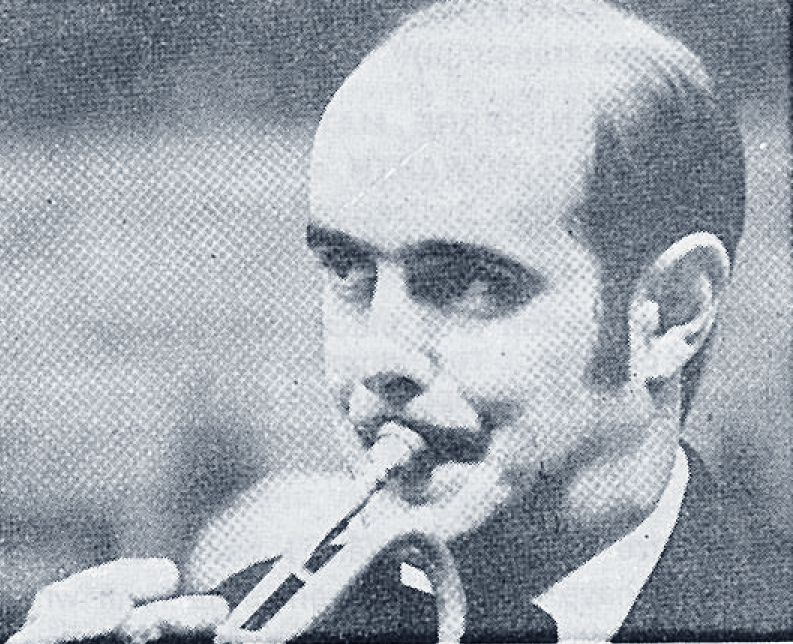
Michael Laird – That's right, yet for me it's a difficult job. You see as a freelance trumpet player I'm mostly concerned with playing first trumpet in various chamber orchestras, whereas now in Philip's ensemble I have to play « lower » parts! I find it a bit of a shock every now and then and also have to find my way musically, trying to do what the others expect of me... But I very highly respect Philip and Garry, so even when I feel overwhelmed by what is going on around me, still I find it very stimulating!
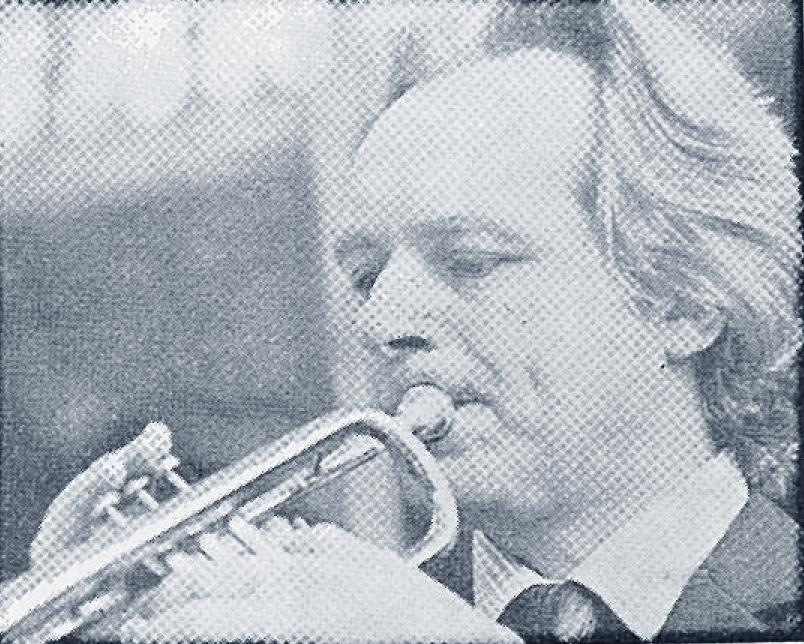
Ph. J. – You see, Michael, the youthful element in the ensemble is of the greatest importance to me. Although you may sometimes feel overwhelmed by what you have to do, it is my pleasure to show you and your generation the possibilities of what we have painfully worked out over the years, so that when the younger generation takes over from us, they have something to build up on and can go on developing brass music, especially brass ensemble music. It doesn't bother me that some of my younger players may feel that our ways are slightly alarming or old-fashioned or that they know more about things than I do. You see, the combination of being alarmed and feeling superior produces a very healthy reaction both ways, from the new players to the old and vice versa. And this, I feel, keeps the ensemble alive and always one step ahead of its competitors!
M. L. – Philip, I do think though that in an ensemble like yours it's very important that one or two people only should be entrusted with the musical direction... If all nine of us had their say as to how a piece should be played – wouldn't things get slightly difficult?
Ph. J. – Well, it's true you couldn't have nine leaders in a nine-piece ensemble! But I like there to be nine voices saying at times what they think and each one of these nine voices is listened to by the other eight and can influence our musical presentation or discipline inside the group. And when sometimes one of us forgets to listen carefully, we may be quietly reminded by one of the other members about the fact that we missed some musical point.
J.-P. M. – If I understand right, this is a kind of natural discipline, I mean a self-imposed one by the whole group, not one forced upon from above?
Ph. J. – Yes, absolutely.
J.-P. M. – Philip, I would like to know what experiences you have had with the ensemble, right from the beginning and if you have a special system for rehearsing, that's to say: how did you work then and how do you work now?
Ph. J. – Well, my first rehearsal system was quite simple. When I started in 1951, nobody in England had the remotest idea what a brass ensemble was. I formed one by choosing three of my colleagues whom I admired as players. We were a quartet and we just sat down to play some music through in a rather carefree way. But mostly I had quite a strong idea of what I felt about the music and – rightly or wrongly – being both the soprano instrument and having a rather aggressive personality, I insisted that we try different ways and approaches in order to discover by the sound which one was the best. Then other members of the ensemble began to take courage and questioned what we were actually doing and how we were playing and so everybody began to throw in an oar, some about musical presentation, others about different aspects of ensemble playing.
« My whole system of rehearsing and developing the ensemble over the years has been to take the best qualities of each musician that I admire as a player and especially as a person, and try to make him co-operate with me, giving me what is in his power to give me. Then it is for me to make the most of what he offers. The great thing for me about ensemble playing is really my personal relationship with other musicians, to try and avoid all competition and only to encourage all talents within the ensemble. And if someone has got a talent just for making me laugh or for stopping me being stupid or nervous, then he is as important to me as the chap who can play three times as high as I and five times as loud! The method of rehearsing is very simple: I always set up the arrangements, I choose the repertoire and then I ask my colleagues in the ensemble what they think of it. If they don't like it, it's thrown out. If they do like it, we discuss the works we are going to play and just how we want to perform them. So we make a process of eliminating the useless and keeping the good and every work is played because we believe in it! Some of us of course believe in it more than others do, but we all have something to offer about the work we are going to play and we all have a definite say in how the style of it is going to be presented and there is not a single voice in my ensemble – I hope – that is not allowed to have his say. Do you think that is so, Michael? »
M. L. – Very true, very true.
J.-P. M. – Philip, looking through the catalogues of brass music publishers, we notice that a lot of modern brass music has been written for you. How did this happen?
Ph. J. – It's just good luck that I am a person who meets a lot of musicians all over the world and I like to ask people to write pieces and to encourage them to think along brass lines which, very often, they haven't done before. And sometimes they are intrigued by the thought of writing a piece for instruments that they had never thought of in harmony together in an ensemble. They thought perhaps of a trumpet in isolation and the horn in isolation and the tuba not at all. So if I say, Hey! What about writing a piece for trumpet, horn and tuba, they first think it's crazy and then they are intrigued by the sound in their heads. And if I am lucky they may write a piece – and if I am extra lucky, it may be good! It's as simple as that.
J.-P. M. – And do you think that London is a good place to have such an ensemble as regards the choice of musicians?
Ph. J. – Oh it's a fantastic place! In London we have a marvellous pool of brass players and quite a few of them are not only players but have other talents and are interested in lots of other things, musical and extra-musical. In my own ensemble I have conductors, composers and players all mixed up together and I think this gives a tremendous strength to the group, because we can draw on experience from all the areas of music making. That's why the brass ensemble sounds as good as it does. It's not just playing brass instruments, it's a whole feeling for music. And each one of us individually has got something to offer.
E. H. – All that is certainly true, but if one is to create a very special ensemble and make a success of it, one needs a single person who is committed to the ideal and energetic enough to present his idea to a wide public. And if it hadn't been for Philip's work over more than 20 years, there would be no brass ensemble music in England at all!
M. L. – Yes, I agree absolutely!
Ph. J. – I think you exaggerate: we all play our important part in it...
J.-P. M. – May I say something at this point. Having been to your concerts twice just now I am sure that the audience does not realize your role and work in the group, Philip, one does not have the impression that you manage it at all! You are terribly modest: there you are mastering the group with your whole personality and it does not even show!
Ph. J. – That's exactly the way I want it...
J.-P. M. – And when you come on stage for the applause, you all bow like one man and not the other way round as one often sees it that one man bows for all!
Ph. J. – Yes, it's absolutely essential: we don't have any « passengers »!
E. H. – That's why I said in the first place that we are not virtuosi. The only potential ones, from a musical point of view, are two: Ifor James, the horn player, has an extraordinary talent and is certainly one of the most brilliant players England has had in the last fifty years, whereas Fletcher, our tuba player, is possibly unique in the world. Besides these two we have a different kind of virtuoso between us: Philip Jones himself! He will be terribly embarrassed for the fact that I am saying it, but he is a kind of Diaghilev in that he manages to persuade other people to use their talents for him and to perform at their peak! I have a bit of a talent for arranging and that sort of thing, Michael has a talent for playing the Baroque trumpet, several of the trombone players have different sorts of talents in all fields and Philip manages to encourage all of these – now I would call that one of the most virtuoso exhibitions that one can hope for from a professional musician!
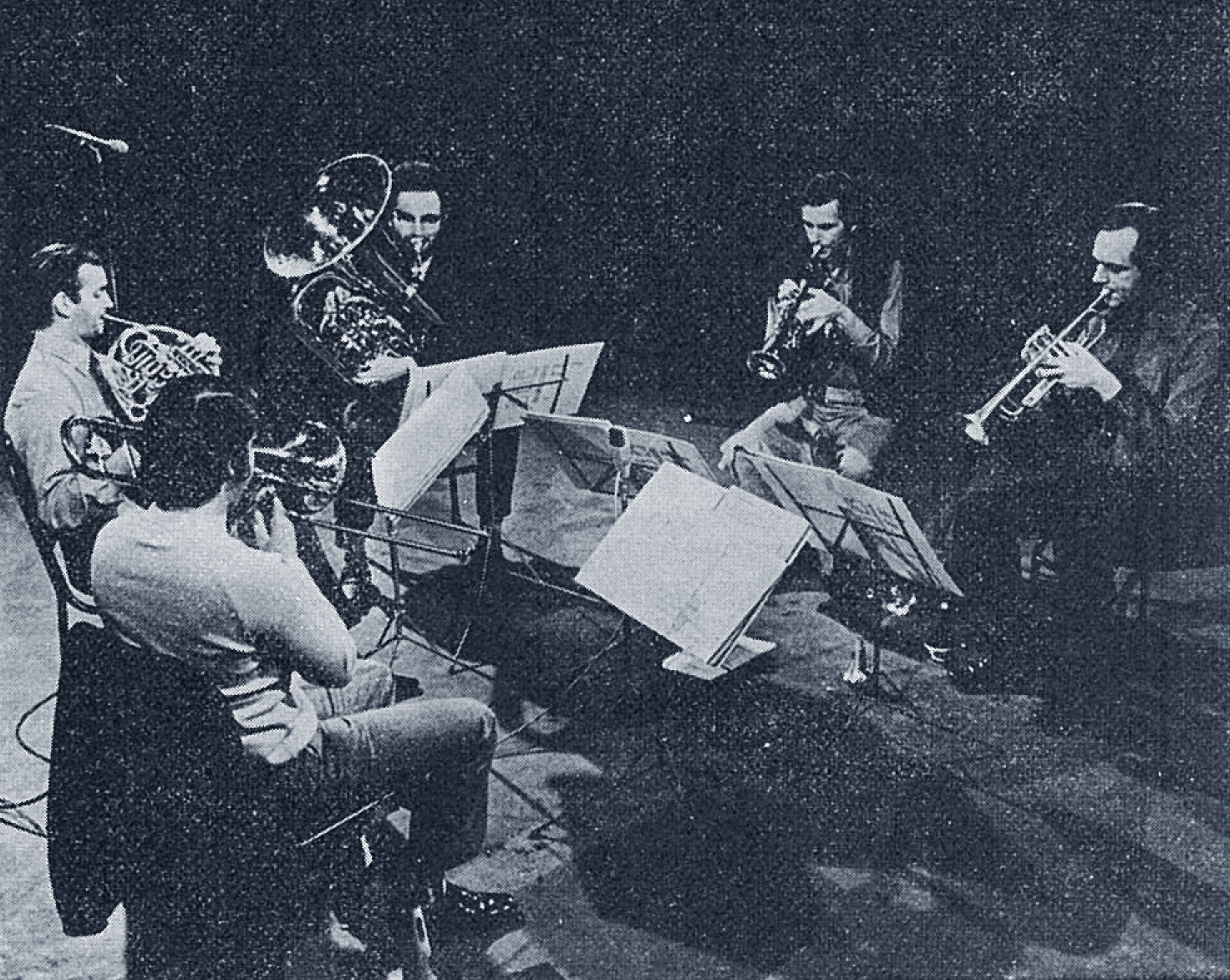
J.-P. M. – No doubt! Tell me, Philip, how do you choose new members when you have to replace someone – how difficult or how easy is it for you to find one?
Ph. J. – Well, it's not too easy to find people, because not every player is interested in sinking his own individuality into a corporate group. But as I told you, we have a lot of good brass players in London and not all of them are intrigued any more with being in a big symphony orchestra. When I began playing, one's career as a good and successful brass player was made – or not made – in the large symphony orchestras. But that has changed. Our five symphony orchestras in London have splendid brass sections, yet lots of very excellent brass players are doing equally excellent jobs as freelance musicians and this is the pool of younger players where I like to draw from and whom I like to meet. I do think that a youngster coming into my group probably finds it a bit of a strain at first because lots of us have been doing it for a long time and we know the ropes. Also every member knows the vagaries of Philip Jones and the fact that he doesn't usually give enough time for rehearsals and expects them to use their wits and their individuality to carry them through their first few performances! But so long as they are prepared to do that and continue to develop their own musical personality, then I do everything on my part to encourage them in that way. But if they don't want to do that, then they naturally drift out of the ensemble as quickly as they came in. I think for the younger ones that is a good thing, because if I had made it too easy for them and didn't assume that they could do a good job straight away, then they would not feel so important. The point is: I want every member that plays for me in my ensemble to feel very important and very special, right from the beginning!
J.-P. M. – Let me ask you another question now – about taste: If someone writes a work for you and you yourself like it but the others don't – what happens then?
Ph. J. – It often happens and in that case it's discussed very seriously and played through a few times and, by and large, if the piece isn't considered by the ensemble something that they really want to do, it's finished, it never goes past one or two performances. I don't think that I am an arbitrary...
M. L. – By way of example: the other day on the train I mentioned to Philip Hindemith's Morgenmusik and Philip said: « Oh no – I don't like that piece, we used to do it and it's not particularly good writing! ». Well, I thought that it was a good piece, especially so with double players and I said so. Philip's immediate reaction was: « Oh yes, that's quite an idea! I must have another look at it and try it again, perhaps I'll like it now! » Isn't that typical? I'm sure he would do it just to keep me happy!
Ph. J. – Of course! And I like to keep things open, as open as possible. We shall definitely try your Hindemith with doubled parts!
J.-P. M. – You know, Philip, the audience feels that you are happy together, it's a feeling emerging from the group...
Ph. J. – I am sure that's because each one of us feels that he is useful, important, unique and if it's only a question of moving a chair or a music-stand on the platform... It's as simple as that.
J.-P. M. – Right! Even then a little message flits across to the audience!
Ph. J. – (Splendid wine this is – what a marvellous place, drinking round a wood fire...)
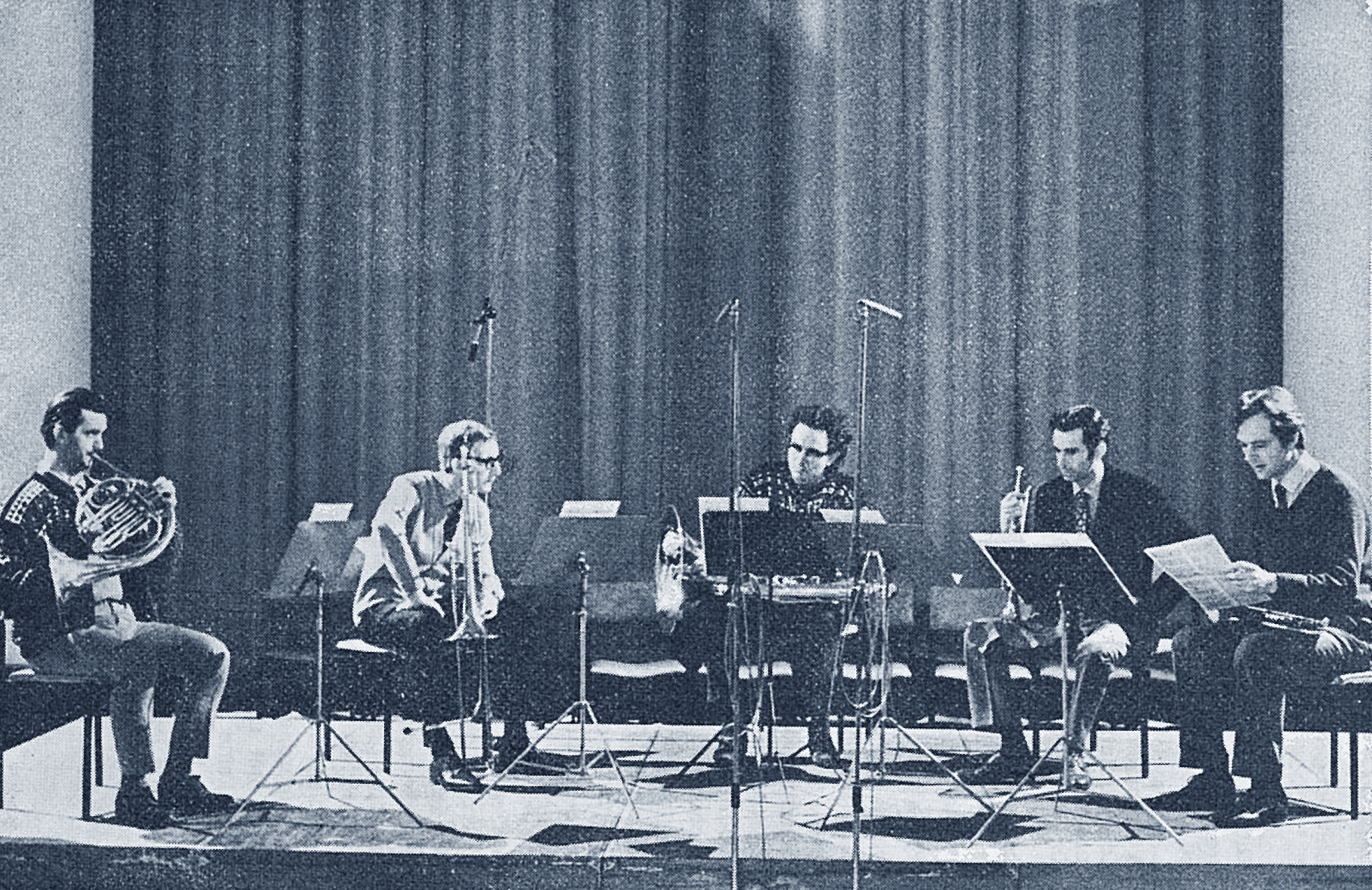
J.-P. M. – What is the ensemble's point of view regarding avant-garde music?
Ph. J. – Well, I'm going to hand you over to Elgar Howarth in a moment about that one. But I will say first of all that as an ensemble I think we have to take in absolutely all periods of music. The avant-garde is even one of the most important areas that we have to investigate, because the way to develop the possibilities of fine playing on brass instruments must doubtlessly be through avant-garde. In our limited experience in avant-garde music playing so far, we have developed not only more confidence in being able to cope with its considerable difficulties, but we also gained a tremendous bonus with all the rest of the music that we play from the earliest to the main-stream 20th century. There is no doubt about it: technically we are better now, from tackling music for which we had very little understanding. Garry has been the catalyst in this matter, he has insisted on making us do something that the rest of us were very reluctant to try because we are all traditional musicians who want it on a plate and he hasn't allowed us to get away with that! So Garry...
E. H. – Well, various things come out of that. The first is that I find that brass players in general are not specially interested in avant-garde music, by the nature of things. Why that is, temperamentally, I can't profess to know. I've been interested in avant-garde music because I started life by wanting to become a composer, in fact I still compose a lot and therefore am always in contact with it. From a purely playing point of view I am mystified why not more brass players are interested in avant-garde music, because the potentiality of expanding technique and of using techniques which many brass players have these days in new forms of music is a very exciting one – or ought to be. What for example can our tuba player Fletcher play? Except for a few arrangements of old music there is absolutely nothing for him to play – unless he turns to avant-garde music! What he and players like him – especially in America – are capable of doing on the instrument is really remarkable. So already from an instrumental point of view they ought to go into that field much more. Not exclusively though. I don't think that the so-called avant-garde is an area which is to be indulged in just for its own gimmicky sake as to say instrumental effects, or to make some kind of perhaps dubious reputation on making curious noises for the sake of modern music. Holliger does not do that on the oboe. Holliger, who happens to be Swiss, plays Mozart and Telemann and everything else as well as and better than most oboists in the world – and he plays modern music with more understanding and more technical facility than any oboist that I know. Because Holliger is a musician who is interested in the development of music as an art and I think that is exactly the right point of view. I have the feeling that that is where the Philip Jones group is too now, especially the Quintet. This new interest has also been prompted by meeting people like Gerry Schwarz from the American Brass Quintet. They are a group who has influenced us a lot both from listening to their live performances and from meeting them personally, discussing music until late into the night – and especially talking to Gerry himself. Recently Philip and I had the pleasure of working with him. Then there is our acquaintance with composers, as Philip already mentioned, and studying the works they write for us, both very stimulating, even if the works are not always successful.
But we have several good pieces: the Connolly piece for instance; it's not now avant-garde music at all, it's right in the mainstream of our music. It's brilliantly written, very effective, very good to play and audiences seem to like it. Avant-garde music is certainly something we shall go into more and more!
J.-P. M. – So you are actually quite close to the young composers, are you?
Ph. J. – Yes, I do think we are quite close to them, especially Garry. Yet much as we appreciate it when they write a piece for us, we do not pay lip-service to them: only if they produce a work which we think will really work for brass, then we'll happily play it!
J.-P. M. – How close are you to the audience really?
Ph. J. – Well, at the moment we are quite close, but my feeling is that we might drift apart for a while. We actually created our own audience, because when we started nobody had ever heard of such a thing as a brass ensemble and now we are getting to the stage where some people even pay money to come and hear us willingly, not reluctantly! Now they may get disappointed when we are going to push on into new fields, but one cannot stay on the same place for any length of time whatsoever. We stay on a spot as long as we need to get really good at it – then we move on and take a chance to discover, sometimes by painful experience both for the audience and ourselves, where our way lies. However I feel confident that our audience will follow us, even into avant-garde music! It's not only that we shall tackle new music, it's also that we want our recitals to be rather more all-embracing than they have been, not just an experience of a rather unusual combination of brass instruments causing people to say with surprise: « Oh isn't it nice that brass players can play in tune? » or « Isn't it amazing that they can make these sorts of sounds? » No, we want to take people on different levels, to involve them emotionally really. This is something that Garry feels very strongly I think, as a composer and creative musician. Myself I am a chap who just organizes events and tries to foretell what these events should be. When some people of my ensemble have creative ideas it is then my job to give them a chance and see to it that these ideas can come to life. What do you think about that, Garry?
E. H. – That's certainly true and surely not only for the Philip Jones Ensemble but for musicians all over the world who are trying to present concerts in a different way.
J.-P. M. – Philip, a last question: Now that you are getting famous...
Ph. J. – Mmh – it's a strong word that!
J.-P. M. – All right, let's say it differently then: after your very successful concert tour now, are you planning to change your programmes considerably or will you continue more or less in the style that brought you all these successes?
Ph. J. – Well, as I told you, we have always changed our programmes. We have extended the time period by going back to earlier music than we could manage in our first programmes and on the other hand we have gone forward to more advanced music. But we certainly have to and want to consider our audiences, because not all of them accept brass ensemble music easily to begin with – especially not as a whole evening's entertainment – and perhaps they are not going to take too easily to new experiences. So according to the audiences we play for, I have to plan the concerts carefully and where I find it necessary I have to put in a lot of – what I regard as fairly safe middle-of-the-road sort of sounds, to keep us all happy...
J.-P. M. – And what kind of music do you think will bring the audience to the Philip Jones Brass Ensemble concerts 10 or 15 years from now?
Ph. J. – In 10 or 15 years, who's to say where music is going to be? But the successors to the Philip Jones Brass Ensemble will undoubtedly discover what is necessary to intrigue an audience's ears at that time – and I wish them THE VERY BEST OF LUCK!