Explore institutional access Explore institutional access
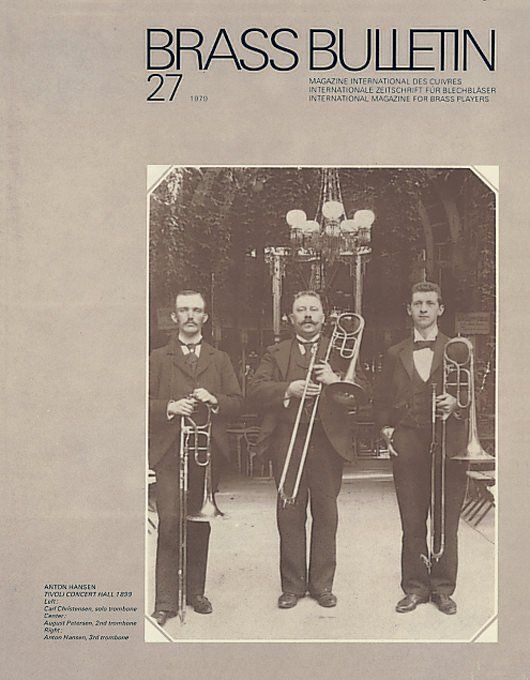
Brass Bulletin 27 - 3 / 1979
Issue
Brass Bulletin No. 27
Date
III / 1979
Pages
104
Contents
9 articles

Out of print

All issues

Brass Bulletin No. 27

III / 1979

Contents

9 articles

Editorial

Jean-Pierre Mathez

pp. 3 Teaching Society

Virtuosity is framed less as method than perception, opposing formula-driven teaching and pointing to attentive listening as the ground for technical clarity and artistic control

The Trumpet in the USA

Part 1

Thomas Stevens

pp. 5–8 Trumpet Society

Across competitions, teaching and equipment in the U.S., trumpet practice exposes clashing ideas of musicality, raising the question of shared standards beyond national styles

Anton Hansen (1877-1947)

Part 1

Father of trombone playing in Scandinavia

Per Gade

pp. 27–40 Trombone History Professional life

From Nørrebro cafés to the Royal Orchestra, Anton Hansen’s early years reveal the shift from valve to slide trombone in Scandinavian orchestras.

John Fletcher

Interview

Jean-Pierre Mathez

pp. 41–44 Tuba Encounters Society

From brass bands to chamber ensembles, John Fletcher reflects on the rapid rise of young British tubists and the changing role of the instrument.

The Leningrad School of Horn Playing

Frøydis Ree Wekre

pp. 45–50 Horn History Teaching

From St. Petersburg to the Soviet era, generations of horn players shaped a distinctive approach to sound, interpretation, and orchestral playing.

On the early history of valves and valve instruments in Germany (1814-1833)

Part 4 – End

Herbert Heyde

pp. 51–61 History Equipment

Poverty, patents and workshop rivalries shaped the first German valve instruments, from Blühmel and Stoelzel to the Vienna and Mainz systems.

Zen and the Art of Horn playing

Part 3

Jeffrey Agrell

pp. 63–70 Horn Health

Between breath, reflex, and attention, Jeffrey Agrell links Zen practice with the physical and mental habits that shape brass playing.

Barry Tuckwell

Interview

Jean-Pierre Mathez

pp. 71–79 Horn Encounters Professional life

Between the London Symphony Orchestra, international solo tours and Mozart or Strauss concertos, Barry Tuckwell reflects on sound, risk and musical instinct.

Philip Jones

Interview

Jean-Pierre Mathez

pp. 81–89 Trumpet Encounters Repertoire

From South London bands to the Philharmonia, Philip Jones recalls his musical upbringing, orchestral life and the rise of brass ensembles in post-war Britain.

Loading…

Questions & Answers

How the Digital Edition works

What does the Digital Edition include?

The Digital Edition brings together the articles already digitized as searchable online texts—not simply as scans or PDF files—along with their original illustrations, notes, authorship, issue information, and available translations. Related-article suggestions currently include only this digitized material.

Are the digital articles identical to the originals?

We preserve the original text, language, illustrations, captions, footnotes, and editorial context as faithfully as possible. The presentation is adapted for comfortable online reading, and obvious transcription or scanning errors may be corrected. The substance and character of the published article remain unchanged.

Which languages are available?

Brass Bulletin was published in English, French, and German throughout its history. Italian and Spanish translations were added from issue No. 60 onward.

On the Italian and Spanish sites, articles from issues 1–59 are therefore shown in English by default.

How often are new articles added?

New articles are added almost daily, with approximately one complete issue digitized each week. The pace may vary depending on the preparation, image work, and editorial checking required.

Why aren’t all articles available digitally?

The complete Brass Bulletin collection contains 1,246 articles published between 1971 and 2003. The full index is already available online, allowing readers to discover every article in the collection, including those whose complete text has not yet been digitized.

Digitization began in February 2026. Each article is carefully prepared for online reading, checked, and connected to its issue, authors, subjects, and illustrations. At the current pace of digitization, the complete collection is expected to be available online by February 2028.

Why do some references mention articles that are not available yet?

References in the original articles are preserved even when the material they point to has not yet been digitized. This keeps the historical and editorial record intact. As more issues are added to the Digital Edition, an increasing number of these references will lead to articles that can be read online.

Can I suggest an article or report a transcription error?

Yes. If there is an article you would particularly like to see digitized, or if you notice a possible transcription error or missing detail, please contact us. Reader feedback helps us improve the Digital Edition and prioritize useful connections within the archive.

How can I support Brass Bulletin?

Your support helps fund the preparation, verification, and online publication of the complete collection.

Subscribe to the Digital Edition

Prefer to support us without subscribing?

Make a donation

Search Brass Bulletin.