Explore institutional access Explore institutional access
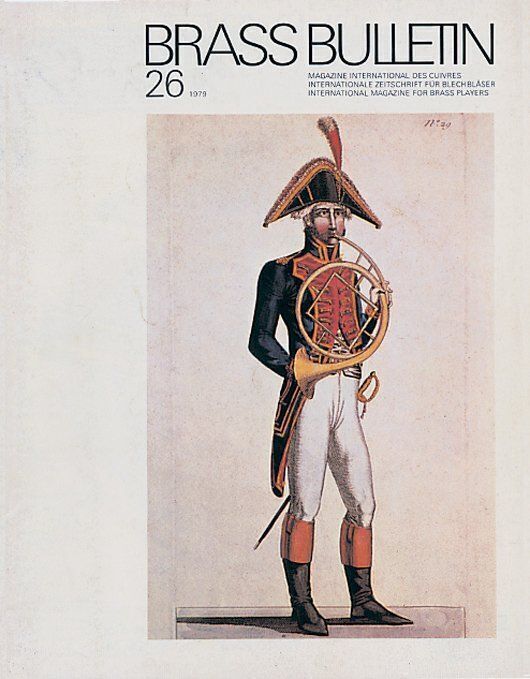
Brass Bulletin 26 - 2 / 1979
Issue
Brass Bulletin No. 26
Date
II / 1979
Pages
104
Contents
11 articles

Out of print

All issues

Brass Bulletin No. 26

II / 1979

Contents

11 articles

Tuba Editorial

Roger Bobo

pp. 3 Tuba Professional life Society

Roger Bobo reflects on orchestral auditions, examining imbalance between candidates and positions and questioning training, selection criteria and prospects for aspiring tubists.

Frankfurt Special 1979

Music Fair

Jean-Pierre Mathez

pp. 17–31 Event Report

Jean-Pierre Mathez surveys the Frankfurt Music Fair, tracing makers, markets and competition, and outlining a brass landscape shaped by adjustment rather than innovation.

Renold Schilke at Frankfurt

Interview

Jean-Pierre Mathez

pp. 33 Trumpet Encounters Instrument Makers

Jean-Pierre Mathez reports on Renold Schilke’s views at Frankfurt, addressing fair organisation, maker–musician collaboration, and shifting market dynamics shaped by demand and quality criteria.

Maurice André

Part 3 – End

Biography

Jean-Pierre Mathez

pp. 35–44 Trumpet Encounters

Maurice André reflects on maturity—balancing performance, recordings and teaching, refining his approach to instruments and audience, and preparing for the limits of a virtuoso career.

The bell-tuning trumpet

Colin Bloch

pp. 45–50 Trumpet Equipment Acoustics

Colin Bloch examines bell- and slide-tuned trumpets, comparing intonation patterns through controlled tests and outlining structural causes behind observed deviations.

Being a woman brass player... So what?

Frøydis Ree Wekre

pp. 51–54 Society Health

Frøydis Ree Wekre reflects on women in brass playing, examining physical assumptions, psychological factors, and practical realities across performance and professional life.

Interview with Miles Anderson

Jean-Pierre Mathez

pp. 55–58 Trombone Encounters Professional life

Jean-Pierre Mathez traces Miles Anderson’s path from early training to orchestral and freelance work, expanding on the tension between livelihood and artistic pursuit.

Vassily Gueorguievitch Brandt (1869–1923)

Biography

Anatoly Selianin

pp. 59–68 Trumpet History Teaching

Sélianine traces Brandt’s life and artistry, from Bolshoi virtuoso to influential pedagogue, revealing the foundations of a distinctly Russian trumpet tradition.

On the early history of valves and valve instruments in Germany (1814-1833)

Part 3

Herbert Heyde

pp. 69–82 History Equipment

Herbert Heyde traces early German valve instruments from Stoelzel’s horns to basses, makers, patents, and shifting brass-band sound.

Contemporary Hungarian Brass Music

Frigyes Varasdy

pp. 83–88 Repertoire Teaching

From early decline to recent revival, Hungarian brass emerges through pedagogy, competitions and new chamber works, with Varasdy outlining key figures and shifting ensemble practices.

Mario Guarneri

Portrait in brief

Jean-Pierre Mathez

pp. 104 Trumpet Encounters Professional life

From San Francisco to New York and Los Angeles, a trumpet career unfolds across major orchestras, recordings and teaching, alongside a sustained commitment to access and contemporary music.

Loading…

Questions & Answers

How the Digital Edition works

What does the Digital Edition include?

The Digital Edition brings together the articles already digitized as searchable online texts—not simply as scans or PDF files—along with their original illustrations, notes, authorship, issue information, and available translations. Related-article suggestions currently include only this digitized material.

Are the digital articles identical to the originals?

We preserve the original text, language, illustrations, captions, footnotes, and editorial context as faithfully as possible. The presentation is adapted for comfortable online reading, and obvious transcription or scanning errors may be corrected. The substance and character of the published article remain unchanged.

Which languages are available?

Brass Bulletin was published in English, French, and German throughout its history. Italian and Spanish translations were added from issue No. 60 onward.

On the Italian and Spanish sites, articles from issues 1–59 are therefore shown in English by default.

How often are new articles added?

New articles are added almost daily, with approximately one complete issue digitized each week. The pace may vary depending on the preparation, image work, and editorial checking required.

Why aren’t all articles available digitally?

The complete Brass Bulletin collection contains 1,246 articles published between 1971 and 2003. The full index is already available online, allowing readers to discover every article in the collection, including those whose complete text has not yet been digitized.

Digitization began in February 2026. Each article is carefully prepared for online reading, checked, and connected to its issue, authors, subjects, and illustrations. At the current pace of digitization, the complete collection is expected to be available online by February 2028.

Why do some references mention articles that are not available yet?

References in the original articles are preserved even when the material they point to has not yet been digitized. This keeps the historical and editorial record intact. As more issues are added to the Digital Edition, an increasing number of these references will lead to articles that can be read online.

Can I suggest an article or report a transcription error?

Yes. If there is an article you would particularly like to see digitized, or if you notice a possible transcription error or missing detail, please contact us. Reader feedback helps us improve the Digital Edition and prioritize useful connections within the archive.

How can I support Brass Bulletin?

Your support helps fund the preparation, verification, and online publication of the complete collection.

Subscribe to the Digital Edition

Prefer to support us without subscribing?

Make a donation

Search Brass Bulletin.