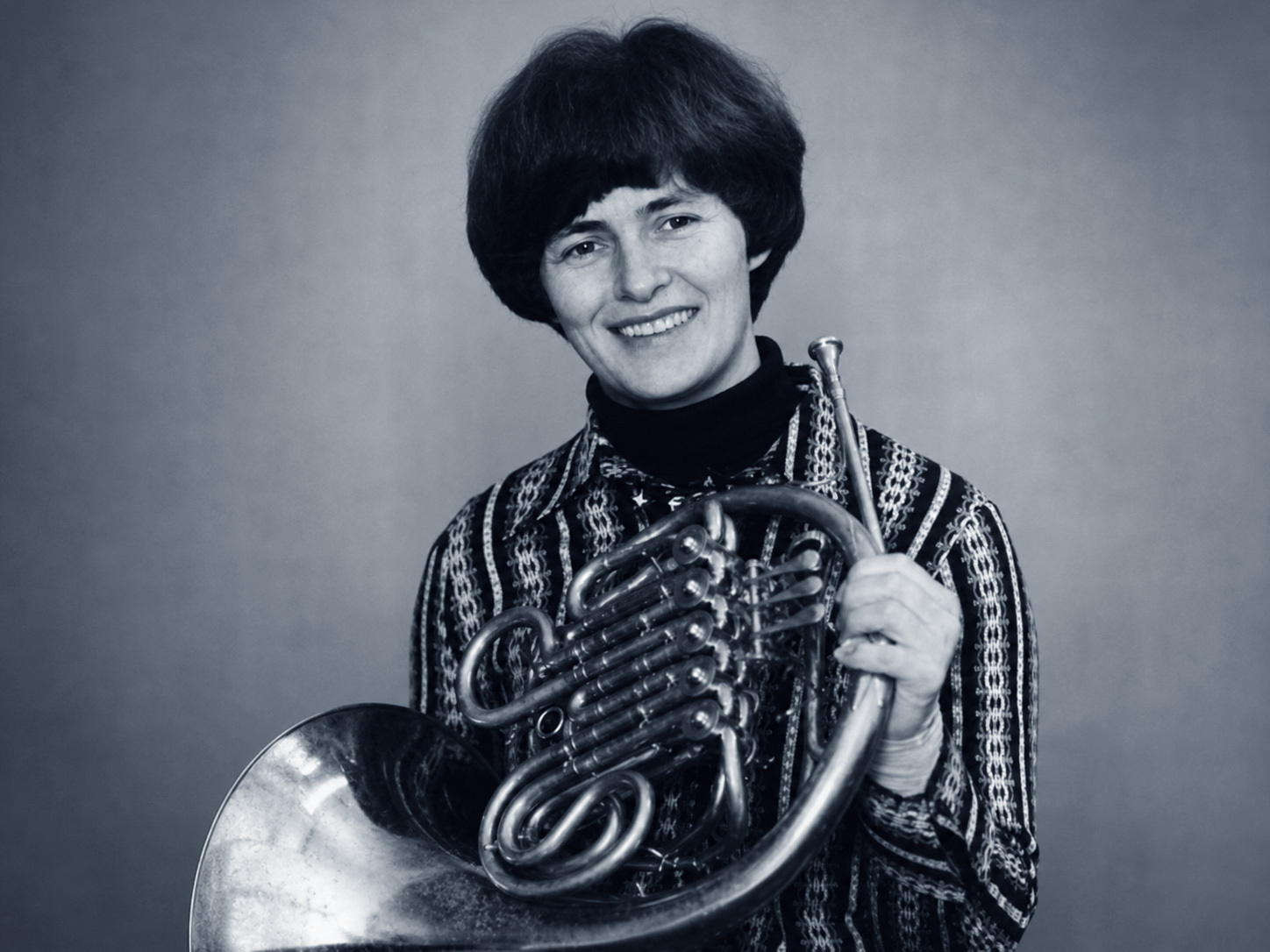
- Can women play loudly?
The ability to play loudly, among other things depends on an active temperament. Also, one must be willing to exert much effort in the full use of the body, and have courage to accept that while playing loudly, the sound does not always seem so "nice". Many women do have this temperament, will and courage. However, the frail image of women, never doing hard physical work, is unfortunately still a common picture in people's minds. For this reason, women should be consciously aware of this attitude and work on overcoming it. After all, this problem is not so big for men, since most of them are brought up to be more "noisy". I can admit that a small woman might not be able to play loudly for the same amount of time as a large man. Nonetheless, it is possible to diminish this problem through an intelligent approach. The small woman must learn "how to lie to the audience" (sic Arnold Jacobs, famous tuba player with very reduced lung capacity due to illness). - Can women play high notes?
To play high is not only dependent on raw power, but also on cleverness, technique, and intelligent work. I know several women players who are especially good in the high range. - Can women really play the heavy music?
Playing heavy music is a problem shared by both sexes. Endurance again is very much a question of intelligence, of knowing how to play with a flexible embouchure, and of knowing where and how to rest quickly while playing. Self-confidence is also important... "The art of believing that one can make it"... a good title for some article. - What about arm strength — endurance in holding the instrument?
Normally strong women who are conscious of static use of muscles, can hold their instrument up as long as the music requires. But the strain on the arms, caused by the static muscle situation, may be a problem, and I have seen more girl students having trouble with arm and neck tensions than boy students. The teacher should be aware of this tendency, and at an early point encourage the students — and especially the girls — to expand their strength through swimming, arm exercises, and other physical activities. Also... "The art of frequent rests while playing"... - Can women play well during menstruation?
This is an individual matter. A few women are really sick for one or two days each month, but most of us are able to work anyhow. I have often played difficult parts on these "days"; and maybe because I did not over-estimate my possibilities, the results were often surprisingly (to myself, at least) good. - Can women play well during pregnancy or after giving birth?
The best example I know of concerns the first hornist in the Norwegian Radio Orchestra, who has two small children. She played up to 14 days before giving birth in both instances. The last 2 months of pregnancy, she played third horn instead of first, but then she was back to her regular routine 3 months after each birth. - Can a woman function well professionally in a group of men?
Definitely, yes. It would be unfair to pass judgement after experiencing a few bad examples among women players. There are arrogant and difficult personalities among male musicians too!
After all this "thinking", I still feel able to ask the same question: Being a woman brass player... so what?