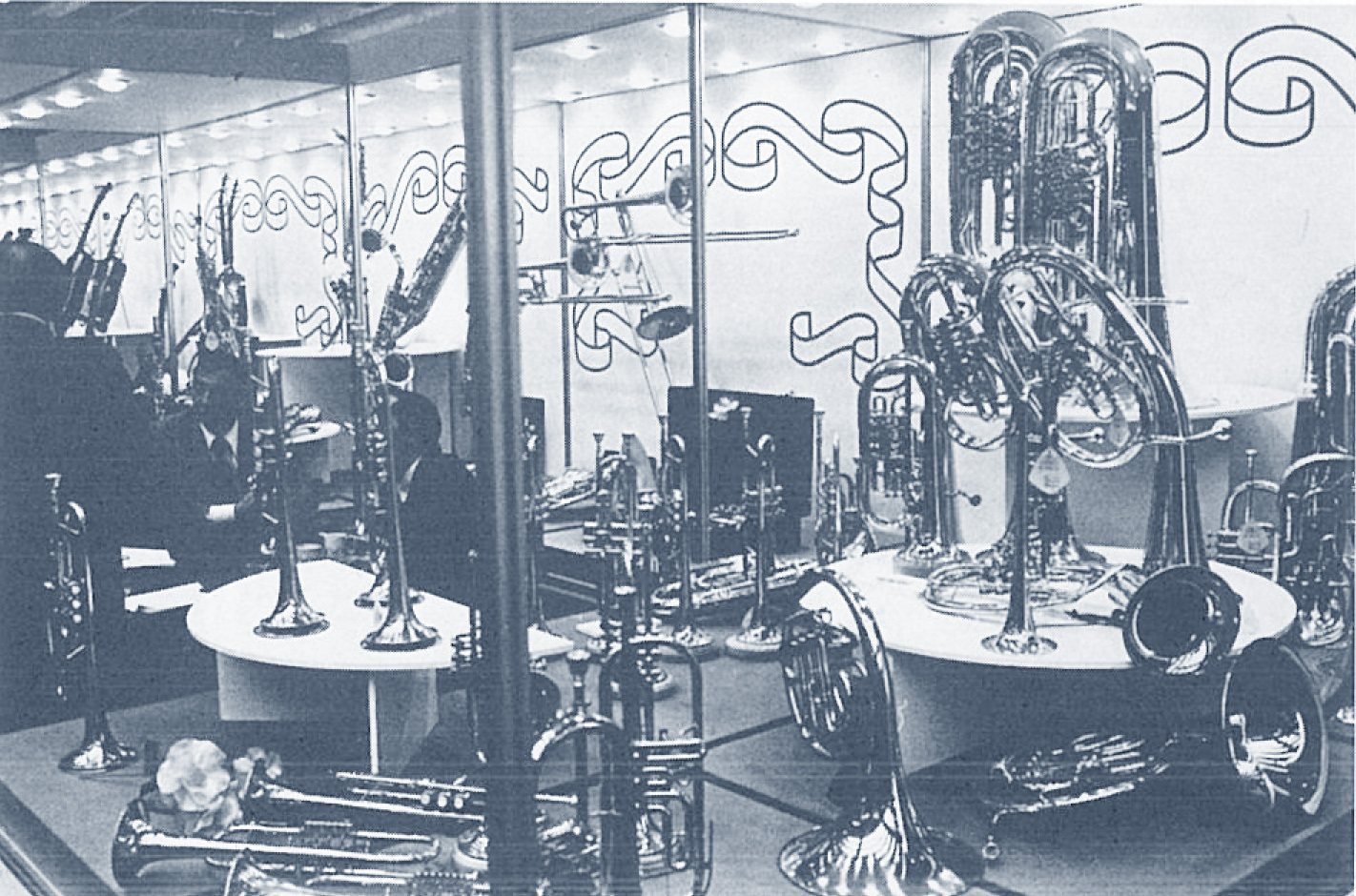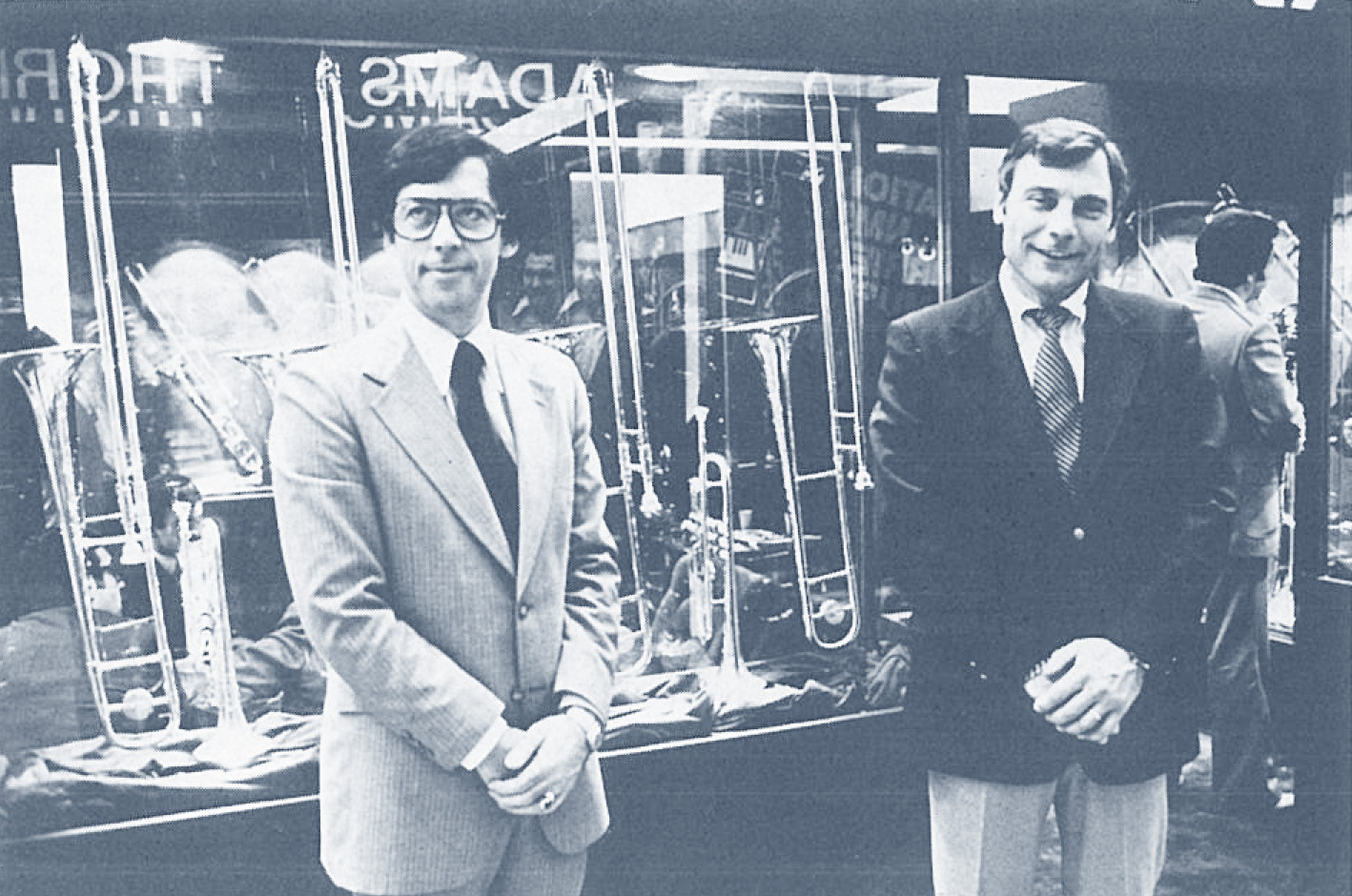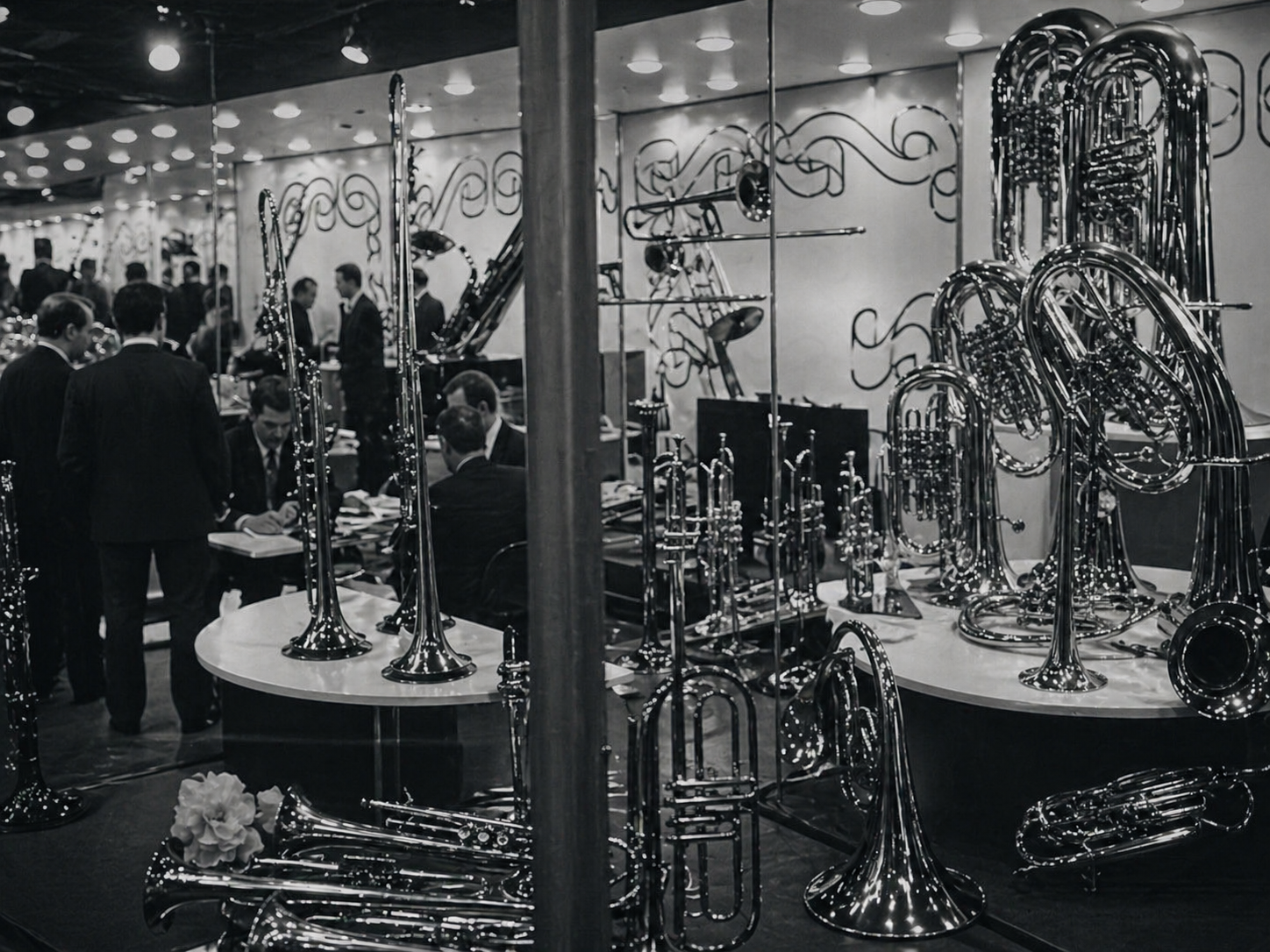
We decided to go along every avenue systematically, avoiding all the "non-brass" stands, of course...
The first person we met was at the stand of Amati, the Czech instruments. Peter Welz, the associate of the German importer Leopold Müller, answered the ritual question, "What is the Fair like this year?" by saying:
— We are satisfied with how business is going. All the same for two years and indeed generally we have had sales problems with our brass instruments. We still don't know exactly why this is, but in the particular case of the German domestic market it originates in the fact that German manufacturers, who at one time sold a lot overseas, cannot do so any more because of the disparity in exchange rates, and because they are now trying to dispose of their excess production in their own country.
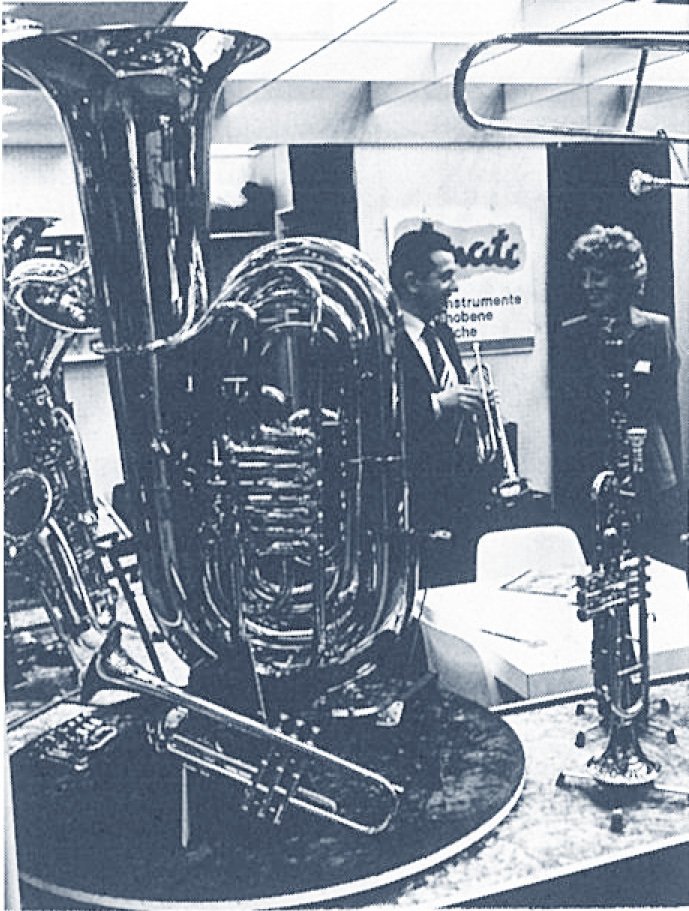
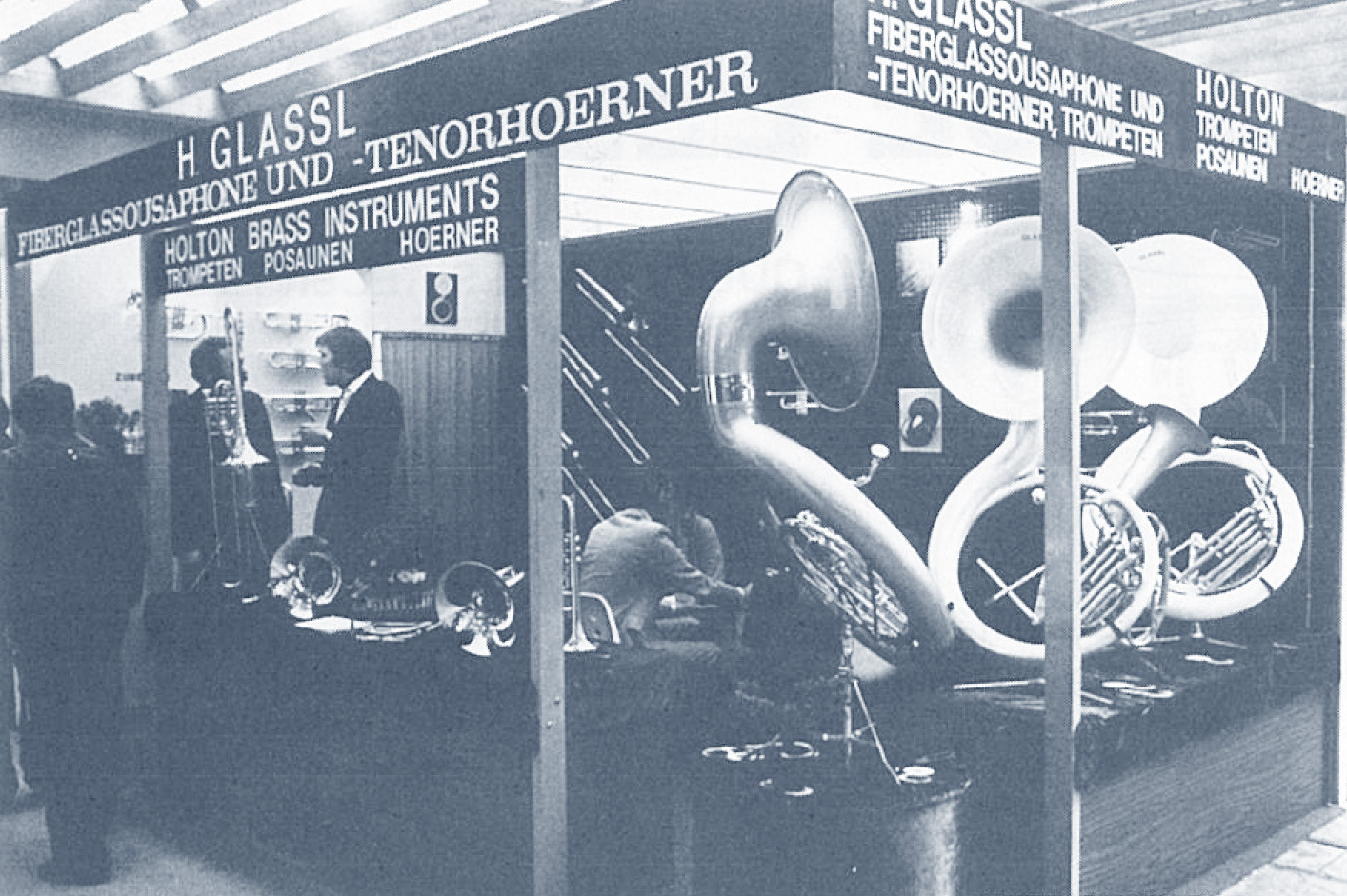
Glassl, the fibreglass sousaphone specialist:
— Anything new?
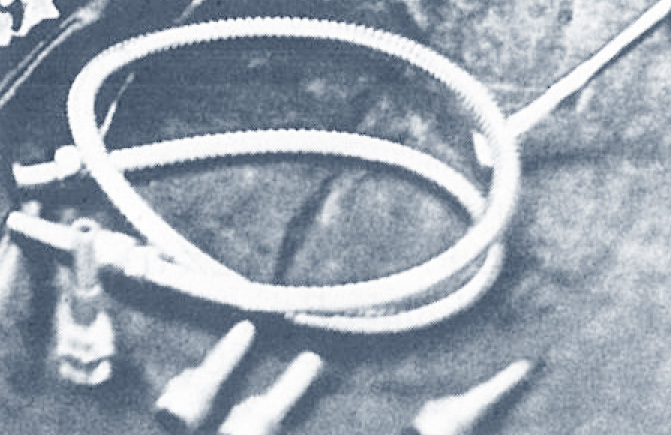
— Yes, a socket system which can be connected to every brass mouthpipe so that the instrument can be attached to a pipe and cleaned internally by means of a concentrated jet of water. We have also brought out a fibreglass baritone.
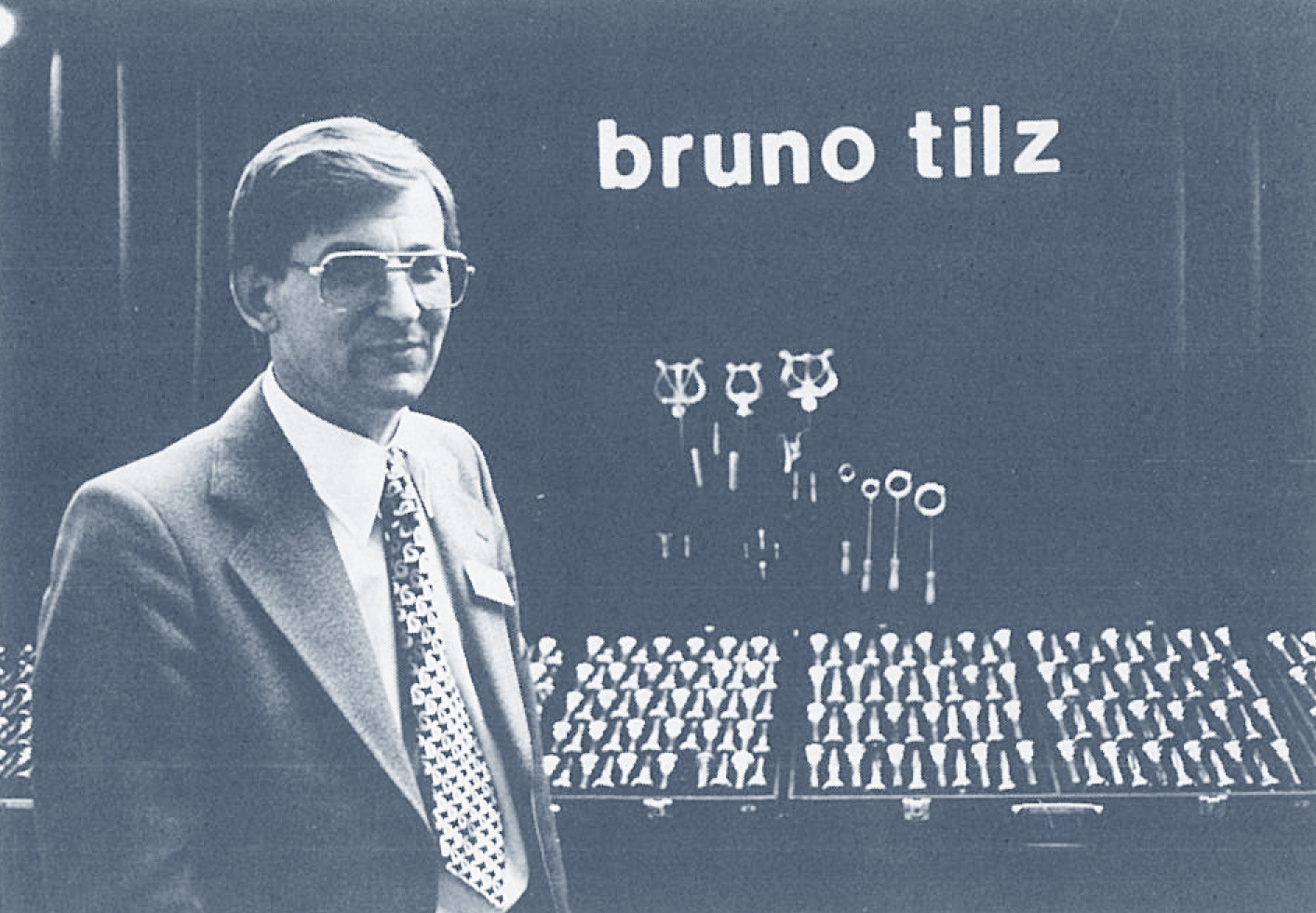
A couple of steps further on was the stand of the German mouthpiece king, Bruno Tilz. A glowing stand, with everything necessary to turn the heads of those looking for the miracle mouthpiece...
— They call you the mouthpiece wizard.
— Well, that's going rather too far! They're simply recognising my skills as a craftsman. From the business point of view things are looking very good this year with the exception of the United States market which remains quiet because of the weakness of the dollar.
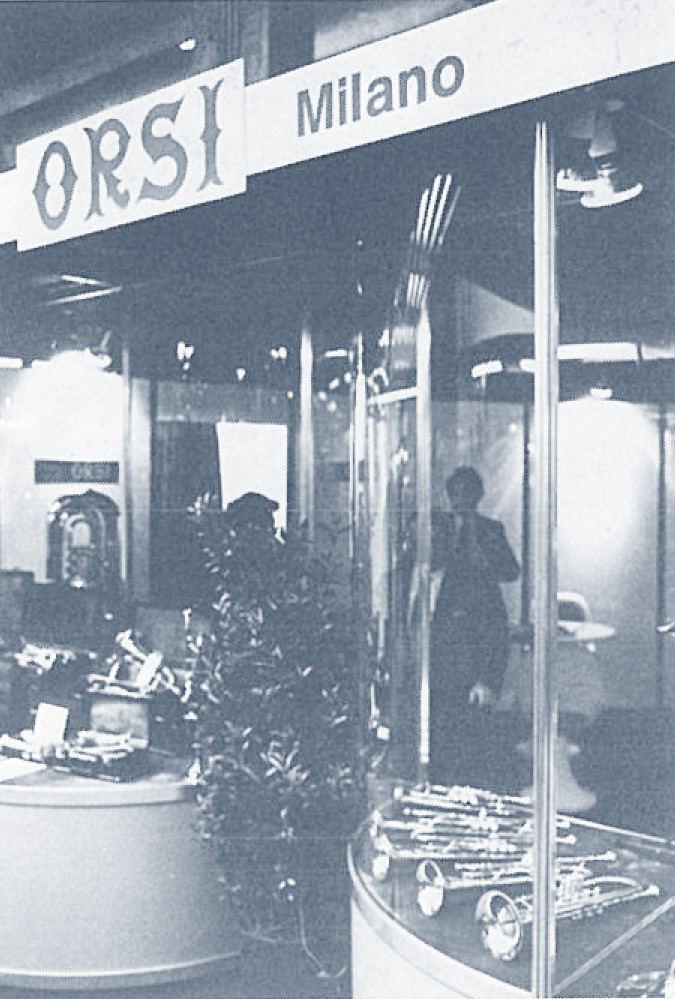
Well, well! The Italian brass manufacturer Orsi Milano. This is an old business, faithful to Frankfurt meeting for 15 years.
— How is business?
— Some problems, but still...
a charming lady tells us. Just think, to survive you have to follow the artists, work with them and for them. Italy still has not recovered from its state of sleepy well-being which the golden age of Verdi and Puccini brought about.
And there was Schenkelaars, the Dutch manufacturer, well-known in band circles, but who has for some years been making real efforts to bring out good "professional" models. An employee said:
— So far the results of our exhibition have been satisfactory. Certainly the competition is always getting stronger but we are managing to keep our place thanks to the great efforts we are making to improve our models. For example our "Prestige" models. This series has been developed in collaboration with the Dutch trumpet-player Sevenstern. For the jazz models we work with Oskar Klein.
At this point Jean-Claude and I decided to have a short break and ordered beer and sausage (Frankfurter!). While we enjoyed these, it occurred to me that musicians must constitute a sufficiently important market for all these people to come here in such numbers...
We set off again. The noise deafened us. Drumkits, pianos, electronic devices, trumpet-players in search of the extreme high register (there are "Fair virtuosos", in need of an audience...), everything mingled as in a nightmare.
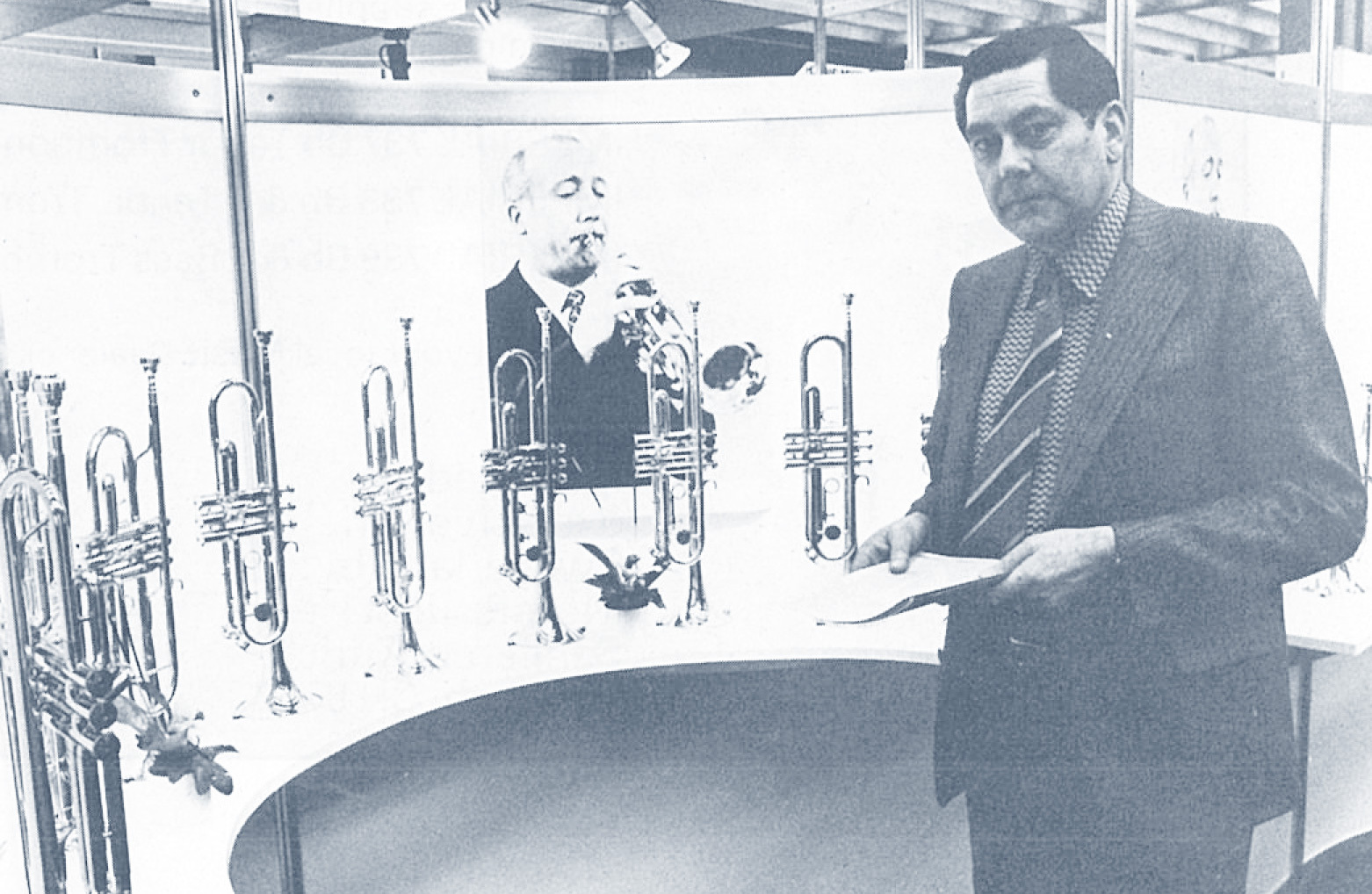
Böhm & Meinl, in the German tradition have been at Frankfurt for 27 years.
— How is business?
— Satisfactory.
— Anything new?
— No, but some improvements. Which seems to be the leitmotiv of the 1979 Fair.
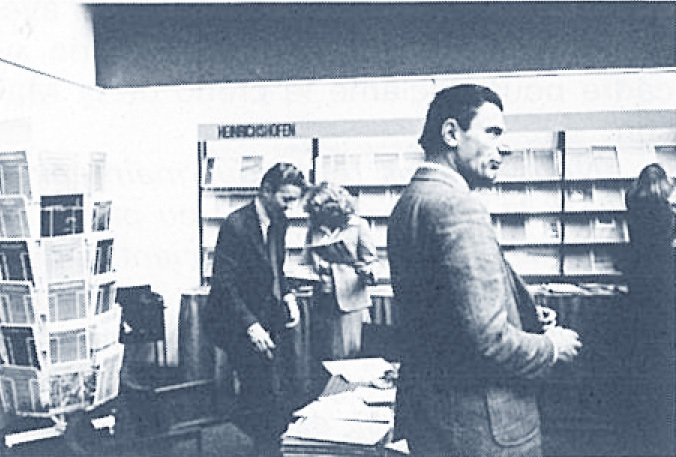
We went on into a quieter section which contrasted with where the instrument stands were. This was music publishers (they also need musicians so that people know what they are doing!). Thousands of scores, and books on music and ideas, just waiting for musicians to bring them to life.
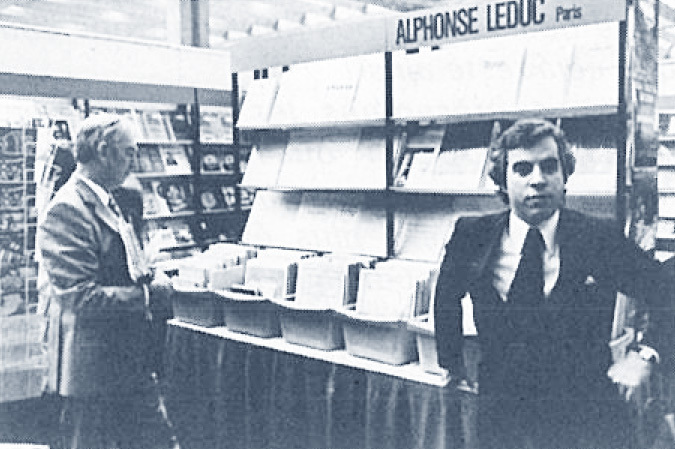
A short stop at the Leduc stand where François Leduc welcomed us.
This is the tenth year that we have been at Frankfurt and things are going very well for us. Lots of people. Just look around! It's the novelties that attract people. This year we have published a good hundred works and our age will be remembered for some of them: — Olivier Messiaen: — 3 orchestral scores, 1000 pages of music, a reasonable price, 4 years of engraving!
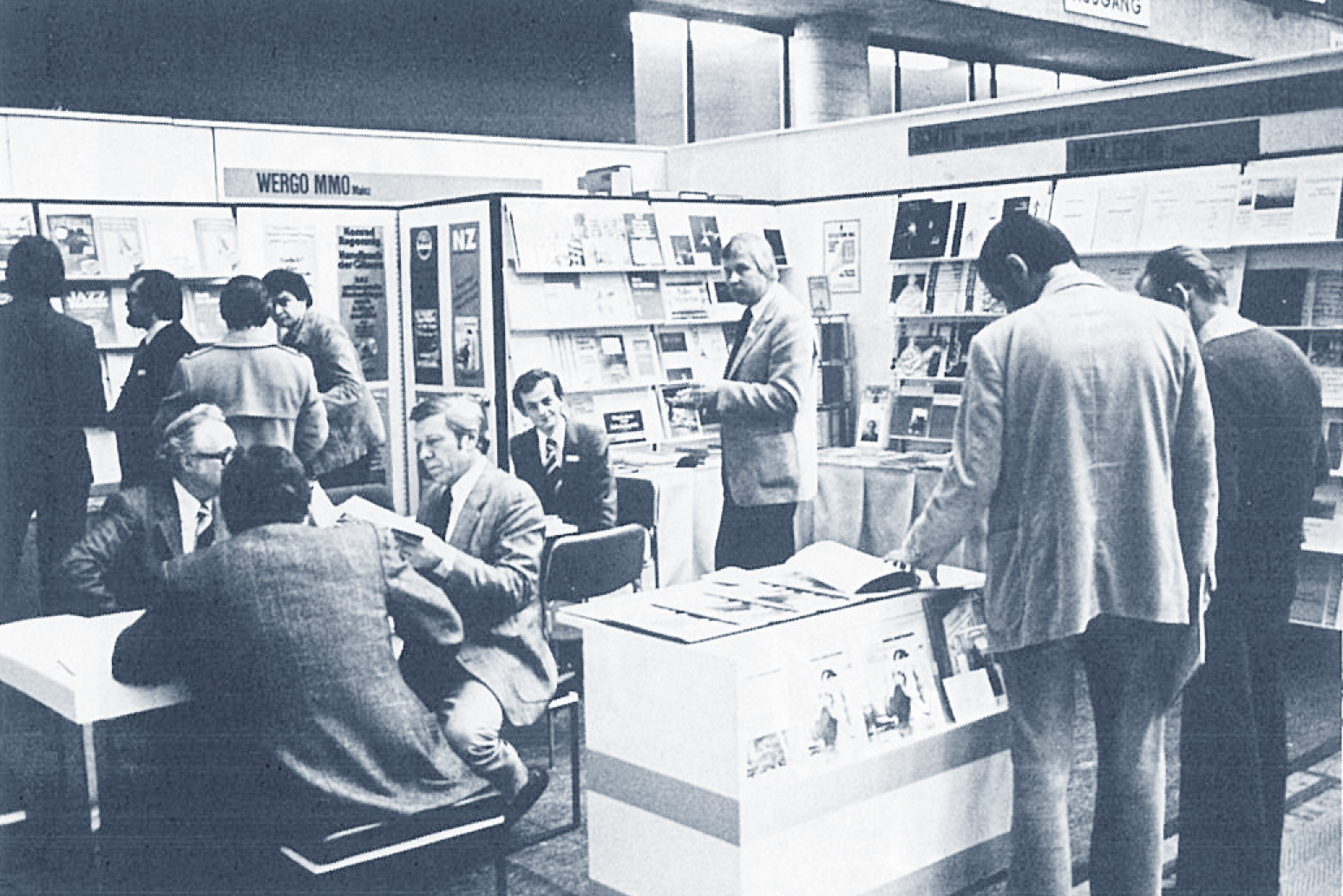
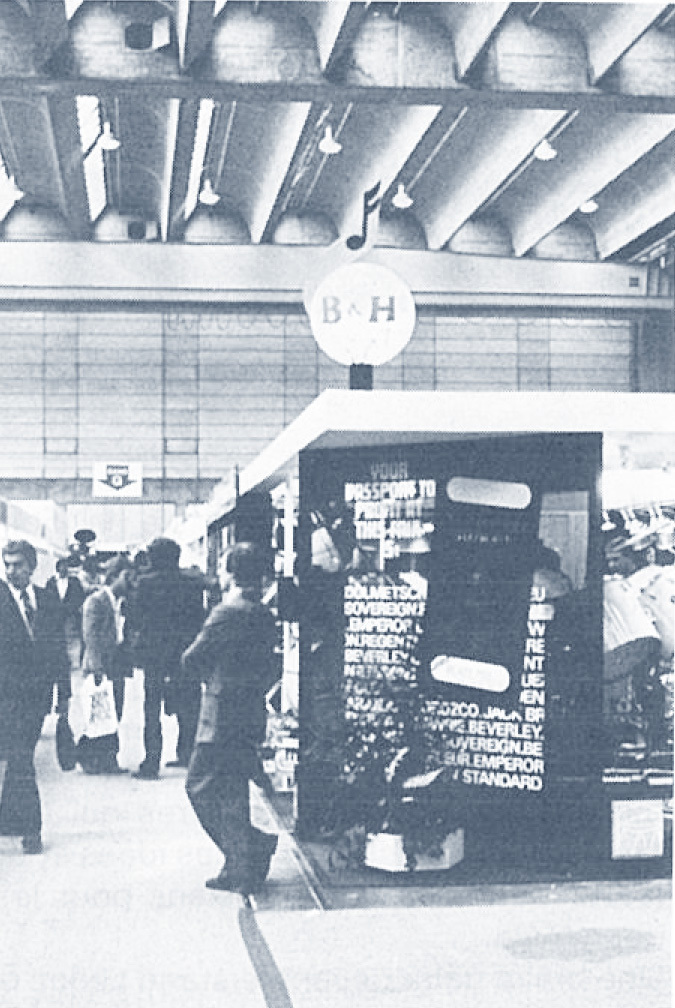
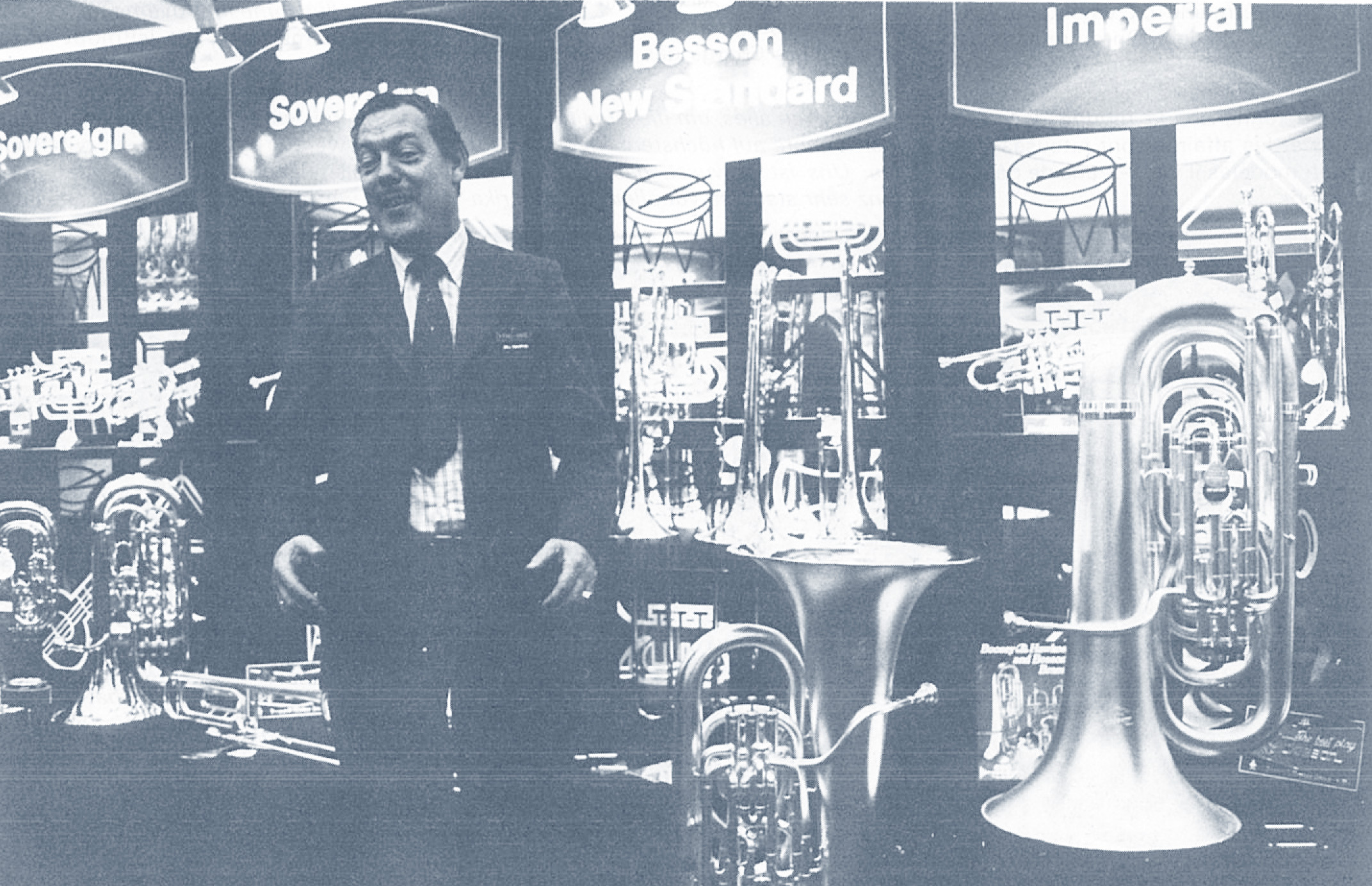
If the people were not so busy, the Fair would look like the other kind of fair (it could almost be one!). It is international but has no customs men. You can go to the Boosey & Hawkes stand without a passport! An impeccably professional welcome. This firm reigns over the brass band world, and business is booming (there are delivery dates of 1 and 2 years for some models). An employee with the style and complexion of Old England, with a cavalry captain's moustache, gave us the firm's creed:
— We do everything possible to keep the quality of our instruments at the highest possible level. We are aware that the competition, from America at the moment (because of the currency problem, which enables them to swamp Europe thanks to very low prices), is very strong. But we are prepared to be dearer because we know that we have better quality. And we will fight to keep it that way!
Here we are presenting the famous tubas, 780 in Eb and 790 in Bb, which we have improved by means of "symphonic" bells, substantially more flared than before. The idea for these new bells came from John Fletcher, the famous English tuba-player, whom our firm consults regularly. 1979 is our best business year and our sole preoccupation is delivery dates. Just a word about cornets — ours are the best in the world but competitors have been racking their brains for years, trying to copy this famous "English model". The Americans in particular have tried everything to seize our market. That is why we have reworked and redesigned most of our cornets and will present a completely new range from next year.
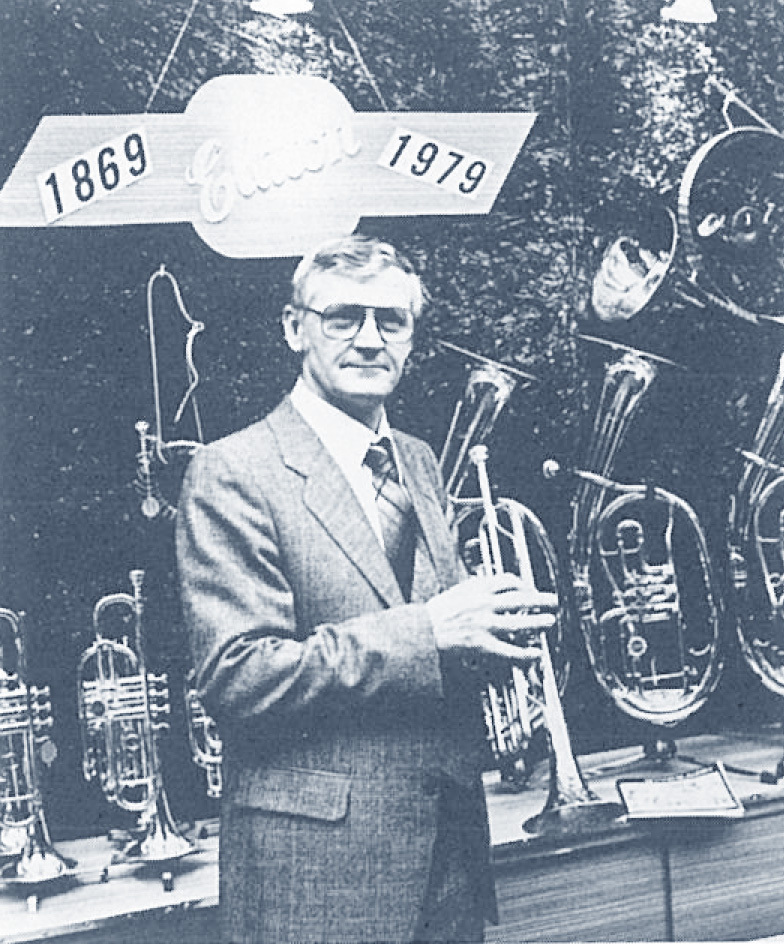
The Elaton stand (West Germany) is run by its proprietor, Herr Langhammer.
— You can't miss the Frankfurt Fair, and we have been here for 27 years. However the future is bleak. In the fifties we sold large quantities of instruments. Nowadays that's all over. The cheap goods come from the East. To survive you have to get good quality.
What does Herr Meinl (specialist in low brass) think?
— The situation has continued to go downhill but for two years we have noticed some degree of stabilisation. As far as we are concerned, we have not developed any new models, but we have improved our instruments mechanically.
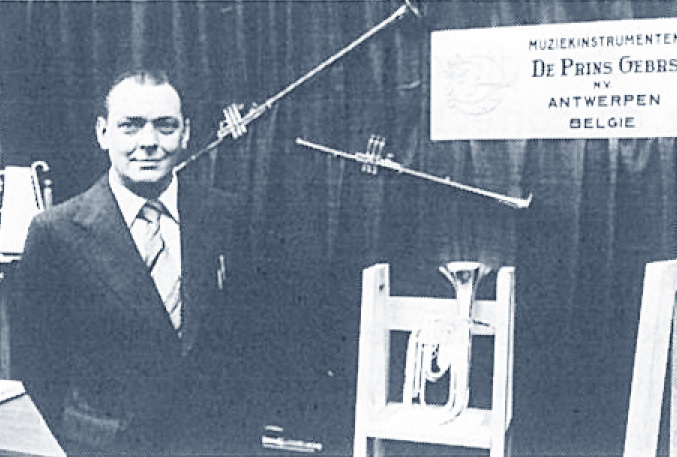
De Prins of Antwerp is the only firm representing Belgium at Frankfurt.
— We have improved our piccolo trumpet and our bass trumpet. Business seems to be picking up a bit.
Behind these non-committal remarks one senses the agony of small and medium-sized firms obstructed by the wrong kind of tradition and badly equipped for modern needs and fashions.
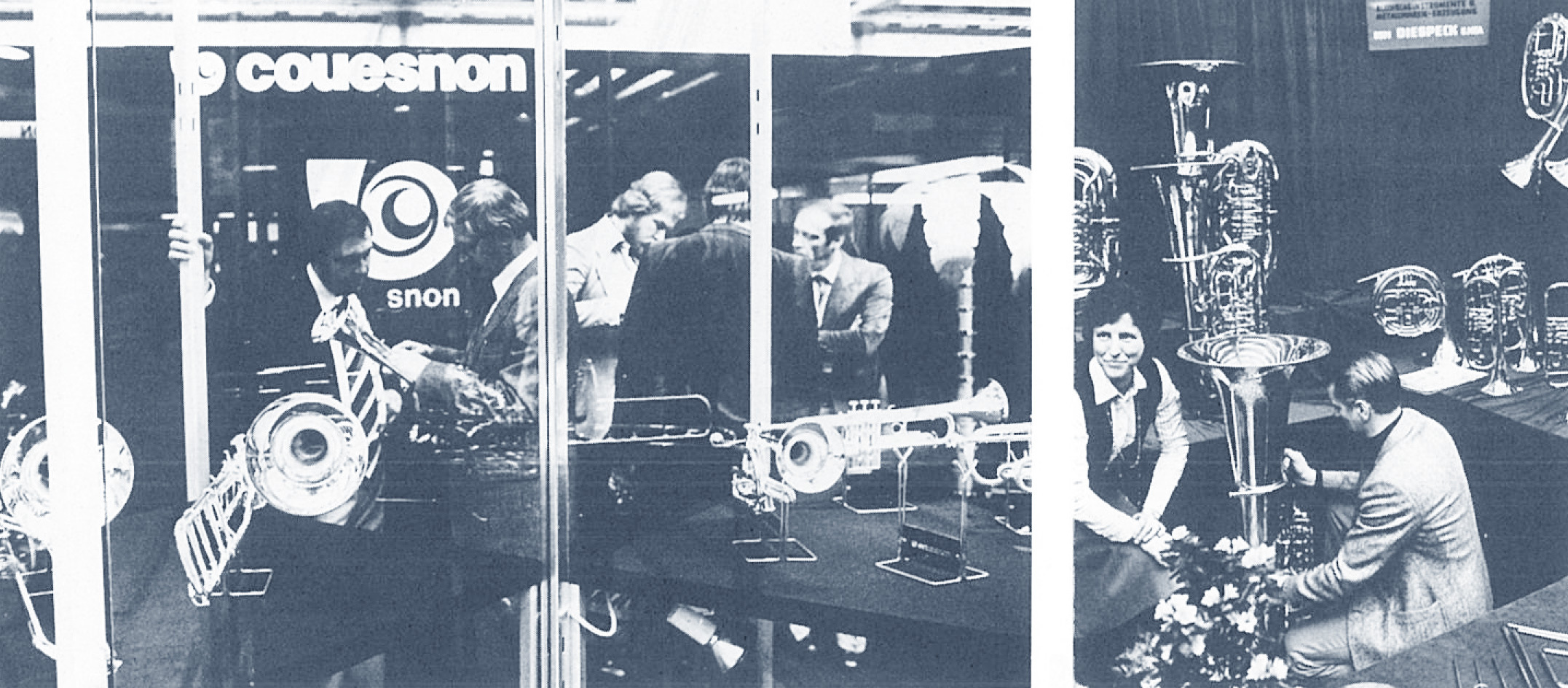
Couesnon is displaying the latest series of instruments developed in 1978. This great firm is making a brave attempt to win back musicians' confidence. You can see the effort they are putting into it, and the excitement round the stand is an indication of obvious interest among dealers.
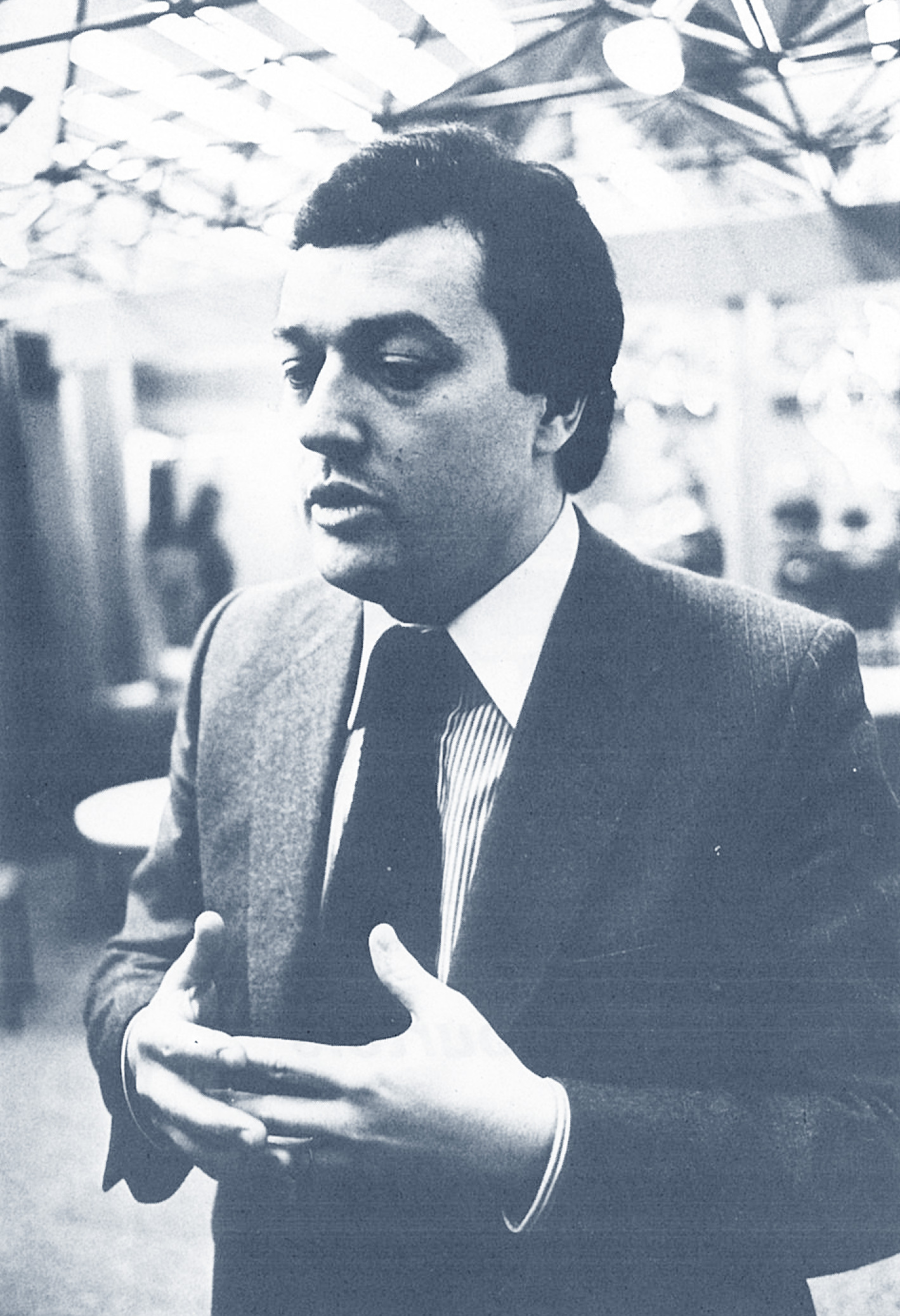
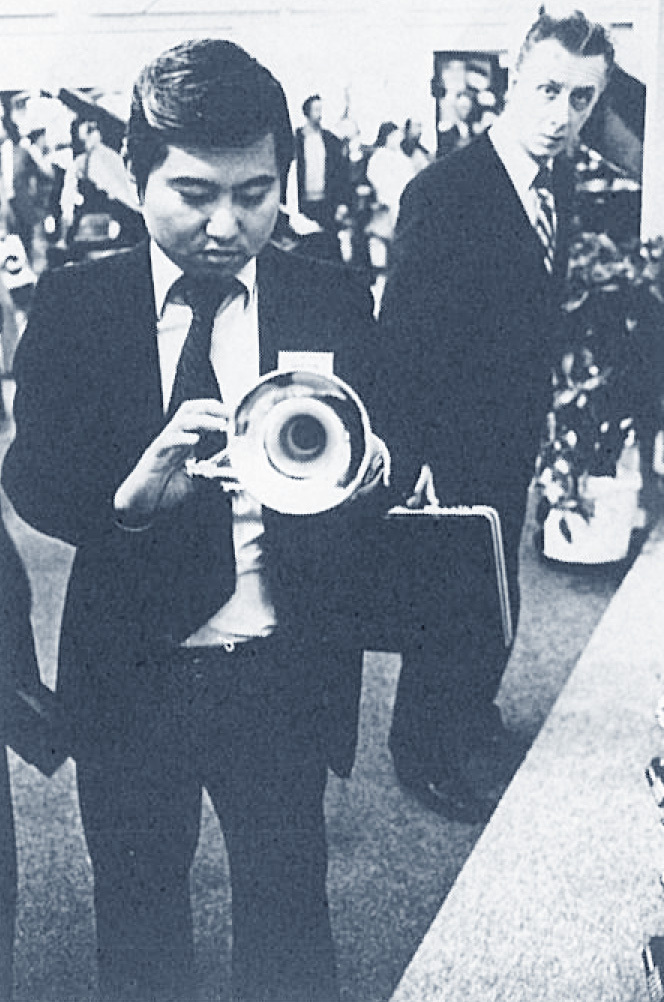
Nearby, in a very sober stand, is Selmer. Patrick Selmer (the new generation of the distinguished family of French manufacturers) assured us that Selmer is taking up the American challenge and that all creative energy is mobilised.
— We want to fight the prejudices and prove that Europe really is in on the world market. Old Europe certainly needs people who will take on the competition enthusiastically (for the good of musicians!) Selmer's big commercial success is still the 4-valve piccolo, now also available in gold brass. We might also mention the considerable interest aroused by the Maurice André mouthpiece with its wide rim for the top lip.
While trying (in vain) to have a few words with someone from the Yamaha stand, I happened to bump into Renold Schilke, the famous American manufacturer from Chicago (see the end of this article), one of the architects of the spectacular leap which Yamaha has made in brass-instrument making in recent years.
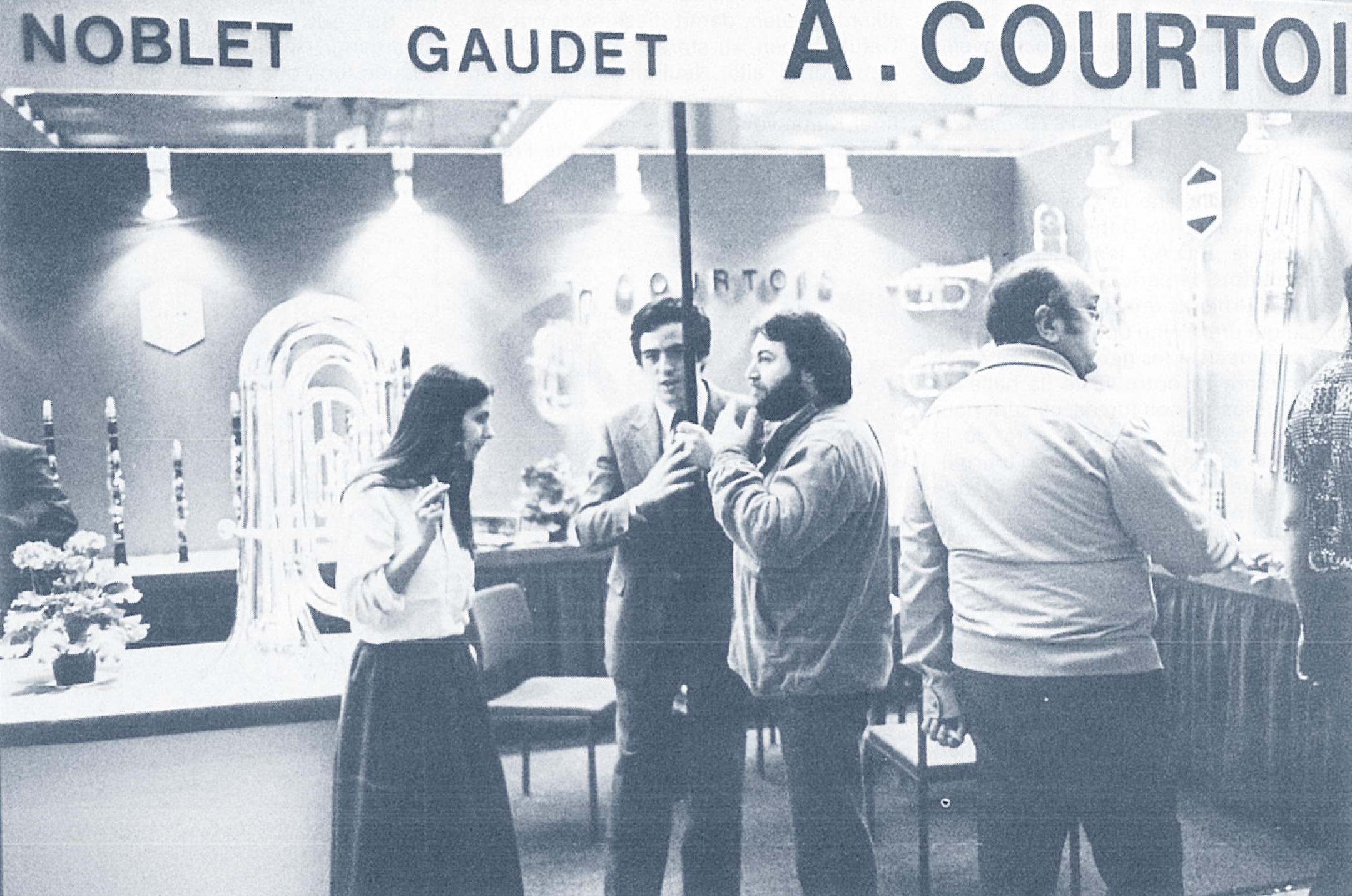
Next came another French manufacturer who, at the price of being constantly busy, keeps himself at the top in brass instrument making — Jacques Gaudet (Antoine Courtois, Paris).
— We have a completely new series of C trumpets with two distinct lines: — one with the traditional system of valving (models C125 ML or L) and the other with direct air column (models C216 ML or L), with various specific options. Our 3 and 4-valve bugles are a world-wide success and musicians are unanimous in praising them.
Certainly Courtois is one of the nice things about the world of brass instrument makers — a firm which searches, eliminates and resumes, in short which fights to stay in our time.
And King was there; in recent years it is mainly their trombones that have been successful in Europe. Mr. Fak revealed that King had produced a completely new range of trumpets (the 600 "Beginner", the 1500 "Student" and the 2000 "Professional") and that the 1979 Fair had been a complete commercial success for the firm.
Let us just mention that the very rich and very busy Demusa stand (East German State producer) provides an indication of the incredible effort in improvement of recent years. Here is a firm taking an option on the future.
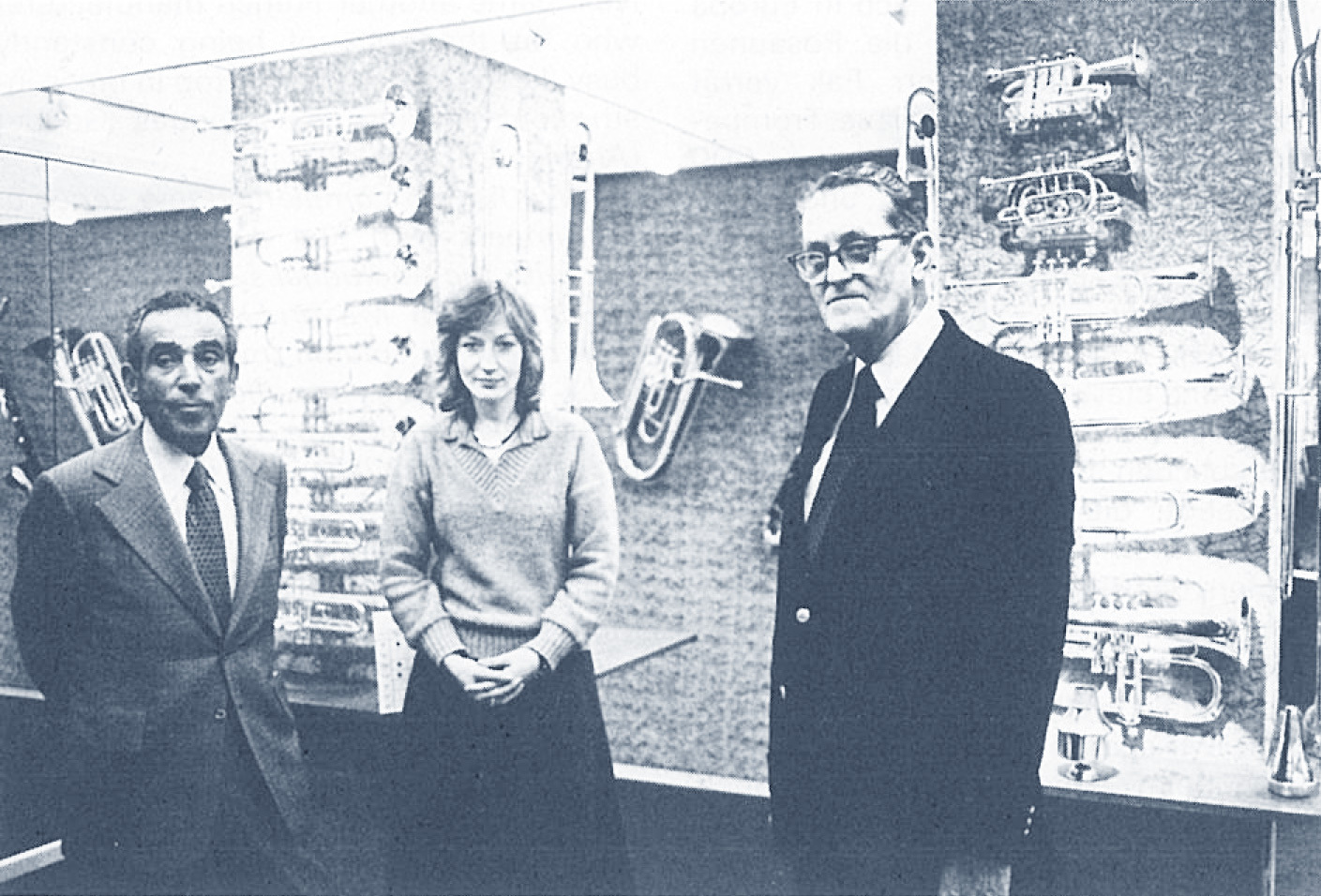
Now we were on our knees and decided to end our visit here. (Hall 5a was too much for us, we'll do it next year.) Right at the exit we saw the Conn stand swarming with businessmen. Jean-Claude took one last photograph and we made for the door in order to avoid the crush when the place closed.
It has to be said that musicians are only tolerated at Frankfurt. Even though they are the ones the businessmen are aiming at, this is a gathering of dealers, where quantities and prices are discussed. There is nothing more to be said about that. (The workshop is where musicians will find dialogue.)
Nevertheless it would be nice if the exhibitors were to engage qualified people with the job of welcoming the musicians so that the latter would not feel that they were intruding and so that they could find out in peace and quiet about the novelties which would be useful to them in their art.
To sum up, we can say that the Frankfurt Fair 1979 was interesting, even though instrument making has nothing revolutionary to say (brass, like strings and woodwind, has reached a definitive point in its basic development and in the future can only expect acoustic improvements in intonation and richness of sound, and improvements in mechanical systems or in metal alloys).
Music publishing, dependent on the inspiration of composers or writers, presents a catalogue richer than ever before in which older works are apparently in the majority while modern music is still a gamble in which prudence is the order of the day... One notes that the amount of "teaching material" is growing but can find few new or interesting ideas in it.
Musical thought and creation are having a break...
It will be interesting to see what we will discover at the 1980 Frankfurt Fair with its new format. We'll be there.