Discoveries for brass players, once a month. Join our free newsletter →

2 min. read

This article is free.

Editorial

Editorial

Whereas the “multi-directional” publicity of the traditional press is sometimes resented as an intrusion into the reader’s privacy, the situation is quite different in a magazine as specialised as BRASS BULLETIN.

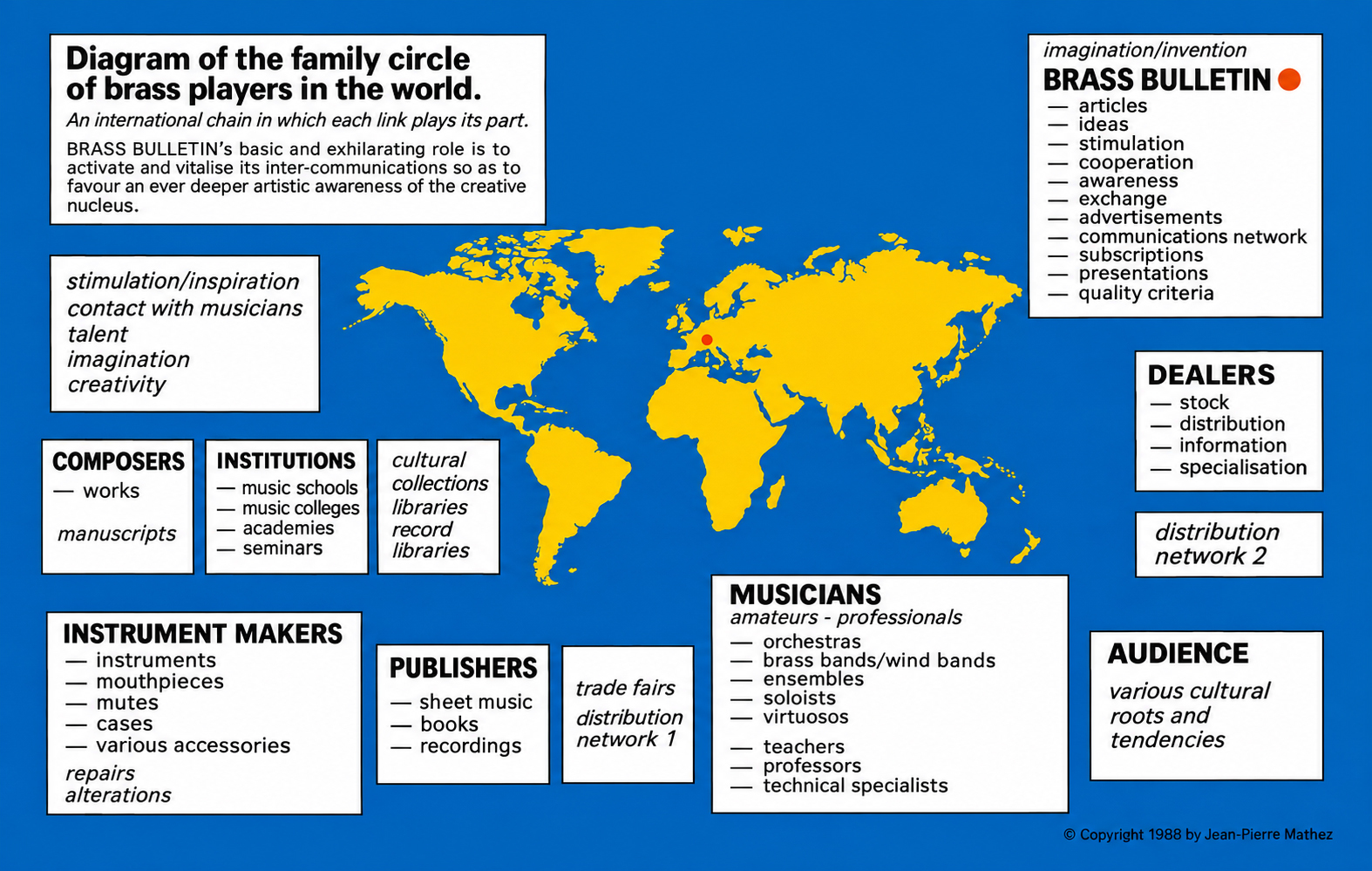
All our advertisers, without exception, belong to the intimate sphere of our family of instruments, and are part of the vital communications network which leads to the concert, the magical dialogue between the musician and his audience.¹

The role of advertisements

Instrument makers (who are inventing the museums of the future!), mouthpiece and accessory specialists, publishers (on behalf of composers), institutions, record manufacturers etc. have to be able to communicate, to make their presence known — and to stimulate their volume of business if they aim to be able to continue their efforts in producing, improving and distributing the brass player’s creative tools.

Of course, advertisers do not always find quite the right touch. Sometimes their slogans sound like journalese, or like the stupid publicity language which agencies use for washing powder. When this happens, BRASS BULLETIN generally contacts the advertiser (or his agent) and tries to remedy the matter. In extreme cases we refuse to accept advertisements which are untruthful, or offensive to competitors (in any case these are often so ridiculous that they have a counterproductive effect on the musician).

We would like to clarify the dialogue between advertisers and musicians, to establish a relationship of confidence and truth, so as to stimulate constructive trade in a spirit of healthy competition. We feel we have contributed a lot to this for several years, and this can be seen from the remarkable quality of most of our publicity pages.

A dialogue vital for everyone

The financial support which advertisements represent is not negligeable, and enables us to reach an exceptional level of quality, unique in the history of instrumental music. Indeed it is thanks to our double financial support (subscriptions/advertisers) that our editorial team is able to continue its work.

Brass Bulletin image

So let us pay attention to these messages and these appeals from our valuable partners. They are more important than may be apparent at first sight. We therefore invite you, dear readers, to take a special interest in these special pages. Do not hesitate to question these para-musical businesses, to challenge them (to improve their products or service) or to criticise them if, for example, the advertisement does not correspond to reality.

“Solidarity” action

Hundreds of you have helped us to find new subscribers. This act of solidarity has touched us deeply. We see this act of mutual aid as a profound sign of encouragement, and we will not disappoint you; we still have many grand ideas which we wish to develop in these columns in the next few years. And so that you may get to know each other better and better, so that your cultural and artistic energy may enable you to enter the new century with a fanfare and so that the fantastic story of our family of instruments may continue through the ages.

BRASS BULLETIN, witness of its age

Thus 1987/1988 are decisive years for BRASS BULLETIN: going from three languages to five, our circle of readers has literally mushroomed. There are several thousand of you (mostly young musicians) who have joined our circle of faithful readers. These young people will ensure the continued presence of our instruments in the music of the 21st century — BRASS BULLETIN will be faithful witness to it.

Jean-Pierre Mathez

¹ See the diagram following this editorial.

Brass Bulletin 61, I / 1988 pages 23–27

All content is protected by copyright © Brass Bulletin 1988–2026

Share this article

Facebook LinkedIn
Loading…

Questions & Answers

How the Digital Edition works

What does the Digital Edition include?

The Digital Edition brings together the articles already digitized as searchable online texts—not simply as scans or PDF files—along with their original illustrations, notes, authorship, issue information, and available translations. Related-article suggestions currently include only this digitized material.

Are the digital articles identical to the originals?

We preserve the original text, language, illustrations, captions, footnotes, and editorial context as faithfully as possible. The presentation is adapted for comfortable online reading, and obvious transcription or scanning errors may be corrected. The substance and character of the published article remain unchanged.

Which languages are available?

Brass Bulletin was published in English, French, and German throughout its history. Italian and Spanish translations were added from issue No. 60 onward.

On the Italian and Spanish sites, articles from issues 1–59 are therefore shown in English by default.

How often are new articles added?

New articles are added almost daily, with approximately one complete issue digitized each week. The pace may vary depending on the preparation, image work, and editorial checking required.

Why aren’t all articles available digitally?

The complete Brass Bulletin collection contains 1,246 articles published between 1971 and 2003. The full index is already available online, allowing readers to discover every article in the collection, including those whose complete text has not yet been digitized.

Digitization began in February 2026. Each article is carefully prepared for online reading, checked, and connected to its issue, authors, subjects, and illustrations. At the current pace of digitization, the complete collection is expected to be available online by February 2028.

Why do some references mention articles that are not available yet?

References in the original articles are preserved even when the material they point to has not yet been digitized. This keeps the historical and editorial record intact. As more issues are added to the Digital Edition, an increasing number of these references will lead to articles that can be read online.

Can I suggest an article or report a transcription error?

Yes. If there is an article you would particularly like to see digitized, or if you notice a possible transcription error or missing detail, please contact us. Reader feedback helps us improve the Digital Edition and prioritize useful connections within the archive.

How can I support Brass Bulletin?

Your support helps fund the preparation, verification, and online publication of the complete collection.

Subscribe to the Digital Edition

Prefer to support us without subscribing?

Make a donation

How is the digitization progressing?

We’re gradually making the Brass Bulletin available online, article by article. You can read newly digitized articles as soon as they’re ready, even before an entire issue is complete.

Visit our Digitization Roadmap to browse recent additions and see estimated availability for upcoming issues. These estimates follow our recent pace and may change.

Search Brass Bulletin.