Brass Bulletin is now also available in Italian and Spanish.

1 min. read

The Remarkable Story Behind the Cover

The Remarkable Story Behind the Cover

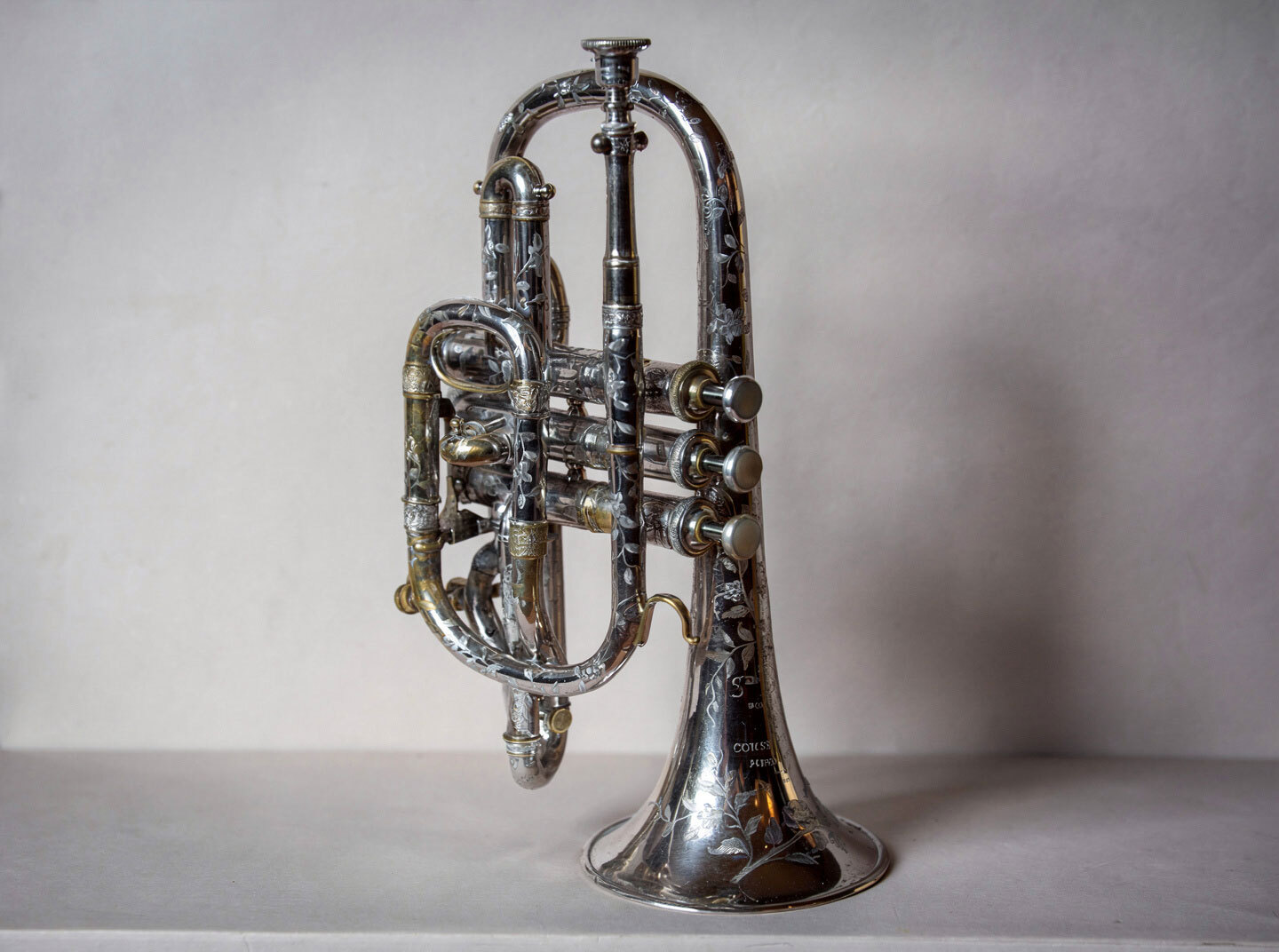
This Couesnon cornet was made shortly after 1895 according to the date inscribed on the crest. I have been unable to discover who first owned it.

At a public sale in Saint-Valéry-en-Caux in Normandy it was sold to Mr. Jules Fête (1880–1947), who was a jeweller but also the head of a musical society which continued in existence until 1933.

During the Second World War, during bombing, while the Fête family was in the shelters, it was stolen. One day Mrs. Fête, passing the German commandant's office, heard and recognised the sound of her husband's cornet. She went to the duty officer, who had the soldier who was playing it brought in. In view of the inadequacy of the latter's explanation of how he came to possess such a fine instrument, the officer ordered him to return it.

In 1950 the instrument was inherited by Lucien Fête (Jules' son), by then living in Saint-Gaudens in the Pyrenees. I had the opportunity of meeting him about a year ago; he entrusted to me the cornet and his recollections of its history.

Mr. Rault, a Paris craftsman and a former Couesnon employee, made an admirable job of restoring the instrument for me. He thought the engraving had been done by hand by one Madame Rose.

The Guilbaut mouthpiece is grooved on the inside to accelerate the air, which shows the concern of those days for technical innovation. The valves are top-sprung and very light.

I agree with Marcel Lagorce, Professor at the Paris Conservatoire, that this cornet has a most beautiful sound and good intonation.

Jean-Michel Gauffriau

Brass Bulletin 38, II / 1982 page 2

All content is protected by copyright © Brass Bulletin 1982–2026

Share this article

Facebook LinkedIn
Loading…

Questions & Answers

How the Digital Edition works

What does the Digital Edition include?

The Digital Edition brings together the articles already digitized as searchable online texts—not simply as scans or PDF files—along with their original illustrations, notes, authorship, issue information, and available translations. Related-article suggestions currently include only this digitized material.

Are the digital articles identical to the originals?

We preserve the original text, language, illustrations, captions, footnotes, and editorial context as faithfully as possible. The presentation is adapted for comfortable online reading, and obvious transcription or scanning errors may be corrected. The substance and character of the published article remain unchanged.

Which languages are available?

Brass Bulletin was published in English, French, and German throughout its history. Italian and Spanish translations were added from issue No. 60 onward.

On the Italian and Spanish sites, articles from issues 1–59 are therefore shown in English by default.

How often are new articles added?

New articles are added almost daily, with approximately one complete issue digitized each week. The pace may vary depending on the preparation, image work, and editorial checking required.

Why aren’t all articles available digitally?

The complete Brass Bulletin collection contains 1,246 articles published between 1971 and 2003. The full index is already available online, allowing readers to discover every article in the collection, including those whose complete text has not yet been digitized.

Digitization began in February 2026. Each article is carefully prepared for online reading, checked, and connected to its issue, authors, subjects, and illustrations. At the current pace of digitization, the complete collection is expected to be available online by February 2028.

Why do some references mention articles that are not available yet?

References in the original articles are preserved even when the material they point to has not yet been digitized. This keeps the historical and editorial record intact. As more issues are added to the Digital Edition, an increasing number of these references will lead to articles that can be read online.

Can I suggest an article or report a transcription error?

Yes. If there is an article you would particularly like to see digitized, or if you notice a possible transcription error or missing detail, please contact us. Reader feedback helps us improve the Digital Edition and prioritize useful connections within the archive.

How can I support Brass Bulletin?

Your support helps fund the preparation, verification, and online publication of the complete collection.

Subscribe to the Digital Edition

Prefer to support us without subscribing?

Make a donation

Search Brass Bulletin.