Explore institutional access Explore institutional access

1 min. read

Ernest Hall, OBE (1890-1984)
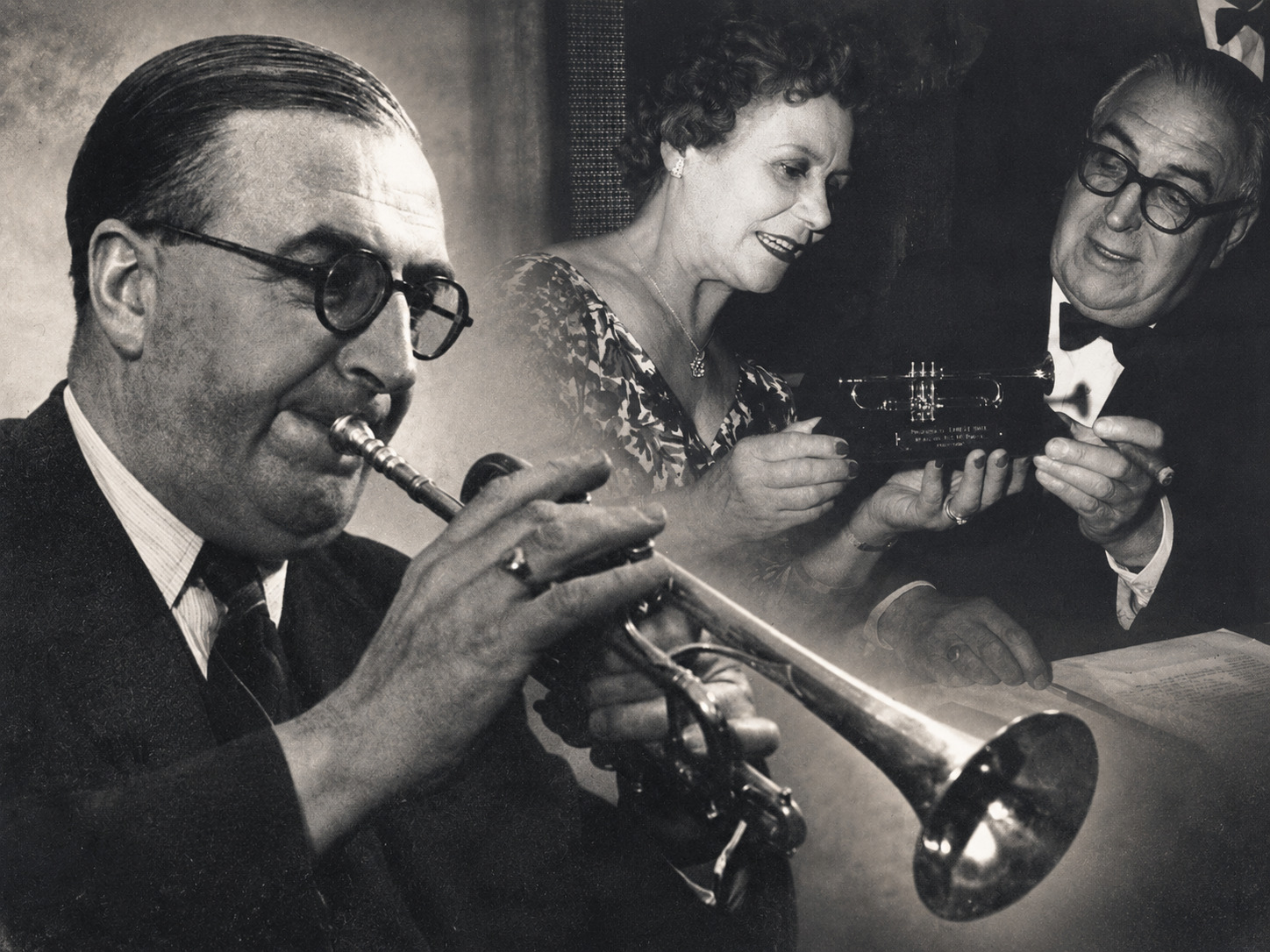
Ernest Hall, OBE (1890-1984)

Ernest Hall 

Ernest Hall is remembered with affection and admiration by many generations of players and students.

His career began at the age of 14 in a theatre orchestra in Liverpool, his home town. At 22, after two years at the Royal College of Music, he went into the London Symphony Orchestra, becoming principal trumpet in 1924. In 1930 he was appointed first trumpet of the newly founded BBC Symphony Orchestra, where he remained until 1950.

He was Professor of Trumpet at the Royal College of Music from 1924 to 1960 and continued to direct wind repertory classes until 1970. He edited two volumes of Difficult Passages for the Trumpet and other instructional works.

Malcolm Smith, now co-principal trumpet of the LSO, once said of him as a teacher:

He was more interested in musical playing than in technical problems. If those had been enormous I’m not sure he’d have been able to put them right. But he gave you something you wanted to get hold of. After three years of him you could play musically. And he was “hot on transposition". Sometimes I’d want to throw things at him and run out of the room.

Another pupil, Bram Gay, Orchestra Director at the Royal Opera House, Covent Garden, remembers his indefatigable common sense.

It’s not a new trumpet you need, just more long notes on this one!

As a player, Bram wrote, in Sounding Brass, he had an unusual embouchure, “a rather narrow but deep mouthpiece set well into a tightly-drawn smile… The truly extraordinary thing about his playing was the consistent quality of his sound. Whatever the register, whatever the dynamic, the sound itself never varied. Dynamically, even in 1953, he commanded a fortissimo which was nearly unbearable in a sizeable room, but the tone never seemed to distort. It was a remarkably beautiful sound in itself, somehow all ‘centre’ with no rough edges at all, and a peculiar sweet intensity which gave one the impression that every nook and cranny of the tube was producing sound. His attack, when roused, amounted almost to physical assault. Yet at the other end of the scale the ultimate piano never failed to speak, bright and clear. His range? Well, I have heard a fine F from him, out of practice too. Notes below bottom C, he said, were not his business. He made rather a good show of the prelude to Carmen, though…”

Brass Bulletin 49, I / 1985 pages 87–89

All content is protected by copyright © Brass Bulletin 1985–2026

Share this article

Facebook LinkedIn
Loading…

Questions & Answers

How the Digital Edition works

What does the Digital Edition include?

The Digital Edition brings together the articles already digitized as searchable online texts—not simply as scans or PDF files—along with their original illustrations, notes, authorship, issue information, and available translations. Related-article suggestions currently include only this digitized material.

Are the digital articles identical to the originals?

We preserve the original text, language, illustrations, captions, footnotes, and editorial context as faithfully as possible. The presentation is adapted for comfortable online reading, and obvious transcription or scanning errors may be corrected. The substance and character of the published article remain unchanged.

Which languages are available?

Brass Bulletin was published in English, French, and German throughout its history. Italian and Spanish translations were added from issue No. 60 onward.

On the Italian and Spanish sites, articles from issues 1–59 are therefore shown in English by default.

How often are new articles added?

New articles are added almost daily, with approximately one complete issue digitized each week. The pace may vary depending on the preparation, image work, and editorial checking required.

Why aren’t all articles available digitally?

The complete Brass Bulletin collection contains 1,246 articles published between 1971 and 2003. The full index is already available online, allowing readers to discover every article in the collection, including those whose complete text has not yet been digitized.

Digitization began in February 2026. Each article is carefully prepared for online reading, checked, and connected to its issue, authors, subjects, and illustrations. At the current pace of digitization, the complete collection is expected to be available online by February 2028.

Why do some references mention articles that are not available yet?

References in the original articles are preserved even when the material they point to has not yet been digitized. This keeps the historical and editorial record intact. As more issues are added to the Digital Edition, an increasing number of these references will lead to articles that can be read online.

Can I suggest an article or report a transcription error?

Yes. If there is an article you would particularly like to see digitized, or if you notice a possible transcription error or missing detail, please contact us. Reader feedback helps us improve the Digital Edition and prioritize useful connections within the archive.

How can I support Brass Bulletin?

Your support helps fund the preparation, verification, and online publication of the complete collection.

Subscribe to the Digital Edition

Prefer to support us without subscribing?

Make a donation

Search Brass Bulletin.