11 min. read
Some thoughts on the euphonium and euphonium technique
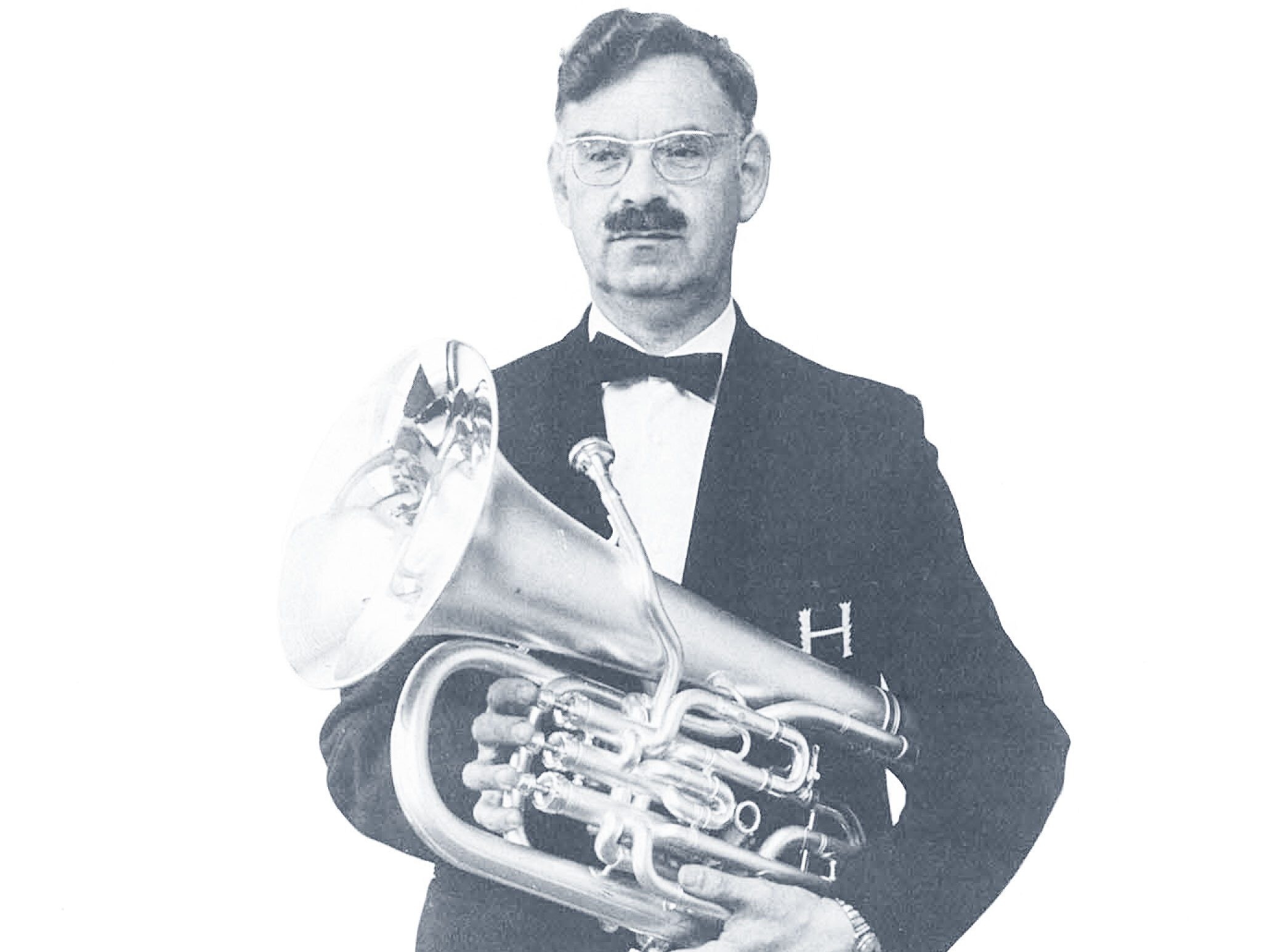
Barrie Perrins
Principal Euphonium, The Hendon Band, since 1960 and British National Champion Euphonium Soloist of Great Britain on four occasions, twice runner-up for title of Champion Soloist of Great Britain. Successfully participated in approximately 150 solo competitions (including concerto and sonata events), he often lectures on brass instruments in clubs, schools and colleges. Instructor/soloist at band camps in Europe, he frequently plays as guest soloist throughout Britain, Switzerland, Belgium and Holland; he toured the USA in 1962 and has featured on British and foreign radio/television programmes. Regular contributor to music journals in Britain and abroad, nearly 400 articles, book, music and record reviews by him have been published. An adjudicator at the 1976 National Solo Championships of Switzerland, he was awarded the Insignia of Honour that year for service to the Brass Band Movement. Although he has choral and orchestral experience, he prefers the musical variety and purpose of the Brass Band. He also has interest in musicology and music therapy. By profession Mr. Perrins is a legal assistant with a public authority.
Probably the most versatile of all brass instruments, the euphonium (sometimes called "euphonion") has a history extending approximately 150 years. Historically associated with the ophicleide, also the family groups of bugle, saxhorn and tuba, it is known orchestrally as the tenor tuba and, less frequently, the bass saxhorn. The name euphonium derives from language roots meaning "pleasing sound". For a long time there has been confusion concerning the British terms "euphonium" and "baritone", particularly in several European countries and the USA. Certain articles and books published in the USA, for example, erroneously describe the euphonium as always having 4 valves, the 3-valved variety being classified as a baritone. Comparable confusion arises with what in Britain is called "tenor horn" but elsewhere is referred to as "alto horn"; for the avoidance of doubt the late Dr. Denis Wright, OBE called that instrument the "Eb saxhorn", which helped clarify the position. Carrying the learned doctor's idea further, it might be prudent to call the British-styled "baritone" (which has a smaller bore than the euphonium) the "Bb saxhorn", and the name "euphonium" could remain as such without fear of misunderstanding; and all larger brass instruments could be termed "bass tubas", with the appropriate pitch prefix applied individually.
One of the earliest references to the euphonium is found in Dr. Adam Carse's book Musical Wind Instruments (Da Capo Press, New York 1965) where German-made examples designed by Wilhelm Wieprecht, Chief Bandmaster in Berlin, are quoted as dating from circa 1830. Among other continental designers/makers associated with the instrument's early development were Sommer (of Weimar), Johann Moritz (of Berlin), Antoine Courtois of France, and the Belgians Mahillon and Adolphe Sax. Incidentally, Sax is perhaps the only wind musical instrument maker for whom a commemorative postage stamp has been issued! The euphonium was introduced to the Band of HM Grenadier Guards in 1851, a significant fact.
Brass Bulletin 22, II / 1978 pages 9–18
All content is protected by copyright © Brass Bulletin 1978–2026