Brass Bulletin is now also available in Italian and Spanish.

2 min. read

Interview with Thomas Müller

Interview with Thomas Müller

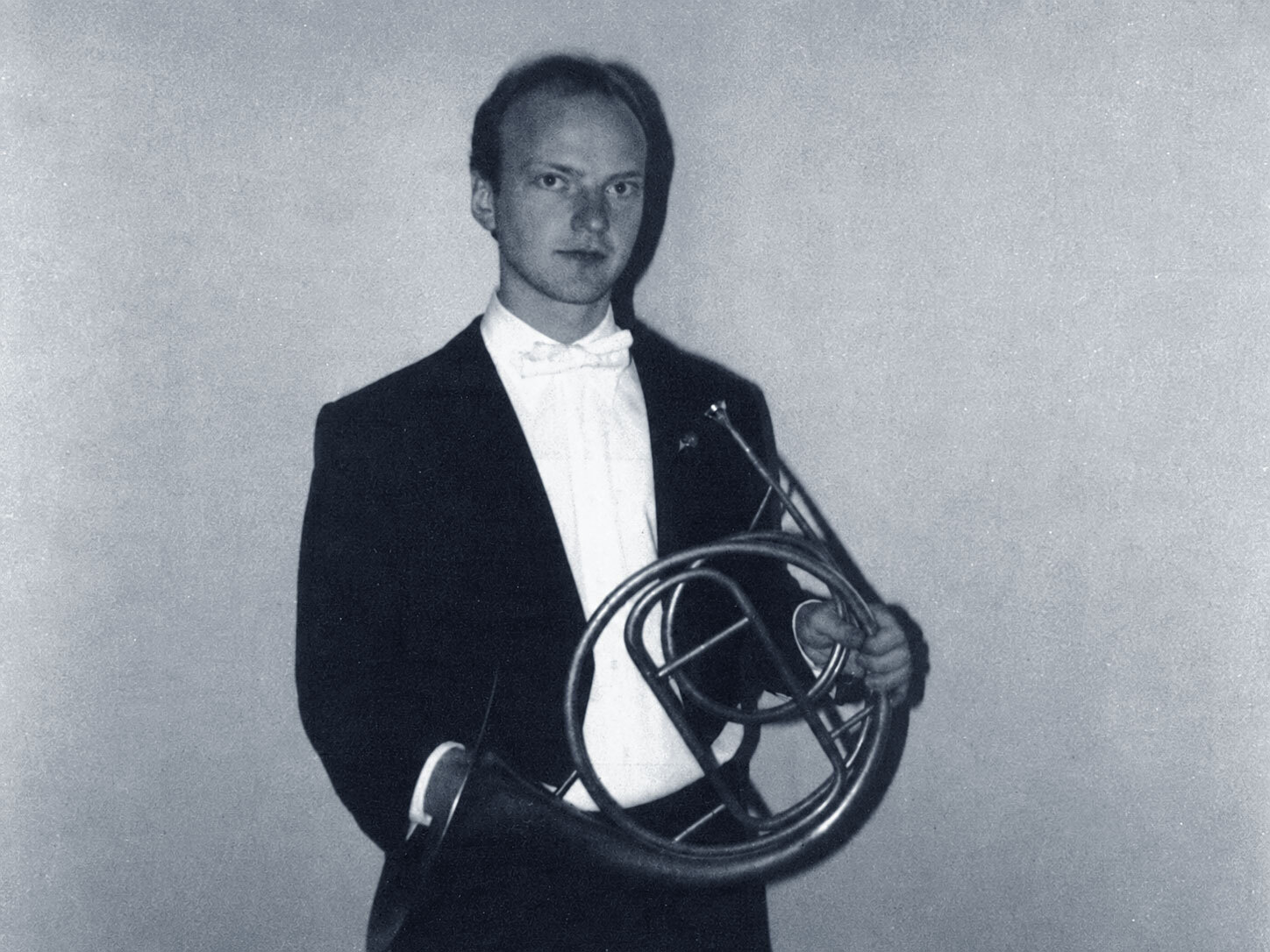
Thomas Müller

The Schola Cantorum Basiliensis, one of the major centers in Europe for the study of old music, has announced the appointment of Thomas Müller as instructor of natural horn. Thomas Müller is presently solo horn of the Bern Symphony Orchestra, but he has had extensive experience in performing on natural horn, including performance of the Bach B minor Mass in Geneva, London and Vienna; concerts and tours with the ensemble Il Divertimento; Baroque opera productions in Milan, Innsbruck, Amsterdam, the Hague and Basel; and participation in eight record albums of Baroque music. Address for further information: Schola Cantorum Basiliensis, Leonhardstr. 6, CH-4051 Basel, Switzerland.

In the following mini-interview, Thomas Müller answers the four questions most typically asked about the study of natural horn.

B.B. Why would one study natural horn in this day and age?

T.M. Today, in order to comprehend any particular branch of a profession as well as possible, one must try to illuminate the subject from any different sides, and frequently one learns more from practical experience than from just theoretical study. It is simply not sufficient to study the horn in its contemporary (often “commercial”) form and use, with no attention to its development. It can be rightfully asserted that no other musical instrument has had as long and steady a development or evolution as the horn.

B.B. Wouldn’t Mozart have written differently if he had had the triple horn?

M.T. Do you know what Mozart and (the contemporary Swiss composer) Kelterborn have without doubt in common? They both display in their compositions the same enthusiasm for the horn of their respective eras. One can ask such a question as “Wouldn’t Mozart have used the horn differently if it had been more ‘modern’?”, but there is no point to it — things were the way they were. You might as well ask what Leonardo da Vinci might have done if he had had a photocopy machine.

B.B. Don’t you run into the danger of ignoring progress?

T.M. One must of course appreciate the contemporary. However, I would speak less of “progress” than “development”; ie things have changed with the times. A look to the past should not be taken as a step backwards. It is a look to increase our scope; it broadens our horizons and furthers our knowledge.

B.B. Does the study of natural horn have advantages or disadvantages for playing technique?

T.M. By the promotion of concentration on such basics as embouchure, breathing, right hand use (stopping techniques), I see only advantages. I also believe that study of the classical natural horn is the most direct path to lyric playing.

The reason to study natural horn today is that this instrument is simply, in every respect, worth the study.

Brass Bulletin 47, III / 1984 pages 31–33

All content is protected by copyright © Brass Bulletin 1984–2026

Share this article

Facebook LinkedIn
Loading…

Questions & Answers

How the Digital Edition works

What does the Digital Edition include?

The Digital Edition brings together the articles already digitized as searchable online texts—not simply as scans or PDF files—along with their original illustrations, notes, authorship, issue information, and available translations. Related-article suggestions currently include only this digitized material.

Are the digital articles identical to the originals?

We preserve the original text, language, illustrations, captions, footnotes, and editorial context as faithfully as possible. The presentation is adapted for comfortable online reading, and obvious transcription or scanning errors may be corrected. The substance and character of the published article remain unchanged.

Which languages are available?

Brass Bulletin was published in English, French, and German throughout its history. Italian and Spanish translations were added from issue No. 60 onward.

On the Italian and Spanish sites, articles from issues 1–59 are therefore shown in English by default.

How often are new articles added?

New articles are added almost daily, with approximately one complete issue digitized each week. The pace may vary depending on the preparation, image work, and editorial checking required.

Why aren’t all articles available digitally?

The complete Brass Bulletin collection contains 1,246 articles published between 1971 and 2003. The full index is already available online, allowing readers to discover every article in the collection, including those whose complete text has not yet been digitized.

Digitization began in February 2026. Each article is carefully prepared for online reading, checked, and connected to its issue, authors, subjects, and illustrations. At the current pace of digitization, the complete collection is expected to be available online by February 2028.

Why do some references mention articles that are not available yet?

References in the original articles are preserved even when the material they point to has not yet been digitized. This keeps the historical and editorial record intact. As more issues are added to the Digital Edition, an increasing number of these references will lead to articles that can be read online.

Can I suggest an article or report a transcription error?

Yes. If there is an article you would particularly like to see digitized, or if you notice a possible transcription error or missing detail, please contact us. Reader feedback helps us improve the Digital Edition and prioritize useful connections within the archive.

How can I support Brass Bulletin?

Your support helps fund the preparation, verification, and online publication of the complete collection.

Subscribe to the Digital Edition

Prefer to support us without subscribing?

Make a donation

Search Brass Bulletin.