Ofrezca Brass Bulletin en su universidad, conservatorio o biblioteca Descubra el acceso institucional

2 min de lectura

Editorial

Editorial

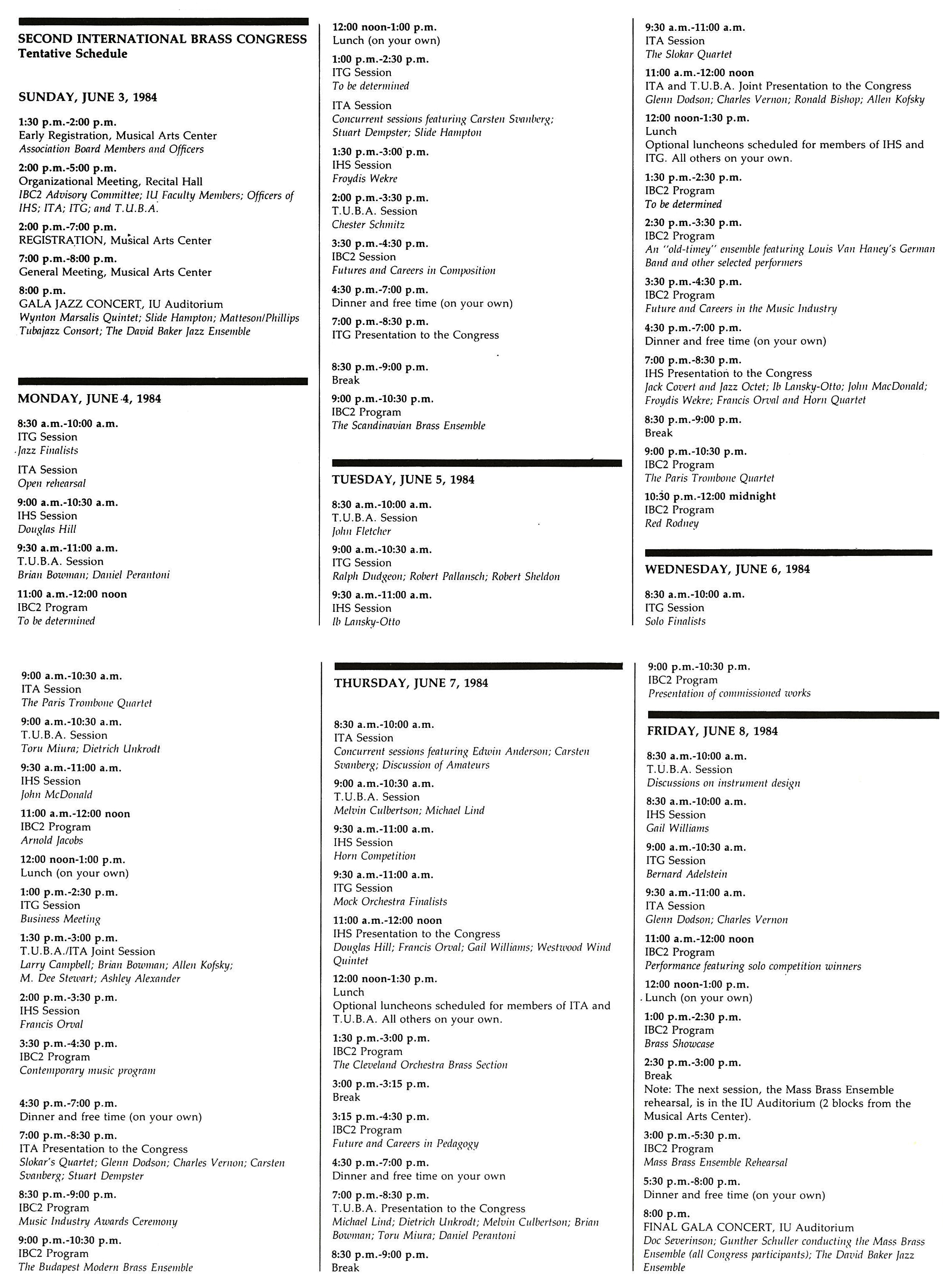
The second International Brass Congress (IBC2) took place recently. Readers will remember the first, which was held in Montreux, in Switzerland, in 1976 thanks to the Institute for Advanced Musical Studies (an ephemeral “US-international” institute which for several years benefited from the amazing generosity of an extremely wealthy Italian-American businessman).

That first meeting was an inspiration to the 500 brass players who took part. An outstanding bill of about 150’000 Swiss francs ($ 80’000) had to be paid by the Institute (its last act of generosity before disappearing from the scene). The founder, the tuba player Harvey Phillips, had envisaged a congress every four years but the economic problems of the last few years prevented him from doing so and it was certainly not easy to find a town and an institution which would agree to assume the inevitable deficit (IBC2 is said to have a budget of $ 200’000). Harvey Phillips, together with his colleagues from the various American guilds, eventually found the necessary support on his doorstep in Bloomington, at Indiana University, in one of the biggest schools of music in the world.

First problem

The location. Bloomington is a small university town and not very easy to get to, especially from overseas (Washington, New York, Boston or Chicago would have been easier) but it had to be done where possible.

Second problem

The date. The musical season and the academic year in American institutions are different from most of those in other countries, especially from those in Europe, where the music college exam period is at its height and the concert season has not finished. The dates 3rd-8th June were convenient from a US domestic point of view and so, understandably enough, they were chosen. The home market had to be considered first. The American brass guilds, although styled “international”, are in fact national, and characteristically American, in their structure, in keeping with the special criteria of that great country.

Third problem

The cost. The American guilds have organised several collections with a view to setting up scholarships to help students to participate. These scholarships will, naturally, go first to young American students. Meanwhile foreigners have to pay the whole cost of transport (which is considerable) as well as accomodation and congress fees (both of which are reasonable).

Not the same

When our American friends honoured us with their presence in Montreux, they were able to benefit from an American organisation on the spot, having travelled on advantageous charter flights. The official language — even in Montreux — was English.

The guilds are useful

Noting a number of problems in establishing internationalism does not mean that one is against this kind of association. It seems obvious that such organisations can help facilitate and develop an exchange of ideas and stimulate a widening of knowledge (although one has to beware of the singular lack of healthy argument which friendly instrumental associations engender — “Everybody’s great, everybody’s nice”).

It must also be recognised that the American guilds have not succeeded in taking a hold of brass players as they had hoped. Their “international” penetration has always been very modest and unrepresentative, despite all their efforts. This is one message which is very clear and which our transatlantic friends should read.

Refusal of hegemony

The world is rich and varied and must remain so. That there should be global influences is a good thing, but we must resist hegemony.

Welcome initiatives

In the last few years we have noted the founding of national associations in many countries. These associations bear clear and legitimate names (French National Horn Association, French Trombone Guild, Japanese Trumpet Guild). BRASS BULLETIN views this movement sympathetically and supports it. It is a good thing that every country, indeed every region, should research and cultivate its identity and pass it on to its artists. On that basis nothing should stand in the way of international exchanges; quite the opposite, indeed. However — the IBC2 organisers have set up a marathon of fabulous events which makes it all the more unfortunate not to be able to attend (see below).
Brass Bulletin image

Brass Bulletin 46, II / 1984 páginas 9–11

Todo el contenido está protegido por derechos de autor © Brass Bulletin 1984–2026

Compartir este artículo

Facebook LinkedIn
Cargando…

Preguntas y respuestas

Cómo funciona la edición digital

¿Qué incluye la edición digital?

La edición digital reúne los artículos ya digitalizados como textos legibles y consultables en línea —no simplemente como escaneos o archivos PDF— junto con sus ilustraciones originales, notas, autoría, información del número y traducciones disponibles. Las sugerencias de artículos relacionados incluyen actualmente solo este material digitalizado.

¿Los artículos digitales son idénticos a los originales?

Conservamos con la mayor fidelidad posible el texto original, el idioma, las ilustraciones, los pies de imagen, las notas y el contexto editorial. La presentación se adapta para facilitar la lectura en línea y pueden corregirse errores evidentes de transcripción o escaneado. El contenido y el carácter del artículo publicado permanecen inalterados.

¿Qué idiomas están disponibles?

Brass Bulletin se publicó en inglés, francés y alemán a lo largo de toda su historia. Las traducciones al italiano y al español se añadieron a partir del número 60. Por este motivo, en los sitios italiano y español los artículos de los números 1 a 59 se muestran en inglés de forma predeterminada.

¿Con qué frecuencia se añaden nuevos artículos?

Se añaden nuevos artículos casi a diario, con aproximadamente un número completo digitalizado cada semana. El ritmo puede variar según el trabajo de preparación, tratamiento de imágenes y revisión editorial necesario.

¿Por qué no están disponibles todos los artículos en formato digital?

La colección completa de Brass Bulletin contiene 1.246 artículos publicados entre 1971 y 2003. El índice completo ya está disponible en línea y permite descubrir todos los artículos de la colección, incluidos aquellos cuyo texto íntegro todavía no ha sido digitalizado.

La digitalización comenzó en febrero de 2026. Cada artículo se prepara cuidadosamente para la lectura en línea, se revisa y se vincula con su número, sus autores, sus temas y sus ilustraciones. Al ritmo actual de digitalización, se prevé que la colección completa esté disponible en línea en febrero de 2028.

¿Por qué algunas referencias mencionan artículos que todavía no están disponibles?

Las referencias de los artículos originales se conservan aunque el material al que remiten aún no haya sido digitalizado. De este modo se mantiene intacto el contexto histórico y editorial. A medida que se incorporen más números a la edición digital, un número creciente de estas referencias conducirá a artículos que podrán leerse en línea.

¿Puedo sugerir un artículo o informar de un error de transcripción?

Sí. Si hay algún artículo que le gustaría especialmente ver digitalizado, o si detecta un posible error de transcripción o algún dato que falta, póngase en contacto con nosotros. Los comentarios de los lectores nos ayudan a mejorar la edición digital y a establecer prioridades útiles dentro del archivo.

¿Cómo puedo apoyar a Brass Bulletin?

Su apoyo ayuda a financiar la preparación, verificación y publicación en línea de la colección completa.

Suscríbase a la Edición Digital

¿Prefiere apoyarnos sin suscribirse?

Haga una donación

¿Cómo avanza la digitalización?

Estamos poniendo Brass Bulletin a disposición de los lectores en línea, artículo por artículo. Pueden leer los artículos recién digitalizados en cuanto estén listos, incluso antes de que se complete un número entero.

Consulten nuestro calendario de digitalización para descubrir las últimas novedades y las fechas estimadas de disponibilidad de los próximos números. Estas estimaciones se basan en nuestro ritmo reciente y pueden cambiar.

Busca en Brass Bulletin.