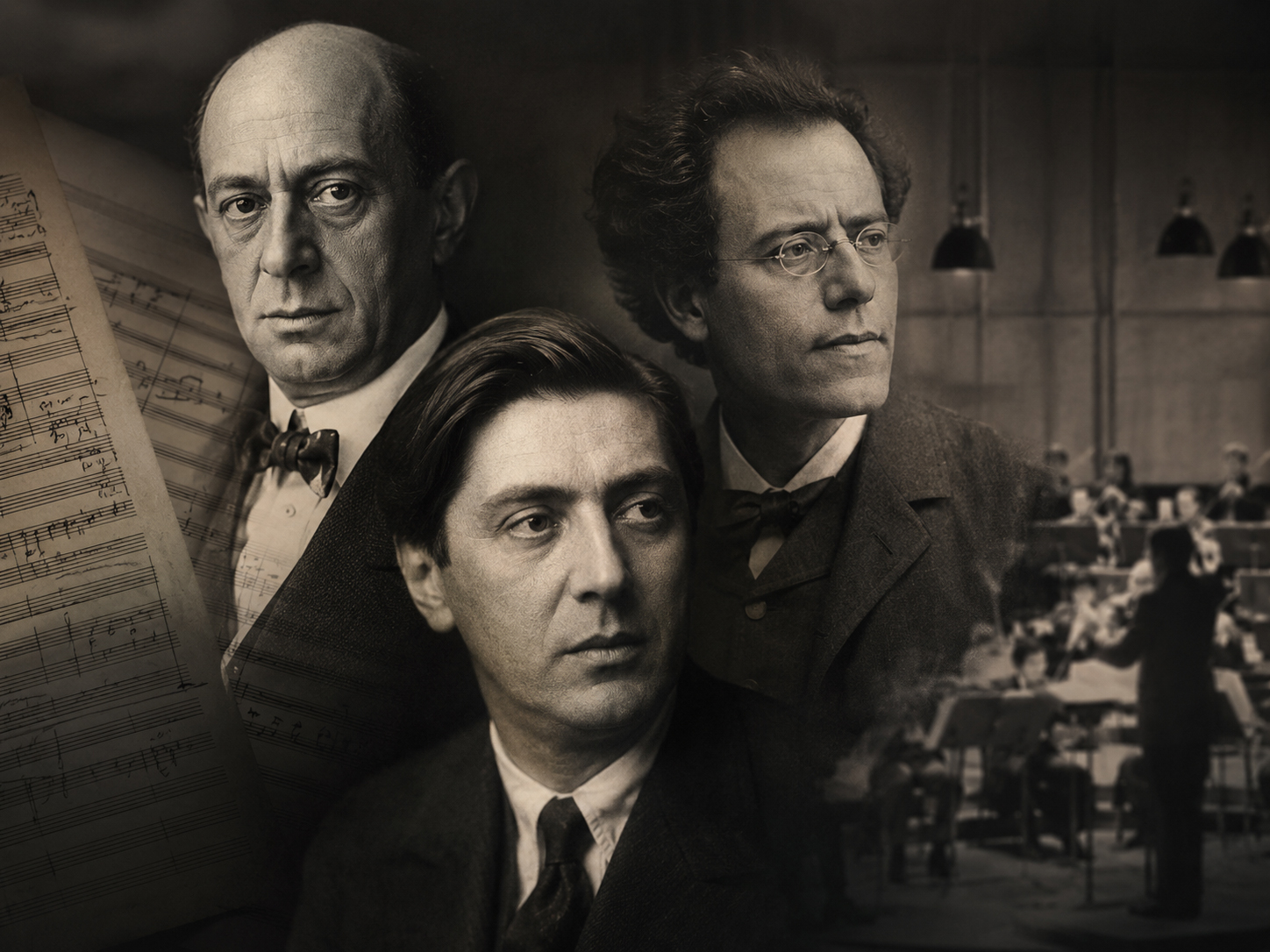
Serious music dispensed with this function at least as far back as early Schönberg. It is demanding, difficult and "elitist". Where popular music attempts diversion, serious music requires concentration. The latter demands a lot, the former gives — in the opinion of its consumers — a great deal more.
It seems pointless to bewail this separation between the two genres. It has been practised by concert promoters and broadcasters for years to such an extent that occasional attempts at "rapprochement" look tearfully nostalgic.
New Music still comes as a shock to audiences. But it affects the composer in the same way. For whereas fascist ideologies decreed how art — and even music — must not be, equally rigorous tendencies after 1945 dictated how music now had to be. During the fifties hardly anyone who wanted to have his music performed and be respected could escape ideological indoctrination by the Darmstadt school.
The history of serious music since 1945 is a series of reactions. All over the world the Darmstadt school was paraded as the only and "obligatory" model primarily because its roots, Schönberg's twelve-note music, had been maligned in the Thousand-Year Reich as a Jewish decadence.
John Cage's aleatory music of the fifties was intended as a radical break with the utter determinism of serial material. Shortly afterwards Stockhausen's inclination towards mysticism and improvisation aimed in the same direction. In the sixties Mauricio Kagel introduced a new aspect into the avant-garde: he wrote pieces in which one could, or should, laugh. There had not been such a thing in the deadly serious world of New Music since at least the early works of Webern.
For the first time the "new simplicity", musica povera, turned its sights back to a wider audience. The aims of neo-tonality had a chance of a broader base only because they largely suspended the late expressionist acoustic repertoire from Schönberg to Luigi Nono and so were able to offer the listener something which — physiologically above all else — he is undoubtedly more interested in: (relative) euphony instead of a pain in the neck.
For decades the only thing about New Music that has been dealt with theoretically or practically is what it contained that was new. To ask what it meant was taboo. What music lost because of this — and not only in techniques or material — has not been calculated.
Around 1930 Hanns Eisler issued a call for the modern composer to "look for a place in society" but in serious music there is still no sign of this happening today. It would be all too simple for producers and audience to place the sole responsibility on each other. It is not simply a question of the "regression of the bourgeois concert-promoting business" on the one hand, or "elitist artistic arrogance" on the other.
Today even the most enlightened have realised that Schönberg's development was a mistake. Not just the twelve-note principle itself, for that was simply the almost unavoidable consequence of free atonality; but the fact that Schönberg, in theory and above all in practice, made discord all-important. In other words, he no longer distinguished between the various degrees of tension, from perfect concord to strong discord. This greatly impoverished the acoustic repertoire, and rendered it largely quite "unusable" as a means of expression. "Atonal" choral works can now be mastered only by elite choirs.
We need to look forward into the eighties. Musicians have no cause for complaint. Production resources have never contained such a wealth of possibilities as they do today. Literally all acoustic resources, from the chord of C major to the most complex background noise, are today at the composer's disposal. It is now only a question of what the most gifted can do with them.
Many, however, because of sheer (technical) possibilities, are at a loss to know what to express and whom to address. Music which addressed itself to defined and varying strata and institutions could become "socially" effective. But music which no longer asks whom it should address must wither in the vacuum.
Someone should have the courage to put a "message" into music. In his music a composer should express a content which goes beyond mere material processes. If a piece — however cleverly written it may be — amounts to no more than reeling off its sound structures for half an hour between treble and quintuple pianissimo, that is just not enough for the survival of a whole branch of music.
Becoming more sensitive, and perhaps also more sensible, is a venture which ought to be undertaken. Whether it should be called neo-tonality or neo-modality, or whether achieved by other means, is less important. In all this there must be no trotting out old clichés and favourite tricks.
Some chance of a future may lie in the ability to have the impoverished acoustic resources of the immediate past seen as outdated. Their literal "expressionlessness" has been proved by many people now for years.
Increased fusion of the two branches of serious and popular music should not be lamented as meaning the death of the "superior" art. An increasing simplification of structures would presumably be unavoidable. But then music which has something to say has never been able to be very complicated.
A composer who derived considerable impulse from this blending was Alban Berg. In this his choice of a strong model in Gustav Mahler had not been in vain. Berg soon spotted the tendency towards "impoverishment" in the Schönberg school. With his adoption of the twelve-note technique around 1925 he also brought traditional elements into his music in increasing amounts. After the Lyric Suite the tonal elements increased continually until the Violin Concerto of 1935.
After 1945 this was criticised as "reactionary". Berg's "vocabulary" was banned from the code of composition for almost twenty years. Yet these are the very things that make Berg sparkle today, and of all the composers of the Second Viennese School he is now the liveliest. And this not only in the public esteem, for even expert opinion now undoubtedly ranks him high above both Schönberg and Anton Webern.
His composing technique, once classified as decadent, now seems particularly vigorous. The pupils who were denied Alban Berg after 1935 would have provided many fresh points of departure today. The score of Lulu was not the first to provide keywords for this, with pluralism of musical language, parody technique, polymetric constructions and acoustic layered thinking.
The call for a recreatio animae should be taken literally. But it should not remain an abstract requirement. The listener ought to be able to know how he can "refresh" himself.
Hans Jürgen von Bose has written a piece for amateur choir, soloists and orchestra, for the 650th anniversary of the city of Darmstadt; first performance in June 1980. Note: amateur choir. This would have been unthinkable a few years ago for no-one would have dared to attempt such a thing — neither the composers, the organisers nor those offering the commission.
For decades only a "trade audience" has been expected at a first performance: "insiders", critics, broadcasting company officials, publishers, managers from the music business, at best some of the composer's colleagues.
Perhaps now, after decades of musical expressionism from Schönberg to Penderecki, someone will be brave enough to establish a new ideal of beauty. This must not, however, simply be an innocuous hedonism in sound, for there are very promising starting points to be found, all the way from Alban Berg via Henze to Sylvano Bussotti and even Peter Michael Hamel.
Contact with "beauty" makes sensitive people more sensitive to the uglinesses and errors all around them — provided it is said with appropriate clarity and determined commitment.
Such a development will not ensure the salvation of serious music in the future. It may, however, ensure that serious music becomes more acceptable, at least in comparison with its record over the last seventy years.
The new and almost sneering distinction of recent times might then become superfluous: instead of drawing a line between serious and popular music we could then happily draw a line between "music for pleasure" and everything else. And the tacit assumption of the phrase "music for pleasure" is that it provides something which nothing else provides.
Greater commitment to "music for pleasure" could hardly be detrimental to a whole genre.