What then of Robert Ischer's theory? In my opinion it is based on a mistaken belief, that of a reductio ad absurdum. According to him improving an instrument would depend on being able to form privileged vibration nodes by the deposit of some kind of matter, favouring some notes to the detriment of others. This line of argument is clearly not tenable. It also fails to mention the fact that the distance between two vibration nodes determines only the pitch of the sound, not its quality.
For my part I think the quality of the sound largely has to do with the composition of the metal the instrument is made of; since the vibrations are reflected off the metal wall, the nature of the latter must play a role otherwise any metal, or even plastic, would do. My explanation may not be very scientific but it is based on observation of actual facts, and here I return to the hunting horn.
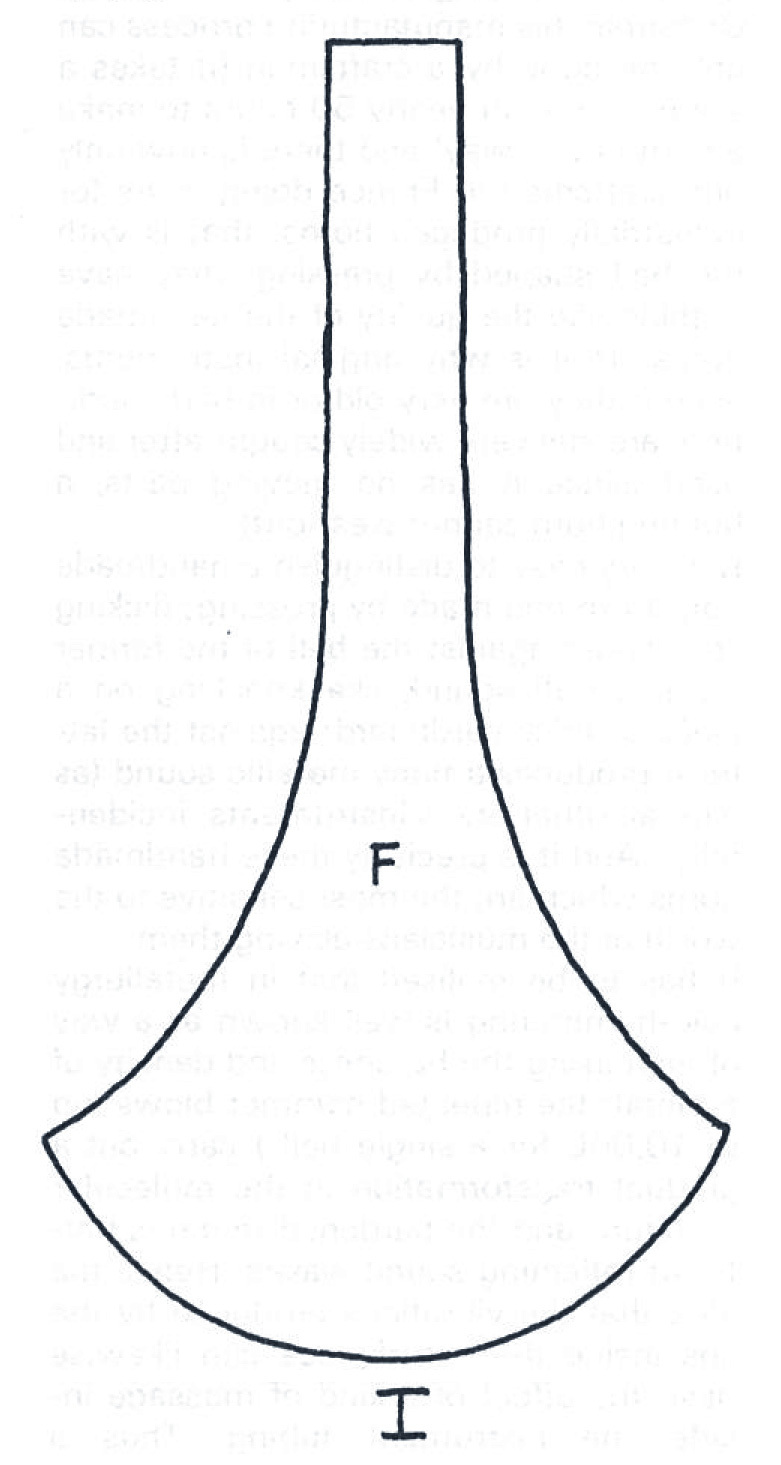
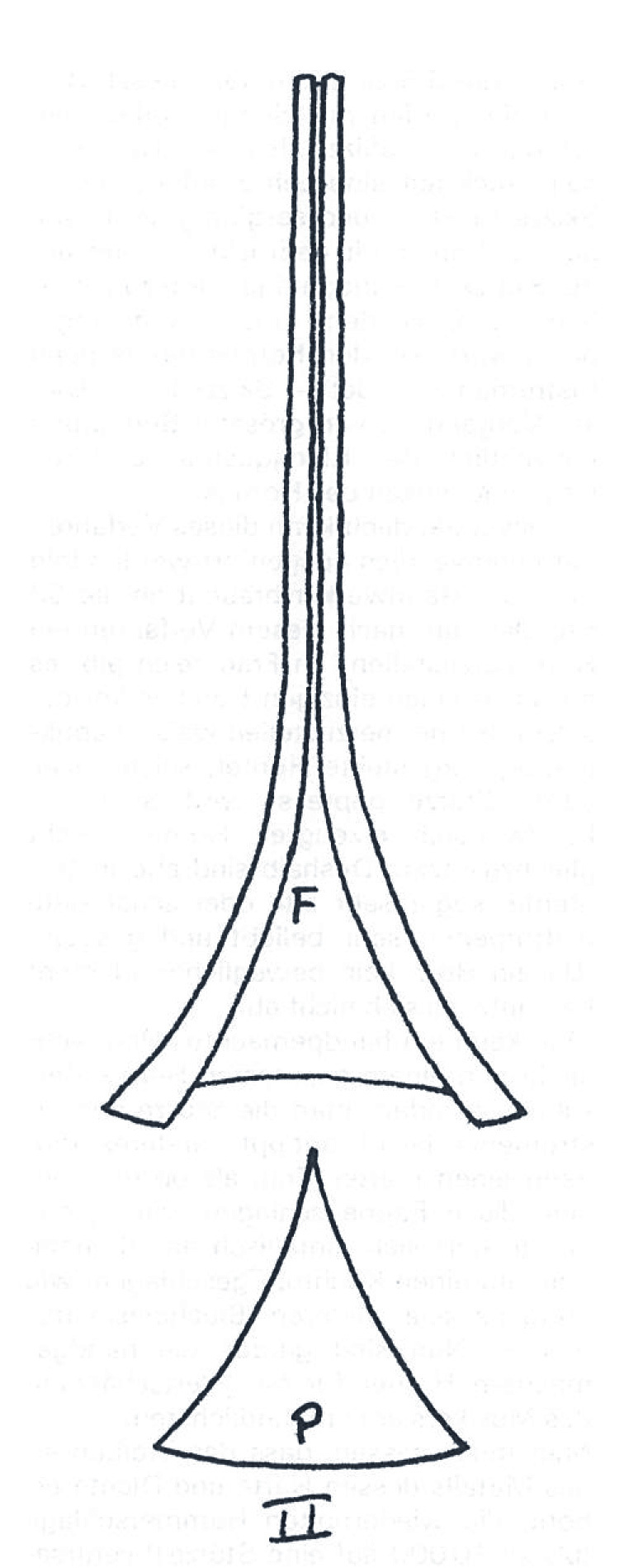
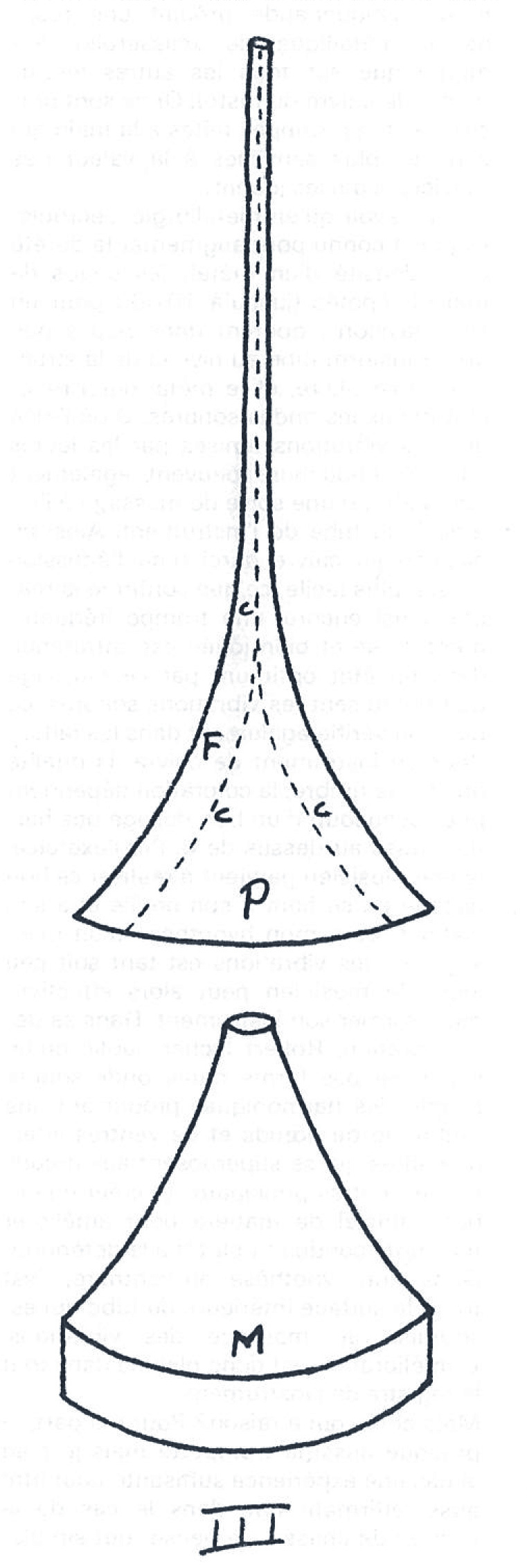
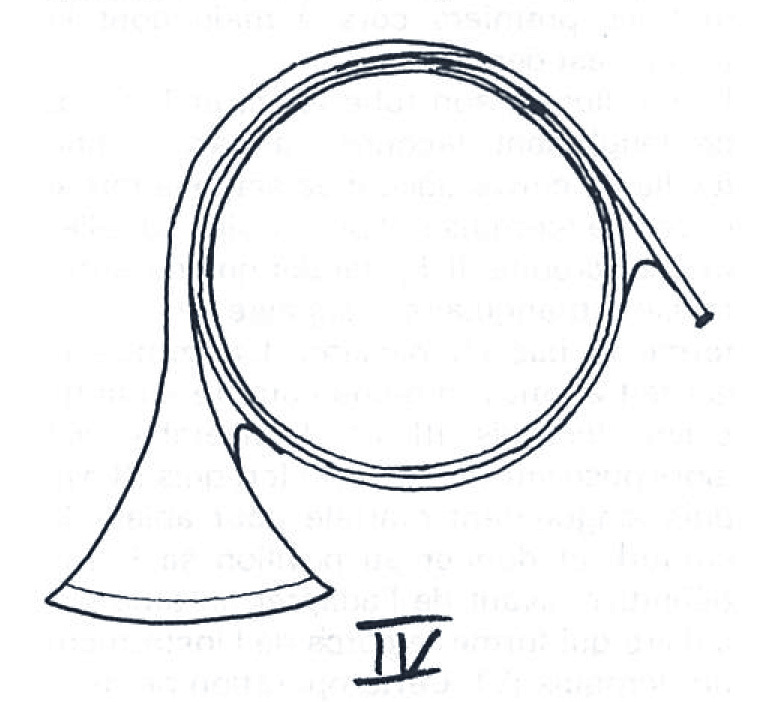
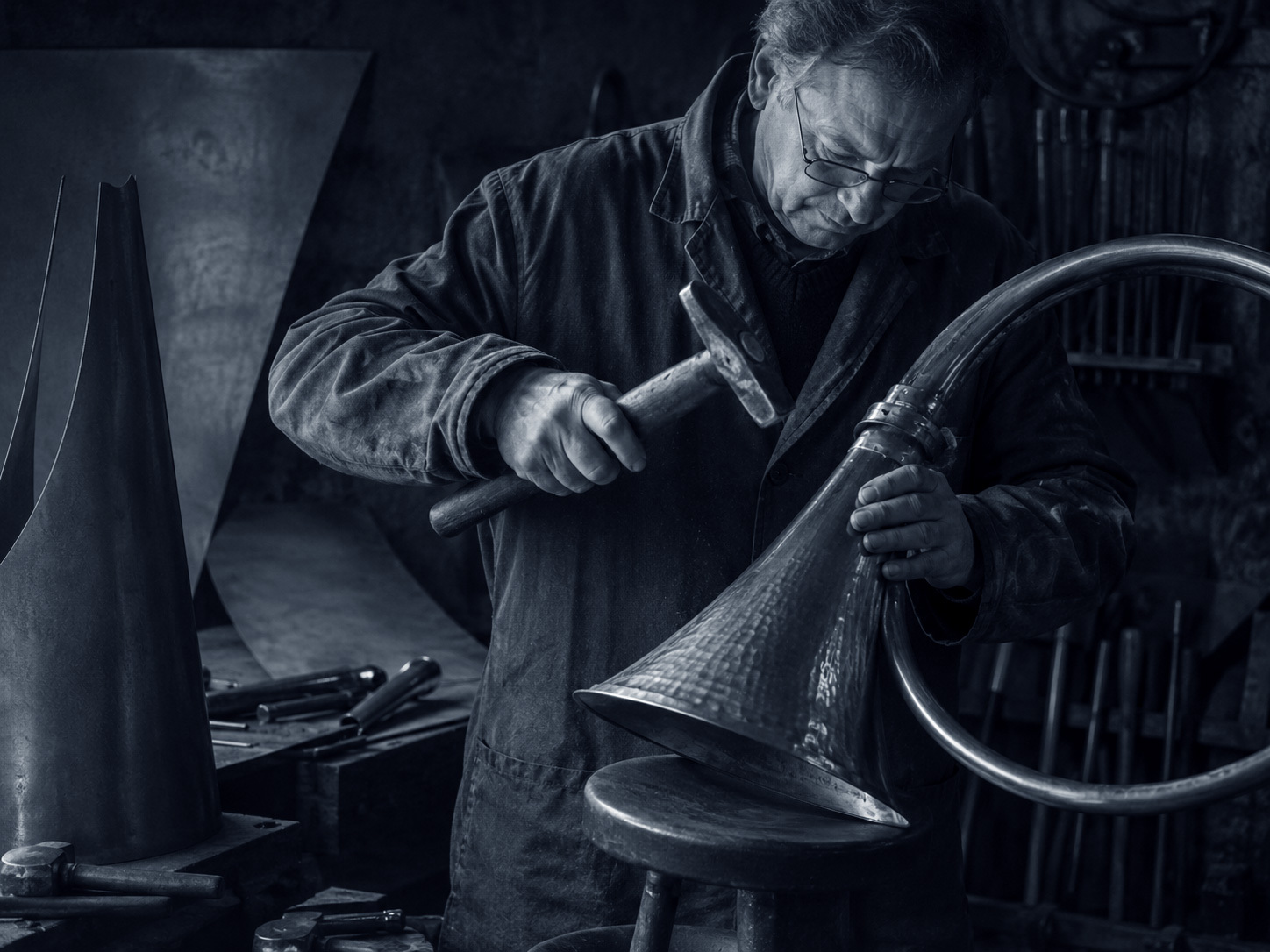
The best horns are still made by a process unchanged since the end of the 17th century, when the first hand horns, from which the hunting horn is derived, appeared. The bell and bellpipe (approximately 120 cm (47") long) are made from a sheet of brass cut out in the shape shown opposite (Diagram I F) then rolled around itself (Diagram II F), while another triangular sheet called the pointe completes the bell. The pieces are assembled, the seams using brass wire (Diagram III C). The whole thing is then placed on a mandrel and then hammered for a long time to flatten the seams and give the bell its final shape before fitting it to the circular tube which forms the body of the finished instrument (Diagram IV).
This hammering operation, known as cold-hammering, is of the greatest importance in giving the horn its sound quality and playing flexibility. Of course this manufacturing process can only be done by a craftsman (it takes a skilful workman nearly 50 hours to make a horn in this way) and there is now only one craftsman in France doing it.
As for industrially produced horns, that is with the bell shaped by pressing, they have nothing like the quality of the handmade horns. That is why original instruments, even if they are very old or in bad condition, are still very widely sought after and used (since it has no moving parts, a hunting horn cannot wear out).
It is very easy to distinguish a handmade horn from one made by pressing; flicking your finger against the bell of the former gives a dull sound, like knocking on a piece of thick cardboard; against the latter it produces a tinny metallic sound (as with all other brass instruments, incidentally). And it is precisely these handmade horns which are the most sensitive to the worth of the musicians playing them.
It has to be realised that in metallurgy cold-hammering is well known as a way of increasing the hardness and density of a metal; the repeated hammer blows (up to 10,000 for a single bell!) carry out a gradual transformation in the molecular structure and the hardened metal is better at reflecting sound waves.
Hence the idea that the vibrations produced by the lips inside the mouthpiece can likewise have the effect of a kind of massage inside the instrument tubing. Thus a hardened brass bell makes sound production easier, as is confirmed by experience; thus again a horn which is played well and frequently is kept in an optimum state by this massage produced by the sound vibrations, as is also verifiable.
In a brass instrument the sound quality, tone and colour depend largely on an abundance of the harmonics above the sixth. With practice a true musician manages to obtain this abundance by relying on his ear and his instinct. And if my hypothesis of vibration massage is correct, to however limited an extent, then the musician can indeed shape his instrument.
In his demonstration Robert Ischer forgets that a sound is not formed by a single sound wave; the harmonics produce a multitude of intermediate nodes and antinodes which are superimposed on the principal nodes and antinodes, and creating an artificial deposit of matter to improve such and such a note would tend rather to make it worse.
According to my hypothesis, on the other hand, the whole inside surface of the tubing is subjected to the vibratory massage. The improvement is therefore general throughout the whole register of the instrument.
So, who is right? Personally, I also play the trumpet but I do not have enough experience of it to be as definite as in the case of the hunting horn. I just think the sensitivity of the instrument is more marked when it is made of metal hardened by cold-hammering. What I have noticed very markedly thanks to the hunting horn is probably less obvious in other instruments.
If a manufacturer were prepared to take the risk of producing a trumpet or trombone, making the bell as I have indicated, we would probably have the wherewithal for a promising experiment!
I would like to make one final observation. I once happened to have in my possession an original hunting horn whose damaged mouthpipe had been replaced by an ordinary piece of water piping made of copper, bought from a plumber. The sound was as full and pure as if the horn had been intact. This seems logical since it is at the end of the tube and in the bell that the sound takes on its final shape and colour before being emitted into the ambient air.
In the hunting horn only the bell and bellpipe (or about 120 cm in length altogether) are subjected to cold-hammering. They are therefore of supreme importance for the quality of the instrument.
This takes us away from the educational level in which Robert Ischer is interested and where I entirely agree with him. The instrument should not serve as an excuse for a poor student. But that is quite a different problem...