This issue is still available in print.
English / French / German
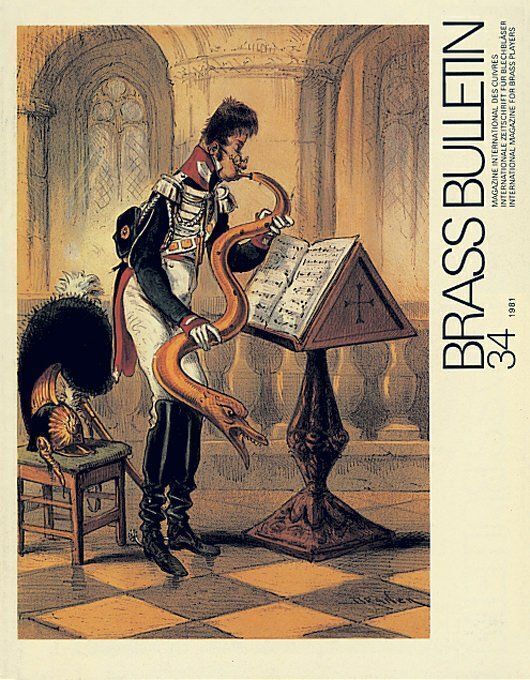
Brass Bulletin No. 34
II / 1981
Contents
Editorial
Jean-Pierre Mathez
Beyond technique and instruction, musical growth depends on trusted relationships, where friendship becomes both a measure of progress and a safeguard against isolation.
A study of musical intonation
Part 3 – EndChristopher Leuba
From wind quintets to brass sections, balance, overtones and perception shape intonation in ways that often diverge from measurable frequency.
Music in an American Frontier Communal Society
Part 1Aurora Colony
Deborah M. Olsen
In a German communal settlement on the Oregon frontier, bands, choirs and original compositions shaped daily life as strongly as faith, work and education.
Viktor Venglowski
Musician and Teacher
Sergej Gorovoj
From the Leningrad Philharmonic to the Conservatoire, one trombonist shaped repertoire, ensembles and generations of players across the Soviet Union.
Practical Hints
Part 5James Stamp
Working from a Clarke study, a modified routine links tone stability to velocity, showing how secure sound supports precision as tempo increases.
Blowing as a body function
William F. Cramer
Breathing habits, posture and body mechanics converge in a practical view of tone production, where William F. Cramer questions prevailing assumptions.
Arnold Jacobs
Part 2 – EndInterview
Roger Bobo
From Curtis to Chicago, a tuba player's path crosses Reiner, Koussevitzky and Ormandy, while teaching evolves toward breathing, thought and musical function.
Instrument Making and the Ear
Emile Ferron
From hearing physiology to workshop testing, E. Ferron links instrument design, acoustics and perception, where no two ears judge sound in quite the same way.
Herpes labialis (lip sores)
A brass players' affliction
Uwe Schwandt
For brass players, a common lip condition can mean weeks away from the instrument, linking embouchure, health habits and recurring interruptions.
Working with the Posaunenchor
Max Sommerhalder
From Württemberg youth groups to mass brass gatherings in Ulm, a community tradition links faith, education and amateur brass playing across generations.