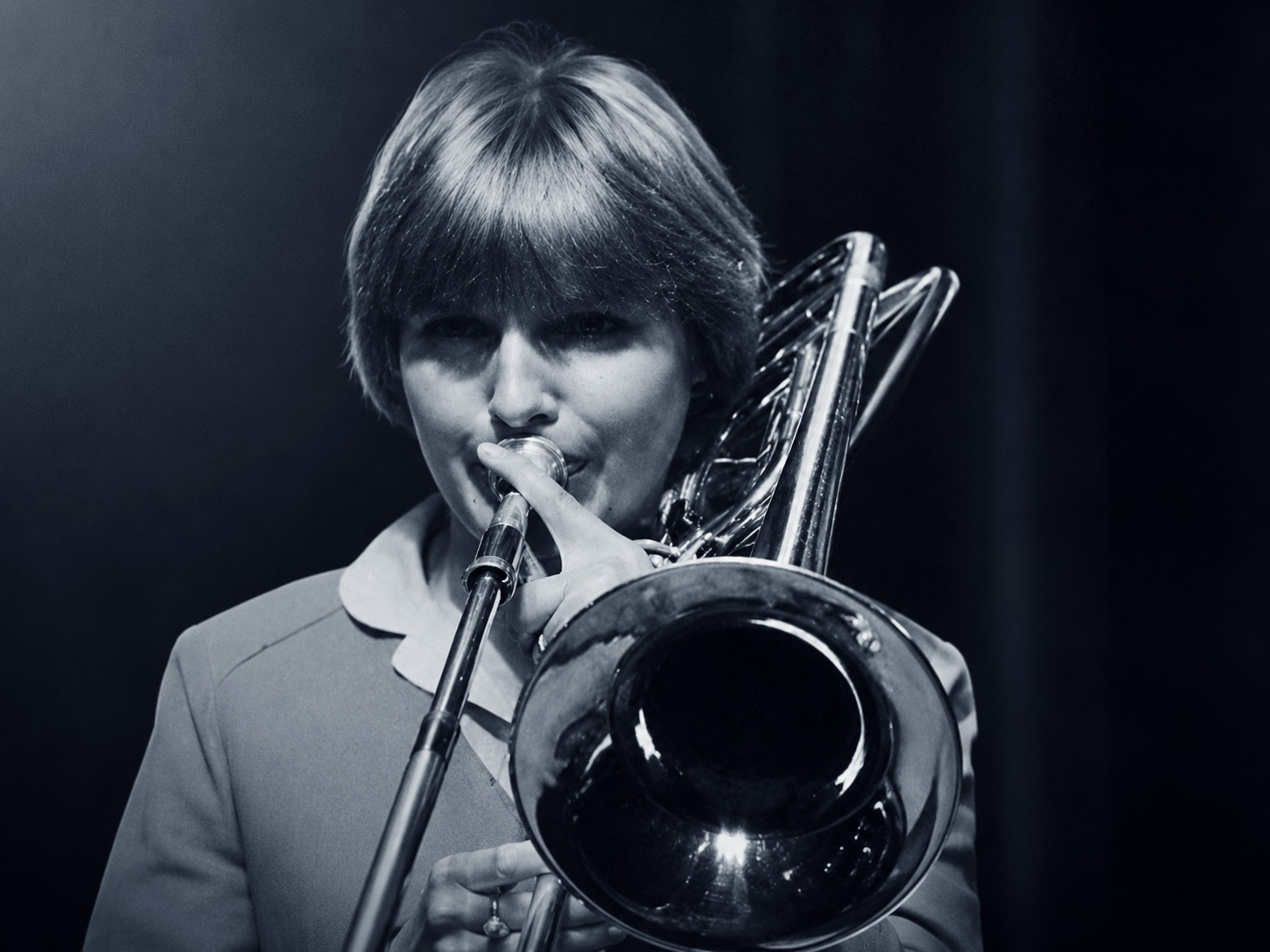
Two years later Yvelise won her first prize. It was then that she really began to discover music; she went to concerts and listened to records, and from then on her music studies were centred more and more on musicality.
The chamber music class in which she also won a first prize was a great help to her in this.
After going round the large Paris symphony orchestras, she deputised several times in the orchestras in Nantes and Limoges. She obviously did not pass unnoticed. There are advantages as well as disadvantages in this; as for example when competitions are involved.
The main advantage is that people listen to her carefully and, if she plays well, her name will be more readily remembered from among the mass of applicants. On the other hand her performance is closely scrutinised, criticised and analysed.
One day Yvelise heard that the National Police Band was holding a competition for two trombonists. The competition was open to women, so she applied and her application was favourably received by Monsieur Bigot, the band's conductor.
Monsieur Bigot made all the necessary approaches to the various ministries. Despite the reservations expressed by some of the musicians, Yvelise was appointed.
The first few months were nevertheless difficult. Dressed in a smart uniform, a charming hat and elegant shoes she forced herself to play at concerts and parades, refusing to accept preferential treatment.
One very cold day she was taken ill during an open-air ceremony but would not accept any assistance until she heard that two of her colleagues had already received treatment (and her honour was satisfied).
Things will no doubt be easier for female musicians who follow her but Yvelise is the first woman trombone player to play in a police band and her path is littered with obstacles.
When they play away from home Monsieur Bigot reserves a hotel room for her so that she does not have to stay in the barracks.
Yvelise was recently successful in another competition held by the Paris Police Band but she is very reluctant to accept the post as she would then be in the same section as her bass-trombonist husband.
She rightly thinks that it is sometimes preferable, for the smooth running of the household, to keep professional and private life separate.
She has found that at work men are more touchy — a remark which may be "pertinent" uttered by a man becomes "unpleasant" when uttered by a woman.
Since she is still new to the business, Yvelise is ruffled by the lack of honesty shown by certain musicians to "the girl trombone player"; her isolation within an orchestra consisting entirely of men disturbs her in spite of everything and she is eager to be joined by a female colleague.
Meanwhile she works extremely hard to prove her worth; she has entered all the international competitions, especially the one in Prague, where she reached the semi-final.
She finds some consolation in the fact that the harshest criticism always comes from rather mediocre musicians. (With a little more experience I think she will come to realise that jealousy and gossip arise without regard to sex...)
Comparing herself to men Yvelise has found that she has the advantage of flexibility and musicality over them; on the other hand she had to force herself to solve the problem of power (unconscious fear of appearing vulgar?...).
Yvelise dreams of joining a large Paris symphony orchestra; she would also like to have a baby. It would make a good story, beginning, "The alto trombone, whose parents the tenor trombone and the bass trombone..."
Yvelise's career will probably take a new turn when she takes up teaching; she will then no longer have to accompany the National Police Band on its numerous trips and will thus be able to give more attention to her home while continuing to play the trombone at the same time.
Through Brass Bulletin she would very much like to get in touch with other female brass players in order to correspond with them and, ultimately, organise some meetings.
The call has been made... I am sure it will be heard.