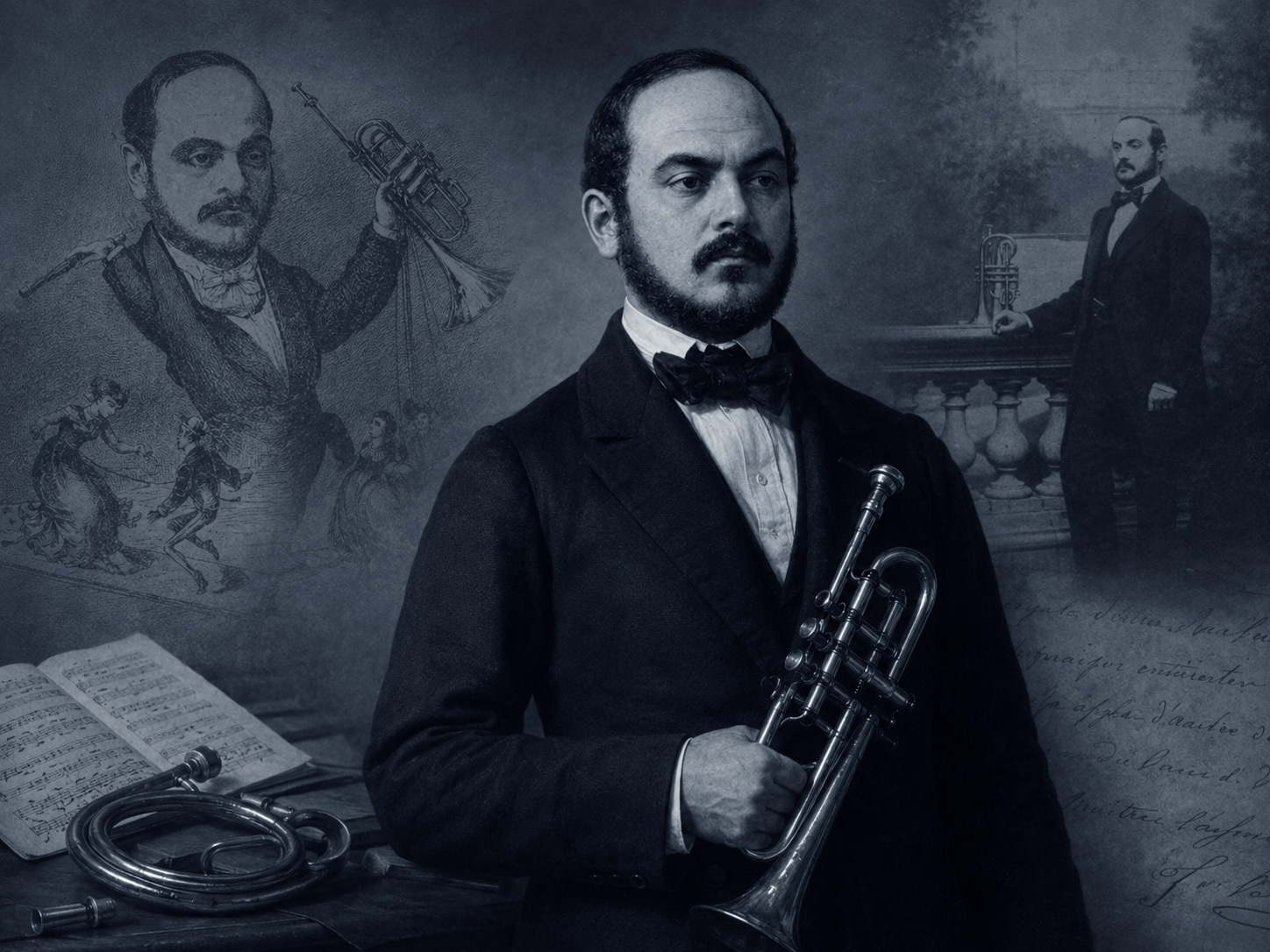
One understands those words better when one discovers that Arban had great difficulties in conveying his knowledge by writing. His texts are stuffed with unsupported affirmations. One discovers with astonishment that he did not know how to or was not able to study thoroughly certain problems such as for example breathing or placing the mouthpiece. He often takes advantage of explanatory texts to denounce and attack his "enemies". He ends his Avant-Propos: "in one word I have always applied myself to lead, without his getting discouraged, the pupil to the last limits of the performance, feeling and style which must characterize the new school."
Follows a "Tablature des harmoniques du corps sonore" (Fingering Chart of the Harmonics of the sonorous body). Arban states that the range of the cornet goes from the low F sharp to the high C, specifying that the extremes are difficult and that "it is not given to everybody to run easily through the full range". In view of his Method and also of pieces in his repertoire one can imagine that Arban did not often venture himself to play in the high register.
He advocates Le cornet à pistons en Ut (C cornet) which "is one of the most brilliant and has a more distinguished timbre than that in B flat." He quotes the "Deuxième Tablature (second Chart) ... which by the way is much used in Germany." This system consists of pulling the valve of the third piston a semitone (C-0 / B-2 / B flat-1 / A-1+2 / A flat-3 / etc.; one can thus descend down to low F natural).
With La position de l'embouchure sur les lèvres (position of the mouthpiece on the lips) Arban does not rack his brains: "The mouthpiece must be put in the middle of the mouth, two thirds on the lower lip and one third on the upper lip..." He only justifies this position by the fact that it personally suits him the best. He adds "To make high notes it is necessary to exert a certain pressure on the lips" ... "you must pull the corners of the mouth..." What an irony! Since generations has one tried to lessen the disastrous effects of those faults. On the Manière d'attaquer le son (Manner of attacking the sound) Arban only sees at the beginning a very clear "tu". "The manner of attacking the sound", he writes, "shows immediately if you have a good or a poor style..." That is the reason why he devotes all the first part of his Method to this sort of exercises: "I shall go on to slurring only when the pupil knows how to attack and to place the sound perfectly". In fact this obsessing "tu" makes you more unaware of the emission. Instead of being a simple form of articulation it becomes the only way of emitting a sound.
Arban's knowledge of breathing is rather slight: "[...] the stomach must not be expanded, on the contrary it must go up at one and the same time as the chest grows through the effect of inspiration". It seems that here Arban was more inspired by the famous (and faulty) position (aesthetical) of a saluting soldier rather than by natural logic.
In the second chapter of his texts Arban tackles the problems of style, in particular the "faults to avoid". In fact he frightens the pupil by numbering, even before making him try the exercises, all the faults to which he will be exposed. Arban wags his finger in the same way when he speaks of "the placing of the sound" (emission), of "the attack of the sound" or other subjects. He concludes by a harsh sentence: "Bad habits are usually too deeply rooted in the musicians who play brass instruments to give in to one warning only and one could never give them a hard enough battle".
I invite the reader to pay special attention to the following paragraph:
Is Arban writing for beginners? It would seem obvious since he indicates fingering for his first exercises, inviting the pupil to learn them by heart as quickly as possible. However all those who use the Arban Method for teaching are in agreement in saying that it starts badly. Indeed after a few brief examples and advice Arban throws the pupil into such precipitous exercises (rhythm and pitch) that no beginner can tackle them without accumulating a mass of faults (tension, bad position, slaughter of the lips, poor breathing, etc.), those very faults that Arban denounces so vehemently! In short Arban creates himself the faults that he denounces.
After this jolting beginning Arban organises himself and establishes a plan of developments in seven points: "Le Coulé" (slurring), "Des Gammes" (scales), "Les notes d'agrément" (ornamentation), "Les Intervalles" (intervals), "De l'Accord [...]" (chords), "Le coup de Langue" (tonguing), "14 Études caractéristiques et 12 Fantaisies et Airs variés" (14 characteristic Studies and 12 varied Airs and Fantasies).
In the explanatory text on "Études sur le coulé" (Studies on slurring), Arban says that he considers that this part "is without contradiction one of the most important". He recommends to work mainly on the exercises which "are done specially through lip movements" [on fixed fingering]. "The interval of a third is the most difficult, as it is often found on degrees where it becomes impossible to resort to pistons to help carry the sound from the lower to the higher note."
Arban increasingly mixes short technical explanations with what he considers to be right or wrong and then suddenly flares up and lifts an accusing finger towards "those Gentlemen" (the wicked enemies of "people of taste"), allowing himself even to scratch in passing the great horn player J.-Fr. Gallay (page 38): there is an example of such a verbal explosion: "I am only giving those exercises [the linking of thirds with fixed fingering] as studies and I am in no way suggesting to the pupils to use them in practice, unlike certain horn players who want to apply to the cornet a system which has no raison d'être, since it is one of the most perfect and complete instruments that repudiates rather than requires factitious procedures, the effect of which will always seem detestable to people of taste." These provocative words found frequently in Arban's text have certainly contributed to widen the gap (still perceptible nowadays) between horn players and trumpeters.
The methodical procedure used by Arban is almost always based on the following pattern: easy to difficult, slow to faster, medium pitch to the highest and back.
After a few purely technical exercises Arban usually attempts to "musicalize" the problem in the form of small pieces (except for scales and intervals). It is a positive element but the style of music that he adopts to this effect has become obsolete in our time.
In the chapter of scales Arban advises to mechanize the movements with the help of a metronome. He mainly develops exercises on the major, minor and chromatic scales, ignoring all other forms of scales.
The presentation of the "Notes d'agrément" (ornamental notes) is succinct (to be treated with caution). Arban punctuates it with personal considerations such as: "One should not overuse this kind of ornamentation [the portamento] for it would be in bad taste...", "There is indeed only the semitone trill which is bearable.", "[...] I have purposely gathered in profusion all sorts of ornamental notes. But one must well guard oneself against overusing them in practice, for it would become in bad taste."
It is noticeable that the art of ornamentation has been lost... The sobriety, rigour and faithfulness to the written line eliminated the last melodic liberties for the instrumentalist, thus provoking the sentimental outpourings of the musical expression, characteristic of this epoch.
The Arban Method exercises are always very gradual, soothing, meant to create an illusion of progress (I say illusion because in fact if a pupil has accumulated faults, no text in the Method will enable him to correct them; the Arban Method can only help those who, by chance, have found the correct way to play).
Arban never stimulates the capacity to analyse or the pupil's imagination. He preaches "courage", "conviction", "work", "[...] and the efforts made to overcome certain impossibilities show rapidly that they are not real. They only present insurmountable obstacles to those artists [sic] who, out of laziness [...]". These are fine principles. They are unfortunately incompatible with sensible instrumental teaching.
The next to last chapter of the Method is devoted to the famous tonguing of which Arban was the great specialist ("Thanks to this kind of articulation there are no difficult lines any longer; one can manage to play as easily as one does the flute [...]").
"The last part" is introduced by a text which resembles a testimony, a kind of message (in code) enabling to discover the treasure island (the treasure being the faculty to play at least as well as Arban!)...
After having encouraged the pupil to work on the long pages of exercises of his Method Arban makes him climb over the final hurdle: "I have composed the fourteen following studies with the aim of inculcating [to inculcate = to imprint in the mind through constant repetition, Diet. Quillet] in the pupils an invincible will-power. They will tire themselves no doubt [...]". Then, in passing, Arban offers a little trick to keep them going: "It is possible on the cornet to obtain, as do singers, clear sounds in opening the lips, and muffled sounds in tightening them. This will be an excellent way to relax without ceasing to play [...]"
Arban has at last led us where he wants us to be: "The twelve great pieces which follow are the summary of the different lessons contained in this volume [...]", in fact they are neither more nor less than the pieces that have made his fame and reputation as a virtuoso cornetist. The aim of the method is to lead the pupil to play "melodies capable of forming the pupil's taste [...]", i.e. to confirm his own (Arban's).
"At this point my task of teacher stops naturally...". Arban does not like writing, he has already said so: "There are things which can only be transmitted from person to person, but which could not be confided on paper without breeding confusion and obscurity or without falling into childishness". In a certain sense he is right, especially when an author has not very clear ideas.
He lets it be understood that "there are other things of such a high and subtle order that they refuse to allow themselves to be interpreted neither by the written nor the spoken word. One can guess or feel but not explain them". One last flight of oratory: "These things make up the high style, the great School that I have the noble ambition to found for the cornet as they already exist for singing and for most other instruments."
His Method ends up with his most precious advice, by an appeal to Providence and to the revealing illumination.
Conclusion
Arban defends rather set ideas. In this sense he caught himself unvoluntarily in his own net: in trying to strive for progress he has managed to imprison the cornet in a system and in a style. He constantly refers to "good taste", perhaps never doubting to what extent this notion is ever-changing. In calling his method complete he has precisely fixed its limitations.
Let us look at it: the musical content is not extraordinary, the omissions are serious (no allusion to breath control, just recommendations to obedience and submission). He begins teaching the instrument with musical notation instead of starting by recognizing sounds, tones and elements specific to the cornet.
So why the incredible success of his work?
It is certainly much easier for the pupil to follow a well signposted road, to obey rather than think.
On the other hand Arban never stops to make promises (If you do as I tell you everything will be all right — the underlying meaning being — if it is not all right it means that you are not doing correctly what I tell you, the dishonest alibi of many, even contemporary, instrumental "methods". Arban, by the serious tone which he gives to the aspect of his Method and by the fullness of his inculcatory (I invent this word to his memory) developments has represented for 112 years the hope for thousands of fans of brass instruments who dream to play one. The startling percentage of failures it made people endure should at last incite us to search for other routes.
At the beginning of this century, hardly twelve years after Arban's death a handful of American Negroes (Buddy Bolden, King Oliver, Freddy Keppard, Louis Armstrong, etc.) managed with magnificent strength to release the cornet from academic rigour, blowing into it through jazz a new life through freedom and creativity.
And now where are we?²