Explore institutional access Explore institutional access

12 min. read

My contacts with the United States
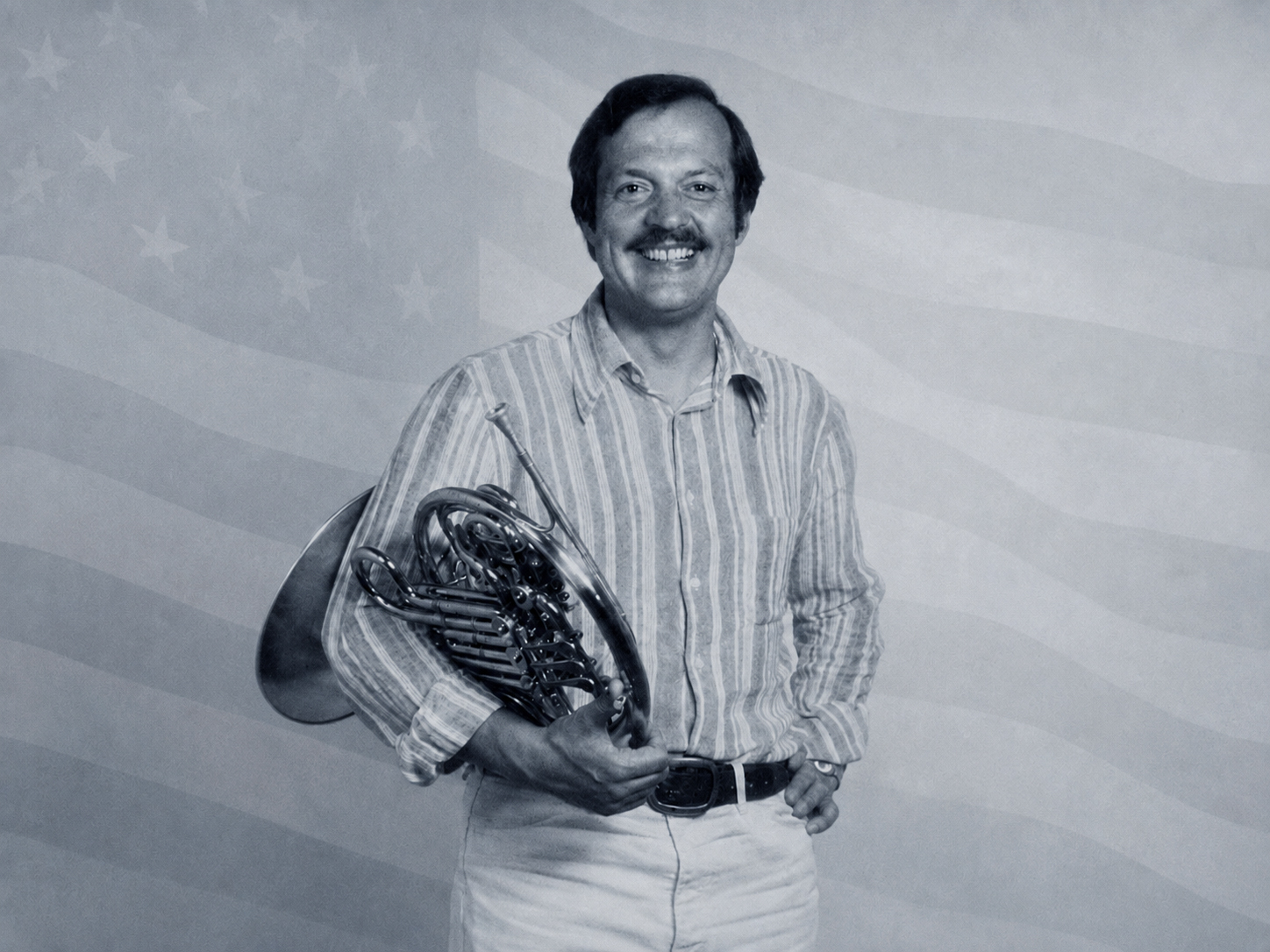
From a simple request to an unexpected invitation: this account dives into Indiana University—between dazzling technique and the search for true musicality.
My contacts with the United States

Introduction: Urgent call...

"Please call collect immediately. Sincerely Dean Willfred C. Bain. Indiana University School of Music, Bloomington, Indiana, USA"

This is the cable I received on May 10, 1970, and it is the beginning of an extraordinary story.

A few weeks previous to that date, I had asked Professor Philip Farkas if he would accept me as his pupil at the Bloomington School of Music during summer vacations. Many years before I had already adopted his book "The Art of French Horn Playing" as the indispensable base of daily practising and of teaching my pupils. Now it was my great wish to attend his classes personally. Farkas' answer was kind and positive, but he begged me to send a tape recording, since before enrolment test playing — even "canned" — was imperative. This seemed to me a little exaggerated in face of the fact that I was solo horn of the Munich Philharmonic, but I did as I was asked and sent Prof. Farkas a tape recording of Jos. Haydn's 1st horn concerto which I had made the year before with the Bamberg Symphony for the Bavarian Radio Munich.

Whereupon the cable arrived, telling me to call immediately. I really could see no reason for such an urgent call and supposed some misunderstanding. However, I called. Dean Bain answered the phone with the deep sonorous voice of the American manager. After a few introductory words, he passed the receiver on to an interpreter, who, in fluent German, spoke the one sentence that showed straight away that I was connected with the country of unlimited possibilities: "Herr Höltzel", the voice said, "Dean Bain wants me to tell you that he and Mr. Farkas have listened to your tape recording and they both agree that you should come to Indiana University not as a summer student, but as a guest teacher, starting next September. When, do you think, can you let us have your definite decision on the subject?"

I was so taken aback by this idea that I could not even show joyful surprise but just stammered something about having been with the Munich Philharmonic for only a few months and that they surely would not be prepared to grant me a year's leave. Besides, I was a teacher at the Salzburg Mozarteum and felt sure that its director would never let me go. However, I finally promised to do my very best to arrange things, the offer being very tempting indeed; and I was granted a time-limit of 24 hours.

Continue reading

Access the full Digital Edition.

Brass Bulletin 15, III / 1976 pages 27–39

All content is protected by copyright © Brass Bulletin 1976–2026

Share this article

Facebook LinkedIn
Loading…

Questions & Answers

How the Digital Edition works

What does the Digital Edition include?

The Digital Edition brings together the articles already digitized as searchable online texts—not simply as scans or PDF files—along with their original illustrations, notes, authorship, issue information, and available translations. Related-article suggestions currently include only this digitized material.

Are the digital articles identical to the originals?

We preserve the original text, language, illustrations, captions, footnotes, and editorial context as faithfully as possible. The presentation is adapted for comfortable online reading, and obvious transcription or scanning errors may be corrected. The substance and character of the published article remain unchanged.

Which languages are available?

Brass Bulletin was published in English, French, and German throughout its history. Italian and Spanish translations were added from issue No. 60 onward.

On the Italian and Spanish sites, articles from issues 1–59 are therefore shown in English by default.

How often are new articles added?

New articles are added almost daily, with approximately one complete issue digitized each week. The pace may vary depending on the preparation, image work, and editorial checking required.

Why aren’t all articles available digitally?

The complete Brass Bulletin collection contains 1,246 articles published between 1971 and 2003. The full index is already available online, allowing readers to discover every article in the collection, including those whose complete text has not yet been digitized.

Digitization began in February 2026. Each article is carefully prepared for online reading, checked, and connected to its issue, authors, subjects, and illustrations. At the current pace of digitization, the complete collection is expected to be available online by February 2028.

Why do some references mention articles that are not available yet?

References in the original articles are preserved even when the material they point to has not yet been digitized. This keeps the historical and editorial record intact. As more issues are added to the Digital Edition, an increasing number of these references will lead to articles that can be read online.

Can I suggest an article or report a transcription error?

Yes. If there is an article you would particularly like to see digitized, or if you notice a possible transcription error or missing detail, please contact us. Reader feedback helps us improve the Digital Edition and prioritize useful connections within the archive.

How can I support Brass Bulletin?

Your support helps fund the preparation, verification, and online publication of the complete collection.

Subscribe to the Digital Edition

Prefer to support us without subscribing?

Make a donation

Search Brass Bulletin.