15 min de lectura
Ornaments in 18th-century Horn Concertos?
Essential ornaments
Por Peter Damm
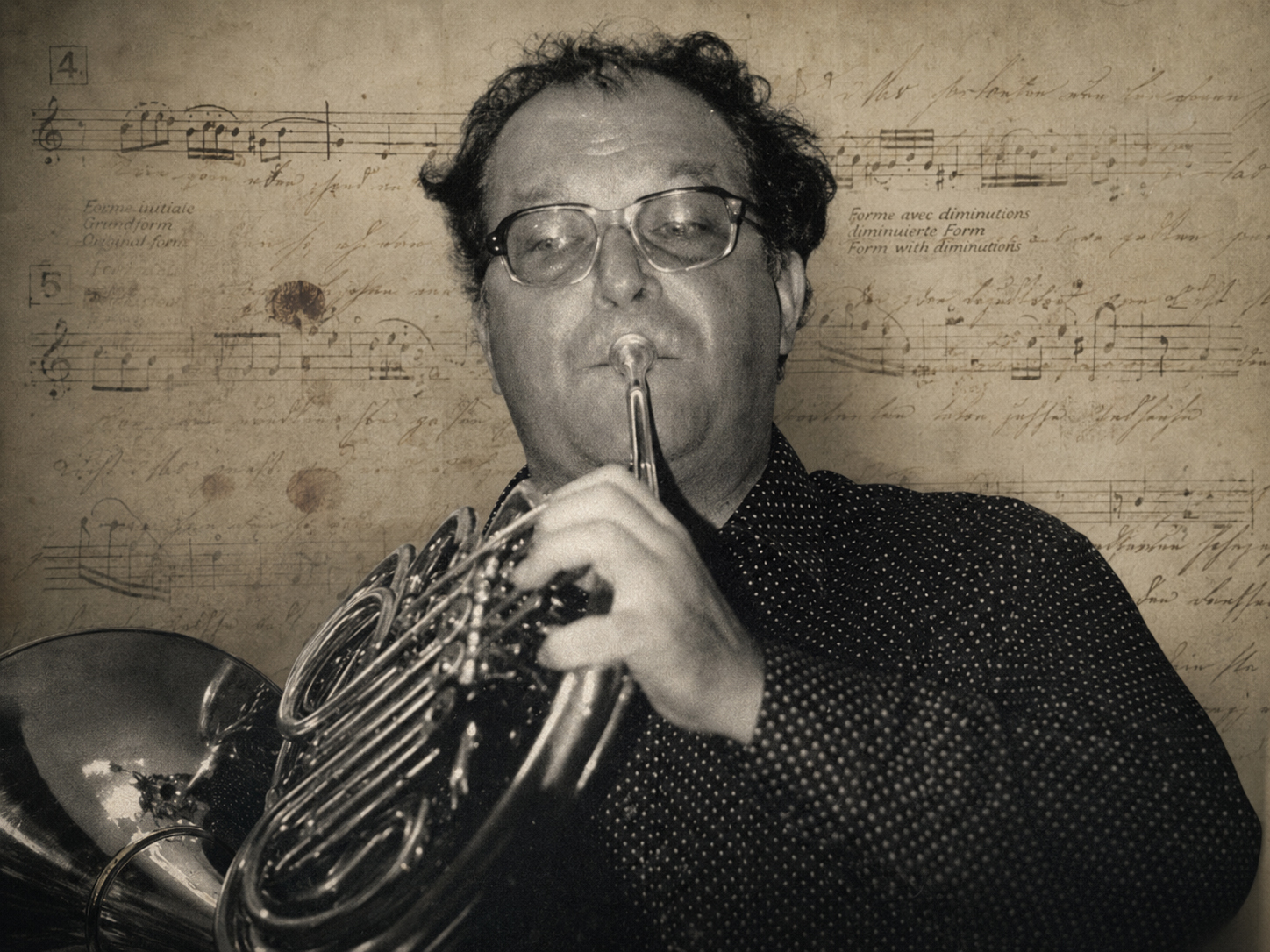
Horn players are not often faced with the question of ornamentation. Why is this? Firstly because it poses the student player considerable problems of high-register playing and, secondly, because a clear trend towards pre-classical horn playing has only developed in the last ten years and there is still little written on the subject.
The earliest solo horn pieces I know include a single-movement Sonata con un corno written around 1670-1680 by an anonymous Bohemian composer and a Concerto a 4 by Johann Beer who died in 1700.⁸
The three-movement Venetian Solo-concerto form developed around 1700 gives us the concertos by Peter Johann Fick (died 1743), Christoph Förster (1693-1745) and Georg Philipp Telemann (1681-1767) as well as the double concertos by this same composer and those of Antonio Vivaldi (1678-1741). The early evidence also includes the Sinfonia da camera and the double concerto by Leopold Mozart (1719-1787) or the double concertos by Franz Xaver Pokorny (1728-1794).
Before I turn to the practicalities of ornamenting horn parts, a few remarks about brass technique in the first half of the 18th century. On the open natural horn, that is, played without the hand in the bell, only the notes of the natural harmonic series can be produced.
A diatonic scale is only possible from the 7th harmonic, the tuning of which is rather dark, and a chromatic scale only from the 13th harmonic. Playing melodies on the natural horn thus only becomes possible in the octave below top C. In accordance with the trumpet technique of the period we refer to this register as the clarino register of the instrument.

1.
+ = sharp as F, too flat as F#
- = rather too flat
It is certain that corno da caccia players benefited from the clarino technique used by trumpeters in the performance of their sometimes very high parts, rising to the 16th, 18th and 20th harmonics and occasionally to the 22nd and 24th. There is also occasional proof that, until the end of the 18th century in bohemia, the same individuals played both “clarino and horn”, leading one to the conclusion that horn players coming from Bohemia or trained there had certainly been taught by trumpet players.⁹
The art of clarino playing frequently gave rise to speculation about secret techniques. The skill of the individual player is of course of crucial importance but this itself results from the way in which the mouthpiece rests on the lips. A comparison with the modern low-pressure embouchure suggests itself. It may not be entirely out of the question, furthermore, to speak of a carefully guarded guild secret. With the development of hand-horn technique and the decline of clarino playing — on both trumpet and horn — many compositions fell into oblivion and are only being rediscovered today. For all their beauty, however, they are still among the hardest things ever written for horn or trumpet.
Continue reading
Accede a la edición digital completa.
Brass Bulletin 43, III / 1983 páginas 34–43
Todo el contenido está protegido por derechos de autor © Brass Bulletin 1983–2026