Ofrezca Brass Bulletin en su universidad, conservatorio o biblioteca Descubra el acceso institucional

3 min de lectura

Handel Horn Duo located in South America

A lost 18th-century horn tutor resurfacing through South America completes a Handel duet and preserves strikingly practical advice on horn playing.
Handel Horn Duo located in South America

In 1981 the second volume of the “Moravian Brass Duet Book” for trumpets or horns was published.¹ The music contained in this and in the first volume² had been sent to the United States from Herrnhut, Bohemia, arriving in Salem, North Carolina on October 26, 1785. Those familiar with this collection know that the first 42 numbers are chorales with German texts and that they are followed by 140 duets proper, many of them minuets and marches. At the end are 20 miscellaneous pieces, some with German titles and some with English ones.

The last three pieces (Nos. 18-20 of the miscellaneous ones) come from an otherwise unspecified “French Horn Instructor”, according to a note in the original manuscript. Since the upper part of these three pieces was missing due to a lack to the last pages of the upper part-book, it was necessary to locate that tutor. As Stephen L. Glover and I stated in our preface, our inquiry with some of the most noted specialists for early horn music resulted only in negative replies. The most helpful person was Kurt Janetzky, who possesses some loose leaves — probably from the missing “Instructor” — containing our Nos. 18 and 19 but lacking both a title-page and our No. 20.³ Glover and I finally went to press, printing the surviving 15 measures of the second horn part of No. 20 in the hope that someday the missing tutor would be discovered and the duet — which is called an “Air by Handel” and stated to be on page 28 of the “French Horn Instructor” — completed.

It was during one of my summer courses at the Palace of Mateus in northern Portugal that fortuitous chance played the long-sought tutor into my hands. One of my colleagues — Pedro Rodriguez, who is horn instructor at the Lisbon Conservatory — had received photocopies of an old tutor from a South American pupil. One day he showed it to me, not even realizing that I was particularly interested in horn music. On a whim, I idly turned to page 28 of the photocopies which Rodriguez had brought me. Imagine my surprise and joy when I discovered the missing piece intact! I am including it here so that all brass players may share in the discovery. (Wrong notes in the U.S. source are marked with an x. Furthermore, in the tutor, the last note in bar 13, first part, is e′′ rather than d′′.)
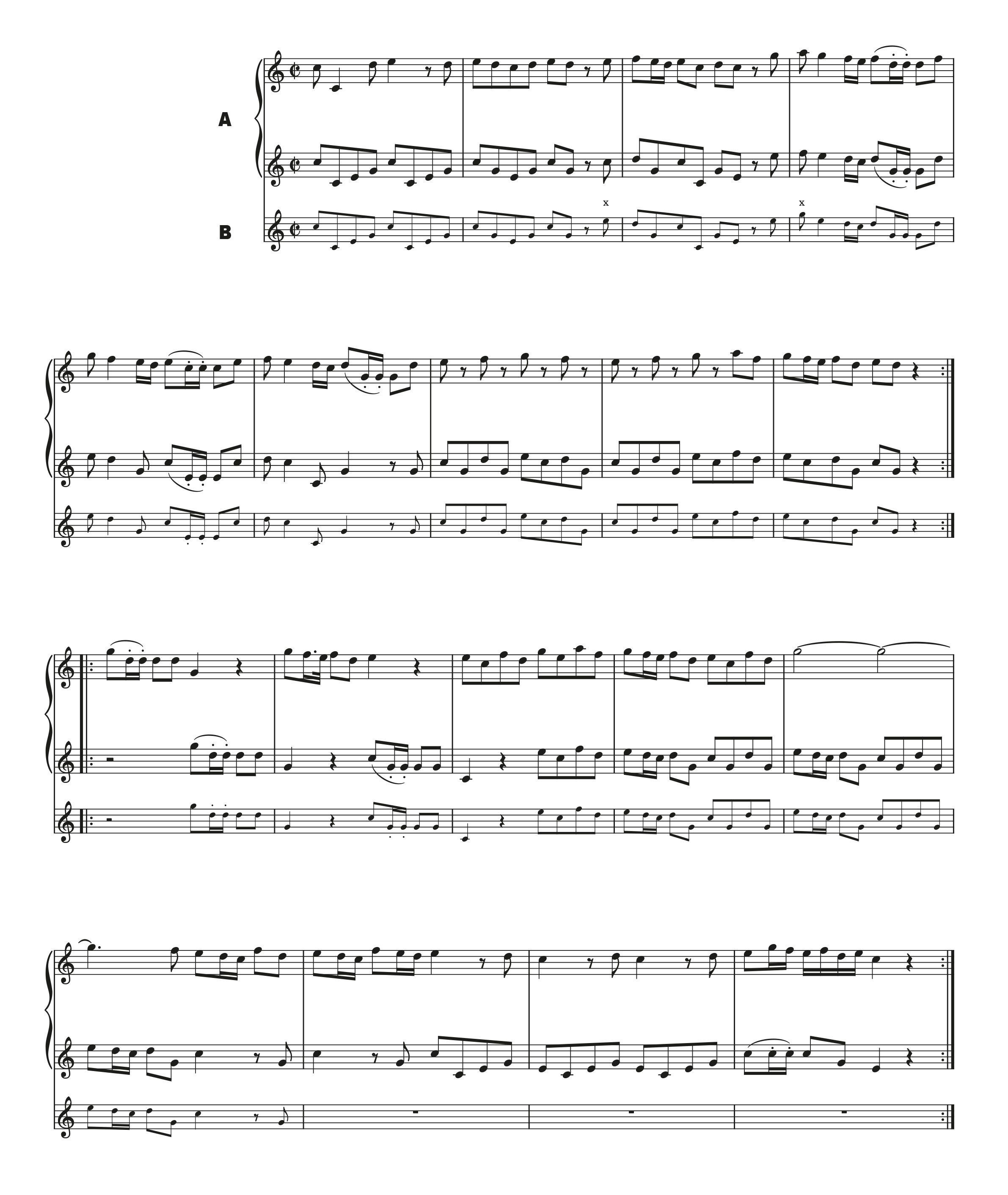
Example 1Air by HandelA = New instructions for the HornB = Fragment of 2nd part preserved in the Moravian Music Archives...

Example 1

Air by Handel

A = New instructions for the Horn
B = Fragment of 2nd part preserved in the Moravian Music Archives, Winston-Salem, N. Carolina

Music Example No. 1

As far as the “French Horn Instructor” itself is concerned, Glover and I had supposed it to be one of several known to musicologists: either “The Compleat Tutor for the French Horn” (London, Simpson, c. 1746, also London, Thompson, c. 1756), or “Instructions for the French Horn” (“Apollo’s Delight” or “The Muses Delight”, Liverpool 1757). However, it is none of these. A complete transcription of the title-page reads as follows:

New Instructions/for the FRENCH HORN,/Containing,/The most modern and best methods for Learners to Blow,/To which are Added,/all the Hunting notes, and a Collection of Tunes, Marches, Minuets, &c./purposely adapted for that Instrument by an Eminent Performer./Pr[ice] 1/6./LONDON,/Printed & sold by Longman & Broderip N°. 26, Cheapside, Where may be had,/French Horns of all sizes, Concert Horns, Trumpets, &c. likewise/all kinds of Wind Instruments, Music Books, Pieces, &c.

Continue reading

Accede a la edición digital completa.

Brass Bulletin 49, I / 1985 páginas 41–44

Todo el contenido está protegido por derechos de autor © Brass Bulletin 1985–2026

Compartir este artículo

Facebook LinkedIn
Cargando…

Preguntas y respuestas

Cómo funciona la edición digital

¿Qué incluye la edición digital?

La edición digital reúne los artículos ya digitalizados como textos legibles y consultables en línea —no simplemente como escaneos o archivos PDF— junto con sus ilustraciones originales, notas, autoría, información del número y traducciones disponibles. Las sugerencias de artículos relacionados incluyen actualmente solo este material digitalizado.

¿Los artículos digitales son idénticos a los originales?

Conservamos con la mayor fidelidad posible el texto original, el idioma, las ilustraciones, los pies de imagen, las notas y el contexto editorial. La presentación se adapta para facilitar la lectura en línea y pueden corregirse errores evidentes de transcripción o escaneado. El contenido y el carácter del artículo publicado permanecen inalterados.

¿Qué idiomas están disponibles?

Brass Bulletin se publicó en inglés, francés y alemán a lo largo de toda su historia. Las traducciones al italiano y al español se añadieron a partir del número 60. Por este motivo, en los sitios italiano y español los artículos de los números 1 a 59 se muestran en inglés de forma predeterminada.

¿Con qué frecuencia se añaden nuevos artículos?

Se añaden nuevos artículos casi a diario, con aproximadamente un número completo digitalizado cada semana. El ritmo puede variar según el trabajo de preparación, tratamiento de imágenes y revisión editorial necesario.

¿Por qué no están disponibles todos los artículos en formato digital?

La colección completa de Brass Bulletin contiene 1.246 artículos publicados entre 1971 y 2003. El índice completo ya está disponible en línea y permite descubrir todos los artículos de la colección, incluidos aquellos cuyo texto íntegro todavía no ha sido digitalizado.

La digitalización comenzó en febrero de 2026. Cada artículo se prepara cuidadosamente para la lectura en línea, se revisa y se vincula con su número, sus autores, sus temas y sus ilustraciones. Al ritmo actual de digitalización, se prevé que la colección completa esté disponible en línea en febrero de 2028.

¿Por qué algunas referencias mencionan artículos que todavía no están disponibles?

Las referencias de los artículos originales se conservan aunque el material al que remiten aún no haya sido digitalizado. De este modo se mantiene intacto el contexto histórico y editorial. A medida que se incorporen más números a la edición digital, un número creciente de estas referencias conducirá a artículos que podrán leerse en línea.

¿Puedo sugerir un artículo o informar de un error de transcripción?

Sí. Si hay algún artículo que le gustaría especialmente ver digitalizado, o si detecta un posible error de transcripción o algún dato que falta, póngase en contacto con nosotros. Los comentarios de los lectores nos ayudan a mejorar la edición digital y a establecer prioridades útiles dentro del archivo.

¿Cómo puedo apoyar a Brass Bulletin?

Su apoyo ayuda a financiar la preparación, verificación y publicación en línea de la colección completa.

Suscríbase a la Edición Digital

¿Prefiere apoyarnos sin suscribirse?

Haga una donación

Busca en Brass Bulletin.