Ofrezca Brass Bulletin en su universidad, conservatorio o biblioteca Descubra el acceso institucional

3 min de lectura

Viktor Venglowski

Musician and Teacher

Viktor Venglowski

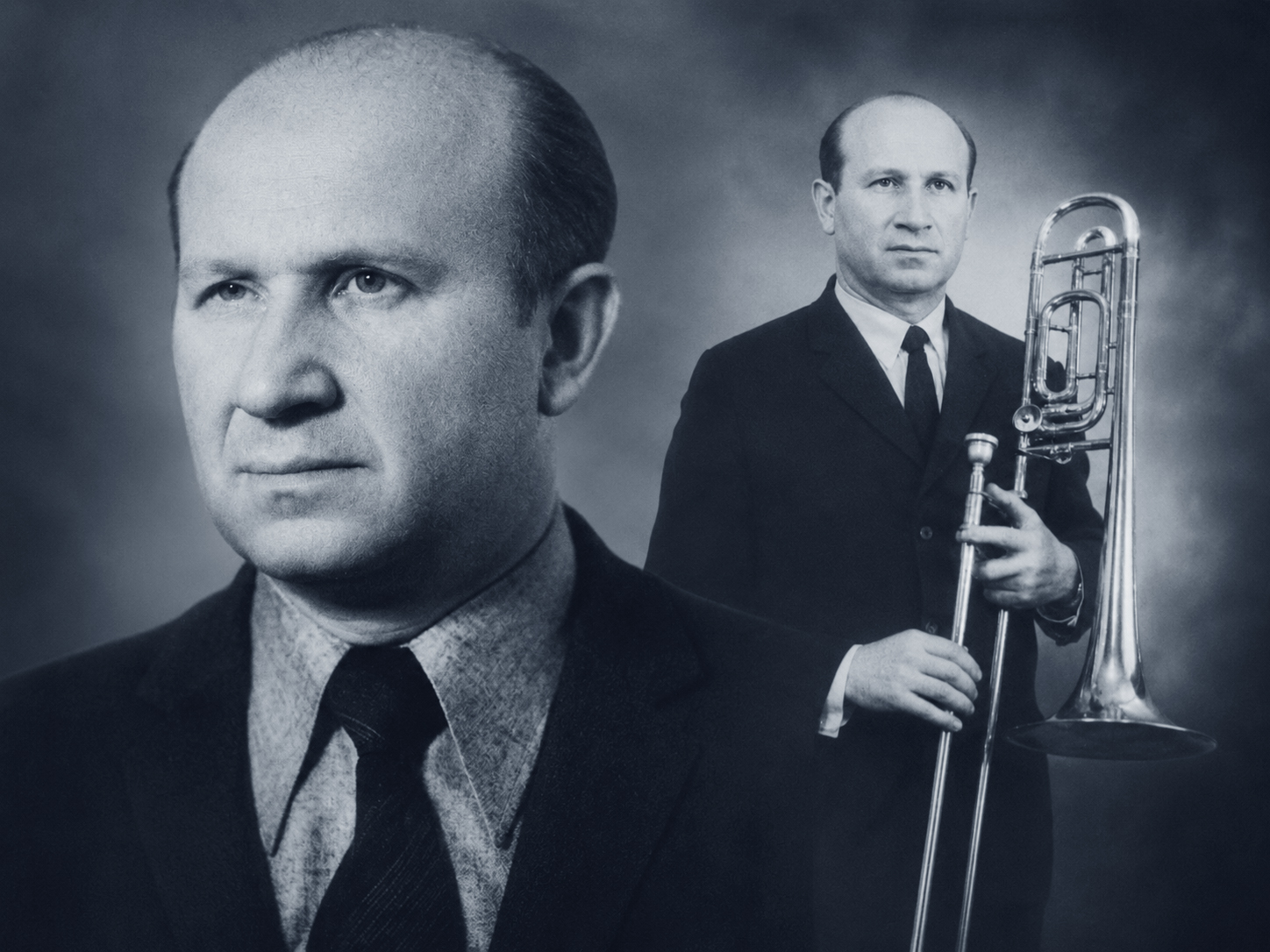
The most important name in trombone circles in the Soviet Union at present is that of the Leningrad trombonist Viktor Fyodorovich Venglovskiy.

As a highly gifted musician and a tireless worker he is making a great contribution to popularising and perfecting trombone playing.

I was fortunate enough to study with Viktor Fyodorovich and teach under him for two years at the Leningrad Conservatoire where he has taught since 1963 and where I saw for myself what a busy musical life he leads and how much effort he devotes to his beloved art.

Although a soloist in one of the world's finest orchestras — the Leningrad Philharmonic Symphony Orchestra, holder of an RSFSR award — since 1950, he does not confine his playing to this. Every year he gives several solo concerts at which he always plays new works, some receiving their first performance in this country. He has provided the initiative for many new works for trombone which have an established place in the Soviet musicians' repertoire.

Seeing great importance in widening the trombone repertoire and keeping it up to date, he not only uses the best foreign pieces but also maintains a tireless search for new material, from classical foreign, Russian and Soviet sources, suitable for arrangement.

He has made the following arrangements for trombone and piano: Grieg, Elegy; Rachmaninov, Elegy; J.S. Bach, Siciliana; Handel, Gigue; Vivaldi, Concerto for 2 Violins and Orchestra, first movement; Shostakovich, Three Preludes and the Romance from the film The Gadfly.

Also, for brass quintet: Tchaikovsky, Elegy; Shostakovich, Prelude and Fugue and Prelude. It is no coincidence that Venglovskiy should write brass quintet arrangements, as he has for several years been a permanent member of a splendid quintet (with V. Malkov, Y. Bol'shiyanov, V. Buyanovskiy and V. Galuzin) which has given interesting concerts in various Leningrad halls.

As well as playing in the quintet, Venglovskiy is also the leader of an excellent and busy trombone quartet, playing works by Beethoven, Bozza, Dondeyne, Serocki, Tomasi, Falla, Kladnitskiy, Boyarskiy and Okunev. The last three of these composers wrote their pieces specially for this quartet, whose skill can be heard to advantage on two recent recordings.

This account of Venglovskiy’s musical activities is all the more impressive if one adds radio and television recordings as well as discs, of which he has now made eight. It would be impossible to list all the composers whose works Venglovskiy has played, they are so numerous.

Some works have been specially written for this outstanding musician, and dedicated to him: the Concertino by Uspenskiy, the Scherzo and Adagio by Okunev, and pieces by Buyanovskiy, Angelov, Yel'cheva, etc.

In addition to his heavy commitments as a performer Venglovskiy is also involved, as a professor at the Leningrad Conservatoire, in passing on his wealth of experience to young people. His achievements in teaching are just as great as in playing.

This is confirmed by the success enjoyed by his students, of whom there have been many over a quarter of a century. Four of his former students work at the Bolshoi Theatre in Moscow: A. Skobelev, who was also the winner of the Geneva international competition in 1973; A. Morozov, V. Golikov and V. Pachkayev.

At the Kirov Opera and Ballet Theatre in Leningrad: N. Novikov, V. Maslov, A. Shutov and N. Timofeyev; R. Krasner at the Malyy Opera and Ballet Theatre in Leningrad; Y. Bryndin at the Kiev Opera and Ballet Theatre; S. Ivanov at the Minsk Bolshoi Opera and Ballet Theatre, etc.

Many of Venglovskiy’s former students also now teach, passing on their teacher's wealth of experience. Amongst these are A. Skobelev at the Moscow Conservatoire, T. Adamavichus at the Lithuanian State Conservatoire, the present author at the Odessa State Conservatoire, etc.

Venglovskiy's success as a performer and teacher is due to his selfless and enthusiastic devotion to his instrument, which he communicates to his students, and the object of his efforts is thus bound to prosper and develop.

A modest and responsive person, he is always ready, despite his heavy workload, to answer any question and help anyone he can. This can be seen from the many contacts he has at home and abroad and from the high esteem in which he is held by the people with whom he maintains these contacts.

This, then, is a brief and incomplete portrait of a great musician and teacher, the international competition prizewinner, Professor Viktor Venglovskiy, a model of selfless devotion to art.

Brass Bulletin 34, II / 1981 páginas 23–26

Todo el contenido está protegido por derechos de autor © Brass Bulletin 1981–2026

Compartir este artículo

Facebook LinkedIn
Cargando…

Preguntas y respuestas

Cómo funciona la edición digital

¿Qué incluye la edición digital?

La edición digital reúne los artículos ya digitalizados como textos legibles y consultables en línea —no simplemente como escaneos o archivos PDF— junto con sus ilustraciones originales, notas, autoría, información del número y traducciones disponibles. Las sugerencias de artículos relacionados incluyen actualmente solo este material digitalizado.

¿Los artículos digitales son idénticos a los originales?

Conservamos con la mayor fidelidad posible el texto original, el idioma, las ilustraciones, los pies de imagen, las notas y el contexto editorial. La presentación se adapta para facilitar la lectura en línea y pueden corregirse errores evidentes de transcripción o escaneado. El contenido y el carácter del artículo publicado permanecen inalterados.

¿Qué idiomas están disponibles?

Brass Bulletin se publicó en inglés, francés y alemán a lo largo de toda su historia. Las traducciones al italiano y al español se añadieron a partir del número 60. Por este motivo, en los sitios italiano y español los artículos de los números 1 a 59 se muestran en inglés de forma predeterminada.

¿Con qué frecuencia se añaden nuevos artículos?

Se añaden nuevos artículos casi a diario, con aproximadamente un número completo digitalizado cada semana. El ritmo puede variar según el trabajo de preparación, tratamiento de imágenes y revisión editorial necesario.

¿Por qué no están disponibles todos los artículos en formato digital?

La colección completa de Brass Bulletin contiene 1.246 artículos publicados entre 1971 y 2003. El índice completo ya está disponible en línea y permite descubrir todos los artículos de la colección, incluidos aquellos cuyo texto íntegro todavía no ha sido digitalizado.

La digitalización comenzó en febrero de 2026. Cada artículo se prepara cuidadosamente para la lectura en línea, se revisa y se vincula con su número, sus autores, sus temas y sus ilustraciones. Al ritmo actual de digitalización, se prevé que la colección completa esté disponible en línea en febrero de 2028.

¿Por qué algunas referencias mencionan artículos que todavía no están disponibles?

Las referencias de los artículos originales se conservan aunque el material al que remiten aún no haya sido digitalizado. De este modo se mantiene intacto el contexto histórico y editorial. A medida que se incorporen más números a la edición digital, un número creciente de estas referencias conducirá a artículos que podrán leerse en línea.

¿Puedo sugerir un artículo o informar de un error de transcripción?

Sí. Si hay algún artículo que le gustaría especialmente ver digitalizado, o si detecta un posible error de transcripción o algún dato que falta, póngase en contacto con nosotros. Los comentarios de los lectores nos ayudan a mejorar la edición digital y a establecer prioridades útiles dentro del archivo.

¿Cómo puedo apoyar a Brass Bulletin?

Su apoyo ayuda a financiar la preparación, verificación y publicación en línea de la colección completa.

Suscríbase a la Edición Digital

¿Prefiere apoyarnos sin suscribirse?

Haga una donación

¿Cómo avanza la digitalización?

Estamos poniendo Brass Bulletin a disposición de los lectores en línea, artículo por artículo. Pueden leer los artículos recién digitalizados en cuanto estén listos, incluso antes de que se complete un número entero.

Consulten nuestro calendario de digitalización para descubrir las últimas novedades y las fechas estimadas de disponibilidad de los próximos números. Estas estimaciones se basan en nuestro ritmo reciente y pueden cambiar.

Busca en Brass Bulletin.