Rendete Brass Bulletin disponibile nella vostra università, nel vostro conservatorio o nella vostra biblioteca Scoprite l’accesso istituzionale

3 min di lettura

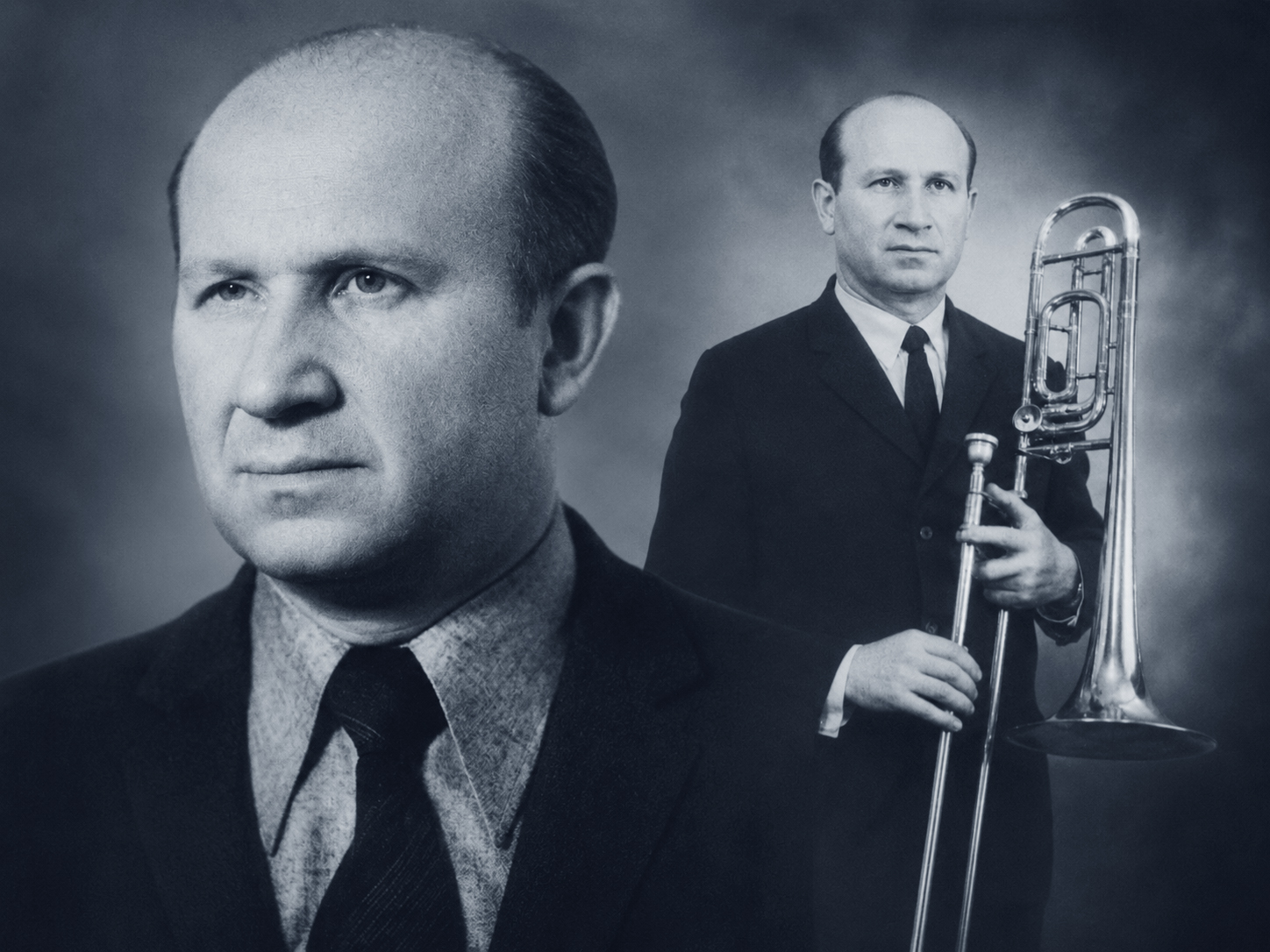
Viktor Venglowski

Musician and Teacher

Viktor Venglowski

The most important name in trombone circles in the Soviet Union at present is that of the Leningrad trombonist Viktor Fyodorovich Venglovskiy.

As a highly gifted musician and a tireless worker he is making a great contribution to popularising and perfecting trombone playing.

I was fortunate enough to study with Viktor Fyodorovich and teach under him for two years at the Leningrad Conservatoire where he has taught since 1963 and where I saw for myself what a busy musical life he leads and how much effort he devotes to his beloved art.

Although a soloist in one of the world's finest orchestras — the Leningrad Philharmonic Symphony Orchestra, holder of an RSFSR award — since 1950, he does not confine his playing to this. Every year he gives several solo concerts at which he always plays new works, some receiving their first performance in this country. He has provided the initiative for many new works for trombone which have an established place in the Soviet musicians' repertoire.

Seeing great importance in widening the trombone repertoire and keeping it up to date, he not only uses the best foreign pieces but also maintains a tireless search for new material, from classical foreign, Russian and Soviet sources, suitable for arrangement.

He has made the following arrangements for trombone and piano: Grieg, Elegy; Rachmaninov, Elegy; J.S. Bach, Siciliana; Handel, Gigue; Vivaldi, Concerto for 2 Violins and Orchestra, first movement; Shostakovich, Three Preludes and the Romance from the film The Gadfly.

Also, for brass quintet: Tchaikovsky, Elegy; Shostakovich, Prelude and Fugue and Prelude. It is no coincidence that Venglovskiy should write brass quintet arrangements, as he has for several years been a permanent member of a splendid quintet (with V. Malkov, Y. Bol'shiyanov, V. Buyanovskiy and V. Galuzin) which has given interesting concerts in various Leningrad halls.

As well as playing in the quintet, Venglovskiy is also the leader of an excellent and busy trombone quartet, playing works by Beethoven, Bozza, Dondeyne, Serocki, Tomasi, Falla, Kladnitskiy, Boyarskiy and Okunev. The last three of these composers wrote their pieces specially for this quartet, whose skill can be heard to advantage on two recent recordings.

This account of Venglovskiy’s musical activities is all the more impressive if one adds radio and television recordings as well as discs, of which he has now made eight. It would be impossible to list all the composers whose works Venglovskiy has played, they are so numerous.

Some works have been specially written for this outstanding musician, and dedicated to him: the Concertino by Uspenskiy, the Scherzo and Adagio by Okunev, and pieces by Buyanovskiy, Angelov, Yel'cheva, etc.

In addition to his heavy commitments as a performer Venglovskiy is also involved, as a professor at the Leningrad Conservatoire, in passing on his wealth of experience to young people. His achievements in teaching are just as great as in playing.

This is confirmed by the success enjoyed by his students, of whom there have been many over a quarter of a century. Four of his former students work at the Bolshoi Theatre in Moscow: A. Skobelev, who was also the winner of the Geneva international competition in 1973; A. Morozov, V. Golikov and V. Pachkayev.

At the Kirov Opera and Ballet Theatre in Leningrad: N. Novikov, V. Maslov, A. Shutov and N. Timofeyev; R. Krasner at the Malyy Opera and Ballet Theatre in Leningrad; Y. Bryndin at the Kiev Opera and Ballet Theatre; S. Ivanov at the Minsk Bolshoi Opera and Ballet Theatre, etc.

Many of Venglovskiy’s former students also now teach, passing on their teacher's wealth of experience. Amongst these are A. Skobelev at the Moscow Conservatoire, T. Adamavichus at the Lithuanian State Conservatoire, the present author at the Odessa State Conservatoire, etc.

Venglovskiy's success as a performer and teacher is due to his selfless and enthusiastic devotion to his instrument, which he communicates to his students, and the object of his efforts is thus bound to prosper and develop.

A modest and responsive person, he is always ready, despite his heavy workload, to answer any question and help anyone he can. This can be seen from the many contacts he has at home and abroad and from the high esteem in which he is held by the people with whom he maintains these contacts.

This, then, is a brief and incomplete portrait of a great musician and teacher, the international competition prizewinner, Professor Viktor Venglovskiy, a model of selfless devotion to art.

Brass Bulletin 34, II / 1981 pagine 23–26

Tutti i contenuti sono protetti dal diritto d’autore © Brass Bulletin 1981–2026

Condividi questo articolo

Facebook LinkedIn
Loading…

Domande e risposte

Come funziona l’edizione digitale

Che cosa comprende l’edizione digitale?

L’edizione digitale riunisce gli articoli già digitalizzati sotto forma di testi leggibili e ricercabili online — non semplicemente come scansioni o file PDF — insieme alle illustrazioni originali, alle note, agli autori, alle informazioni sul numero della rivista e alle traduzioni disponibili. I suggerimenti di articoli correlati comprendono attualmente solo questo materiale digitalizzato.

Gli articoli digitali sono identici agli originali?

Conserviamo il più fedelmente possibile il testo originale, la lingua, le illustrazioni, le didascalie, le note e il contesto editoriale. La presentazione viene adattata per una lettura confortevole online e gli evidenti errori di trascrizione o scansione possono essere corretti. Il contenuto e il carattere dell’articolo pubblicato rimangono invariati.

Quali lingue sono disponibili?

Brass Bulletin è stato pubblicato in inglese, francese e tedesco nel corso di tutta la sua storia. Le traduzioni italiane e spagnole sono state aggiunte a partire dal numero 60. Sui siti italiano e spagnolo, gli articoli dei numeri da 1 a 59 vengono quindi mostrati in inglese per impostazione predefinita.

Con quale frequenza vengono aggiunti nuovi articoli?

Nuovi articoli vengono aggiunti quasi ogni giorno, con circa un numero completo digitalizzato ogni settimana. Il ritmo può variare in base al lavoro di preparazione, elaborazione delle immagini e verifica editoriale necessario.

Perché non tutti gli articoli sono disponibili in formato digitale?

La collezione completa di Brass Bulletin comprende 1.246 articoli pubblicati tra il 1971 e il 2003. L’indice completo è già disponibile online e consente di scoprire tutti gli articoli della collezione, compresi quelli il cui testo integrale non è ancora stato digitalizzato.

La digitalizzazione è iniziata nel febbraio 2026. Ogni articolo viene accuratamente preparato per la lettura online, verificato e collegato al relativo numero, agli autori, agli argomenti e alle illustrazioni. Al ritmo attuale di digitalizzazione, la collezione completa dovrebbe essere disponibile online entro febbraio 2028.

Perché alcuni riferimenti citano articoli che non sono ancora disponibili?

I riferimenti presenti negli articoli originali vengono conservati anche quando il materiale a cui rimandano non è ancora stato digitalizzato. In questo modo si preserva l’integrità storica ed editoriale della rivista. Man mano che nuovi numeri vengono aggiunti all’edizione digitale, un numero crescente di questi riferimenti condurrà ad articoli leggibili online.

Posso suggerire un articolo o segnalare un errore di trascrizione?

Sì. Se desiderate che un determinato articolo venga digitalizzato, oppure se notate un possibile errore di trascrizione o un’informazione mancante, contattateci. I riscontri dei lettori ci aiutano a migliorare l’edizione digitale e a stabilire priorità utili all’interno dell’archivio.

Come posso sostenere Brass Bulletin?

Il vostro sostegno contribuisce a finanziare la preparazione, la verifica e la pubblicazione online dell’intera collezione.

Abbonati all’Edizione digitale

Preferite sostenerci senza abbonarvi?

Fate una donazione

Come procede la digitalizzazione?

Stiamo rendendo Brass Bulletin disponibile online gradualmente, articolo per articolo. Potete leggere gli articoli appena digitalizzati non appena sono pronti, anche prima che un intero numero sia completato.

Consultate il nostro calendario di digitalizzazione per scoprire le ultime aggiunte e le date di disponibilità stimate dei prossimi numeri. Le stime si basano sul nostro ritmo recente e possono cambiare.

Cerca in Brass Bulletin.