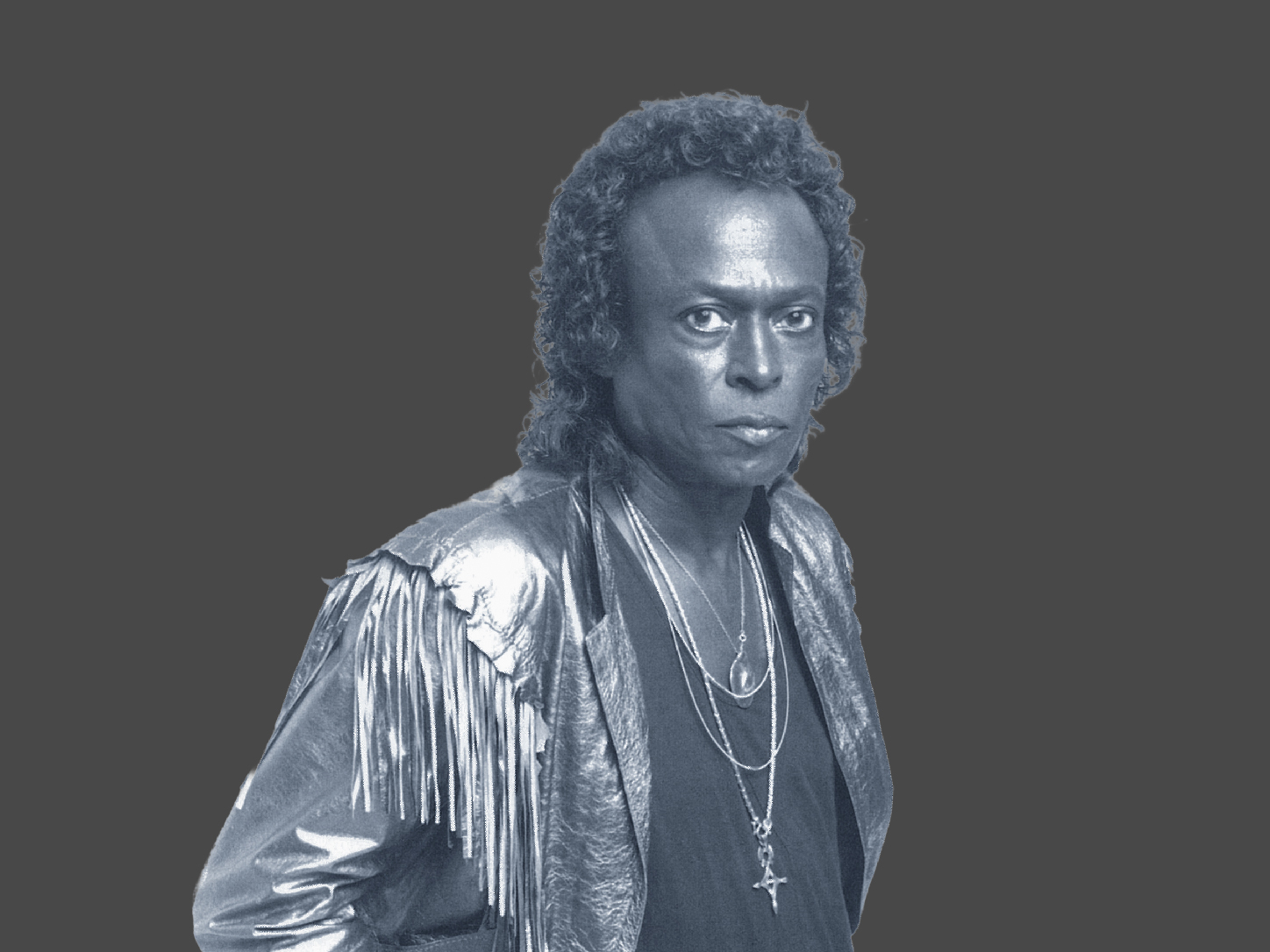
I felt she could have any God damn thing she wanted. I hate hospitals, and all those sorry-ass nurses. My mother was 90 pounds when she died, Bob. I could pick her up like a baby. It was scary. Damn! That cancer is a bitch, man. How do people get that shit I wonder?
I told him I thought one way some people got it was from a lifetime of poor diet, eating too much meat laced with chemicals and hormones. A lifetime of never really cleaning the colon properly could lead to colon cancer, for instance. Allowing meat, which has no roughage, to accumulate on the walls of the colon and putrefy. Another reason I believe people get cancer is from stress. What they feel about themselves, the hates and hurts they might be carrying around with them, can eat away at them and lead to tumors.
Miles looked at me long and hard and said,
You a crazy motherfucker, Bob. I ain’t never heard no shit like that. You smart too. Don’t get me wrong. But shit, that is some powerful information, and a little scary... ’cause I hate and resent a lot of motherfuckers. You think I could catch that shit?
The greens were beginning to boil and the conversation shifted back to cooking. Miles was trying to remember exactly what his mother put in her greens that made them so good. He grabbed a soul food cookbook and glanced through it. Nothing. He asked me if Barbara were home. I told him she was at traffic school all day.
“Damn”, he said, “there’s something missing in these motherfuckers. I know it, Bob! Who do you know that can cook greens?”
I told him the only person I knew for sure was my own mother.
“Where is she?” Miles asked. “New Jersey,” I said. “Call her up,” he said. “Fuck it, call her. Here’s the phone!”
When Mile got my mother on the phone, he spoke to her with great respect. I was very pleased, and of course my mother was totally surprised to be speaking with him. He sounded like a little boy speaking to his own mother or grandmother.
After getting the greens squared away to simmer a couple of hours in the pot, Miles wanted to go to the stable to see my horse. Just about this time, a friend of his son’s came over with hot chicken wings and glazed donuts. Miles told me to eat some chicken while he sat down and enjoyed a large glazed donut.
Dad, no, don’t eat that please,” his son pleaded. “Shut the fuck up, I’ll eat what I fuckin’ please.
Miles’ son begged us to eat all the other donuts so Miles wouldn’t eat them. He was a diabetic and sugar was deadly for him. So I had to stuff down this big funky donut with hot chicken wings and a beer.
When we finally left the house, Miles first got into my car before asking,
Would you like to zip up there in the Ferrari?
I sure as hell would! I answered.
Miles asked if I had ever been in a Ferrari. I hadn’t. I wondered aloud if I would fit?
Yea, we’ll get your ass in there somehow, Bob. You ain’t that big, motherfucker.
We drove about a mile to the riding stables.
This car is much faster than my Volvo,
I said. Miles turned slowly and fixed me in a sarcastic gaze.
No shit?
After seeing my horse, Miles wanted to show me his. We drove over Kanan Dume Road to the San Fernando Valley when he realized that we were on the wrong road. He confessed that he couldn’t remember where the horses were because his son usually drove him.
“Fuck it,” he said. “We’ll go back.”
On the trip back to Malibu, he started telling me about his boxing days. Boxing is the most wonderful way to get into condition to do anything, he said. He had trained with some of the best fighters and trainers in the world. After workouts like that, he said playing the horn was a snap.
Once back at his house, I realized that it was about time for me to warm up my horn for the evening concert.
“Bring that thing in,” Miles said. “I want to hear you play a little bit.”
He said he really liked the [French] horn and watched closely as I warmed-up. He said I played like his old trumpet teacher using no lip pressure. As I continued, playing faster and faster figures, Miles yelled out from the kitchen,
Alright, Bob. Don’t get cute now!
By now the greens were ready. Miles placed a plate-full in front of me while I was playing. He said for me to keep playing while he made a phone call.
He called our friend Barbara. I could hear him talking to her about me. He said he thought I was a nice guy, a little strange, but that he thought I was a genius. I was shocked at hearing this.
After he got off the phone, he asked me to play the final horn solo from the Firebird Suite by Stravinsky.
“Why is that solo so hard,” he asked. “Motherfuckers always turn red when they play that. What’s so hard about it?”
I told him it really wasn’t difficult. “Play it,” he said. “Play it!”
As many times as I’ve performed this passage, I never dreamed I’d be playing it for Miles. He was impressed.
“Must be the white boys that turn red, Bob,” he said. “A nigger ain’t never turned no colors except blue.”
Miles then told me that I could practice at his house anytime, even if he’s out of town. I guess we had hit it off.
After this initial meeting, I would see Miles from time to time when he was in town. Sometimes Barbara and I would just walk into his house, greet Miles and go straight out the back door to the beach. We could eat at his house, watch his giant TV and leave after a few hours.
There were also times when Miles would ask us to come over, but he wouldn’t spend any time with us at all. We had the run of the house, and he might be on the phone or practicing all the while we were there. When we were ready to leave, he’d come out of his room and say, “Nice having you.” He didn’t need to sit and visit with you to enjoy your company.
My impression of Miles changed totally after meeting him. He told me once he liked being by himself. he was “just doing his thing, and why in hell couldn’t people do the same and leave him the fuck alone?” he said.
He could become eloquently angry discussing how he felt the black man was the foundation for all black people. The black man has intelligence, strength and musical feeling grounded to earth, he said. That’s why everyone is trying to steal black music, he said. It’s powerful, he emphasized, like the black man.
Miles anger ran very very deep. He saw almost everything happening in his surroundings. He perceived it more readily and absorbed it more thoroughly than most people.
Miles loved his audience on his own terms. He knew also that some of the same people who flocked to his concerts would have snuffed him out like a candle if they had the opportunity. They would have ripped off his talent, watered it down, and replaced him with the Elvis Presley of bebop.
But he had moved far beyond bebop, leaving so many hardcore fans of his straight-ahead playing behind. He had to change, evolve, reach for something new.
Once when Barbara and I were looking at some of his new paintings, we came across on in a style he didn’t use any longer. Barbara asked him why he didn’t paint in that style any more. He threw his head back, strutted across the room and announced: “I’m too hip for that now. I can’t go back to that style.”
Bob Watt
Bob Watt is assistant principal horn of the Los Angeles Philharmonic. He studied horn with Harry Shapiro at the New England Conservatory in Boston. While he was there he debuted as a soloist with the Boston Pops Orchestra under the baton of Arthur Fiedler, playing the 2nd Horn Concerto of Richard Strauss. He continued studies with James Stagliano and Gunther Schuller at the Berkshire Music Center at Tanglewood. Before his engagement with the L.A. Philharmonic, he played as a soloist several times with this orchestra, conducted by Zubin Mehta. Today Bob Watt continues his activities as a soloist, performing frequently during summer at European festivals. He dedicates his leisure time to dressage and classical equestrian ballet. He teaches horn at Santa Monica College, the University of Southern California and at California State-Dominguez Hills.