Explore institutional access Explore institutional access
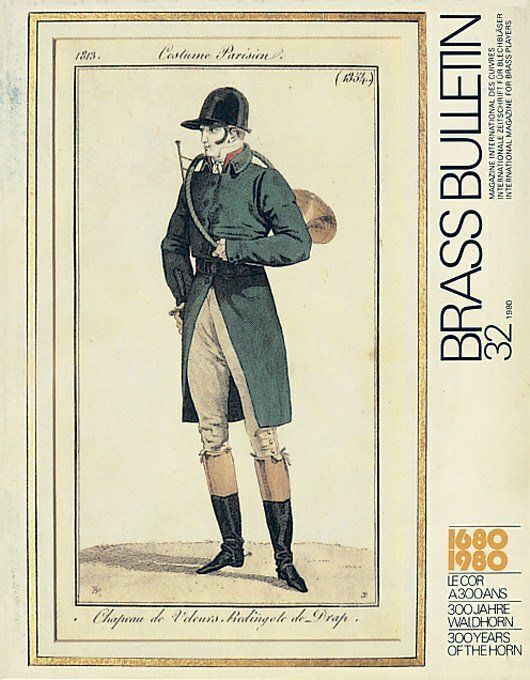
Brass Bulletin 32 - 4 / 1980
Issue
Brass Bulletin No. 32
Date
IV / 1980
Pages
100
Contents
8 articles

This issue is still available in print.

English / French / German

CHF 15.00
All issues

Brass Bulletin No. 32

IV / 1980

Contents

8 articles

Editorial

Progress by Stages

Jean-Pierre Mathez

pp. 4–5 Teaching Health

Between technical routine and lived experience, musical growth emerges through setbacks, observation and the gradual shaping of an individual voice.

300 Years of the Horn

Part 2 – End

in the Dresden Court Orchestra

Peter Damm

pp. 19–41 Horn History Equipment

From Dresden’s court musicians to Hampel’s hand-horn technique, virtuoso players and court repertoire shaped a decisive shift in horn playing and orchestral writing.

Henri Renart (1887-1979)

Interview

Robert Coutet

pp. 43–51 Tuba Encounters Professional life

Henri Renart looks back on a remarkable musical life, from the wind bands of northern France to Paris’s leading orchestras, performing under renowned conductors while witnessing decades of change in performance, recording, teaching, and brass playing.

Basics in breathing

An Outline to a Better Sound

Joel Elias

pp. 53–58 Technique Teaching

From breathing awareness to sound production, practical exercises link physical relaxation, air control and rhythmic precision in everyday brass playing.

A study of musical intonation

Part 1

Christopher Leuba

pp. 59–74 Acoustics Teaching

Resultant tones, harmonic series ratios and chord spacing challenge equal temperament, linking acoustics and practical ensemble intonation.

Brass studies in Australia

David O'Meara

pp. 75–78 Report Teaching

As international performers, seminars and teachers reached Australia in the late 1970s, a geographically isolated brass scene began finding its own direction.

Serious Music this Side of the Ghetto

Rolf Urs Ringger

pp. 79–83 Repertoire Society

Between Darmstadt serialism and neo-tonality, the place of serious music in society is questioned through Berg, Schönberg and the post-war avant-garde.

Practical Hints

Part 3

James Stamp

pp. 84 Technique Teaching

A preparatory adaptation of a Clarke technical study reframes finger technique, airflow, and efficiency through a progressive approach to daily practice.

Loading…

Questions & Answers

How the Digital Edition works

What does the Digital Edition include?

The Digital Edition brings together the articles already digitized as searchable online texts—not simply as scans or PDF files—along with their original illustrations, notes, authorship, issue information, and available translations. Related-article suggestions currently include only this digitized material.

Are the digital articles identical to the originals?

We preserve the original text, language, illustrations, captions, footnotes, and editorial context as faithfully as possible. The presentation is adapted for comfortable online reading, and obvious transcription or scanning errors may be corrected. The substance and character of the published article remain unchanged.

Which languages are available?

Brass Bulletin was published in English, French, and German throughout its history. Italian and Spanish translations were added from issue No. 60 onward.

On the Italian and Spanish sites, articles from issues 1–59 are therefore shown in English by default.

How often are new articles added?

New articles are added almost daily, with approximately one complete issue digitized each week. The pace may vary depending on the preparation, image work, and editorial checking required.

Why aren’t all articles available digitally?

The complete Brass Bulletin collection contains 1,246 articles published between 1971 and 2003. The full index is already available online, allowing readers to discover every article in the collection, including those whose complete text has not yet been digitized.

Digitization began in February 2026. Each article is carefully prepared for online reading, checked, and connected to its issue, authors, subjects, and illustrations. At the current pace of digitization, the complete collection is expected to be available online by February 2028.

Why do some references mention articles that are not available yet?

References in the original articles are preserved even when the material they point to has not yet been digitized. This keeps the historical and editorial record intact. As more issues are added to the Digital Edition, an increasing number of these references will lead to articles that can be read online.

Can I suggest an article or report a transcription error?

Yes. If there is an article you would particularly like to see digitized, or if you notice a possible transcription error or missing detail, please contact us. Reader feedback helps us improve the Digital Edition and prioritize useful connections within the archive.

How can I support Brass Bulletin?

Your support helps fund the preparation, verification, and online publication of the complete collection.

Subscribe to the Digital Edition

Prefer to support us without subscribing?

Make a donation

Search Brass Bulletin.