Explore institutional access Explore institutional access

2 min. read

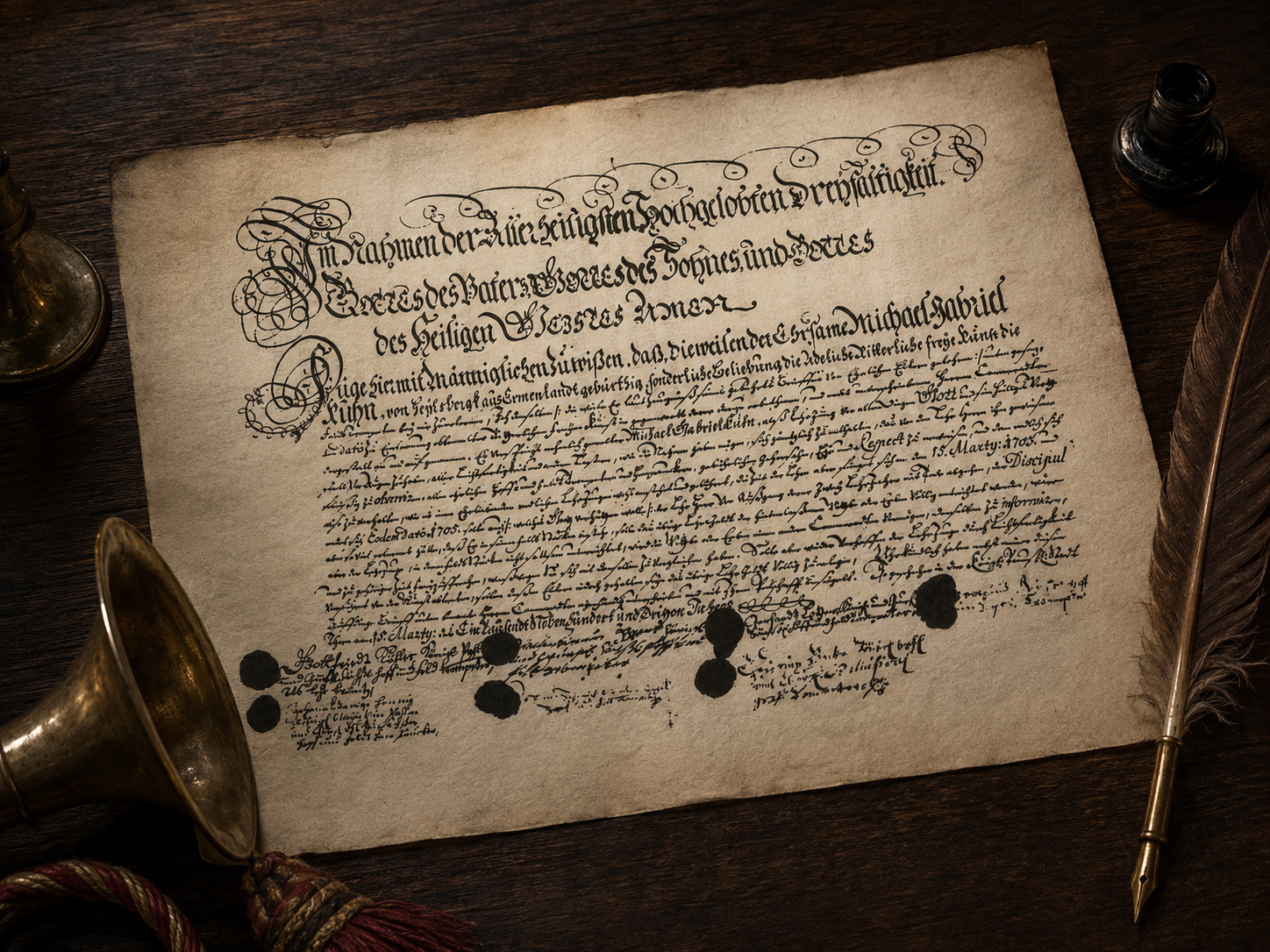
Contract of apprenticeship as Field-trumpeter 1703

Contract of apprenticeship as Field-trumpeter 1703

« IN THE NAME OF THE MOST HOLY AND PRAISED TRINITY, OF THE FATHER, THE SON AND THE HOLY GHOST. AMEN. »

» Be it made known to the public that the honourable Michael Gabriel Kuhn from Heylsbergk in Ermenlandt, who desires me to initiate him into the noble and free Art of Fieldtrumpeter and whose birth certificate testifies that he was born from honest parents, has been accepted by me as a pupil of the above noble art, in presence of the Companions who were asked to witness and sign this document.

» The named Michael Gabriel Kuhn promises to keep in mind primarily the Lord and His Holy Word, to refrain from wantonness and other vices whatever their name may be, to be a diligent pupil to his teachers, to show due respect and obedience to all honest court- and field-trumpeters and army-drummers and lastly to behave in a proper manner as befits an honour loving apprentice.

» The time of apprenticeship begins on March 15, 1703 and ends on the same date 1705. Should the teacher die in the course of these two years - which God forbid - and the apprentice not be sufficiently instructed in all things military, then the widow or the heirs will appoint another teacher to continue the education and come to an agreement with him.

» Should however - against all hope - the apprentice be tempted by wantonness to renounce the Art, then the parents will nevertheless have to pay the full amount for apprenticeship.

This document, which serves as a contract, has been signed and sealed by myself and the under named Companions. Thus done in the Royal Prussian Town of Thorn on March 15 of the year one thousand seven hundred and three. »
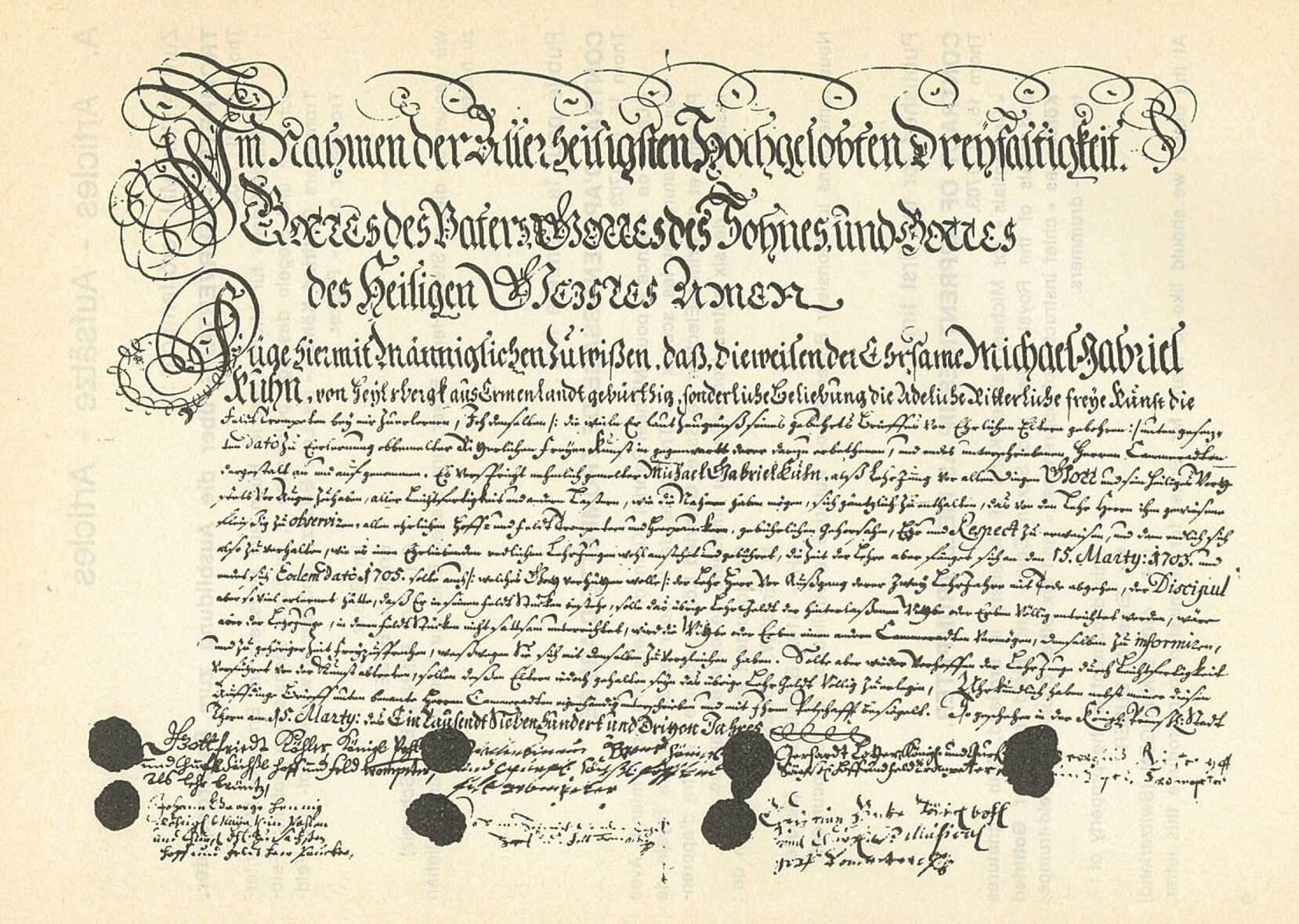
Thorn 15. Ill. 1703. « Credentials » for Michael Gabriel Kuhn of Heilsberg in Ermland. With signatures and seals of the...
Thorn 15. Ill. 1703. « Credentials » for Michael Gabriel Kuhn of Heilsberg in Ermland. With signatures and seals of the Royal Polish and Saxon Court- and Field-Trumpeter Gottfried Kôhler, as « chief instructor of apprentices » and six other court- and field-trumpeters and - drummers.

(Signatures):

Gottfriedt Köhler, Königl. Polnischer und Churftl. Sächs. Hoff- und Feld-Trompeter, als Lehr Brünz
Johann George Hennig, Königl. Mayr in Pohlen und Churftl. H. zu Sachsen Hoff- und Feldt Heer Paucker
Vallentinus Brand, Königl. und Churftl. Sächs. Hoff- und Feld Trompeter
Johann Heinrich Lindenbrecher, Hoff- und Feld Trompeter
Gerhardt Lotter, Königl. und Churftl. Sächs. Hoff- und Feld Trompeter
Georgius Richter, Hoff- und Feldt Trompeter
Christian Breke, Königl. Poln. und Churftl. Musical Hoff Trompeter

This document is the property of : Mr. Ernst-W. BUSER. CH - 4102 BINNINGEN (Switzerland)
At the outset we should like to thank Mr. Buser for permission to reproduce this letter.

Brass Bulletin 3, II / 1972 pages 9–12

All content is protected by copyright © Brass Bulletin 1972–2026

Share this article

Facebook LinkedIn
Loading…

Questions & Answers

How the Digital Edition works

What does the Digital Edition include?

The Digital Edition brings together the articles already digitized as searchable online texts—not simply as scans or PDF files—along with their original illustrations, notes, authorship, issue information, and available translations. Related-article suggestions currently include only this digitized material.

Are the digital articles identical to the originals?

We preserve the original text, language, illustrations, captions, footnotes, and editorial context as faithfully as possible. The presentation is adapted for comfortable online reading, and obvious transcription or scanning errors may be corrected. The substance and character of the published article remain unchanged.

Which languages are available?

Brass Bulletin was published in English, French, and German throughout its history. Italian and Spanish translations were added from issue No. 60 onward.

On the Italian and Spanish sites, articles from issues 1–59 are therefore shown in English by default.

How often are new articles added?

New articles are added almost daily, with approximately one complete issue digitized each week. The pace may vary depending on the preparation, image work, and editorial checking required.

Why aren’t all articles available digitally?

The complete Brass Bulletin collection contains 1,246 articles published between 1971 and 2003. The full index is already available online, allowing readers to discover every article in the collection, including those whose complete text has not yet been digitized.

Digitization began in February 2026. Each article is carefully prepared for online reading, checked, and connected to its issue, authors, subjects, and illustrations. At the current pace of digitization, the complete collection is expected to be available online by February 2028.

Why do some references mention articles that are not available yet?

References in the original articles are preserved even when the material they point to has not yet been digitized. This keeps the historical and editorial record intact. As more issues are added to the Digital Edition, an increasing number of these references will lead to articles that can be read online.

Can I suggest an article or report a transcription error?

Yes. If there is an article you would particularly like to see digitized, or if you notice a possible transcription error or missing detail, please contact us. Reader feedback helps us improve the Digital Edition and prioritize useful connections within the archive.

How can I support Brass Bulletin?

Your support helps fund the preparation, verification, and online publication of the complete collection.

Subscribe to the Digital Edition

Prefer to support us without subscribing?

Make a donation

Search Brass Bulletin.