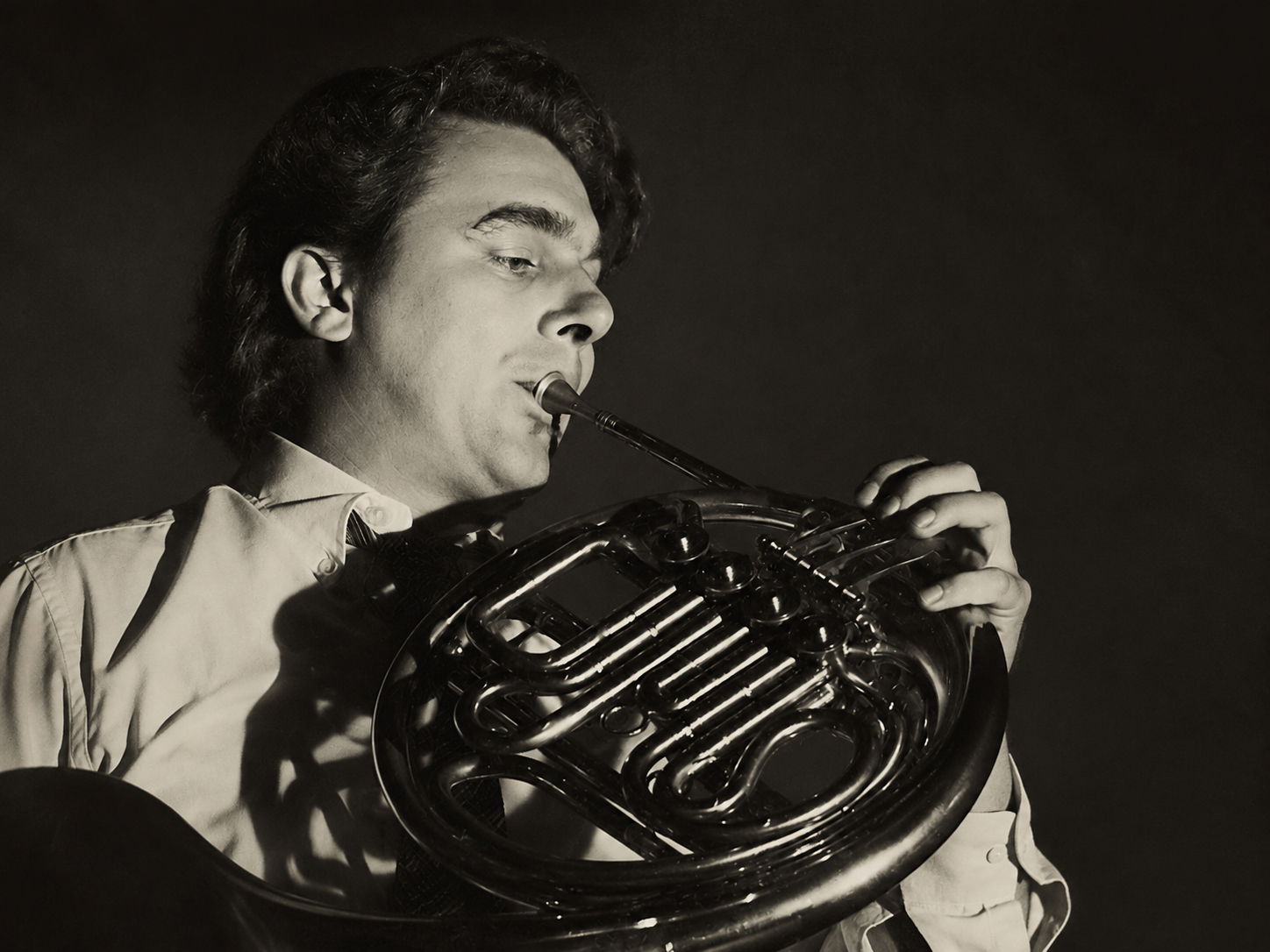
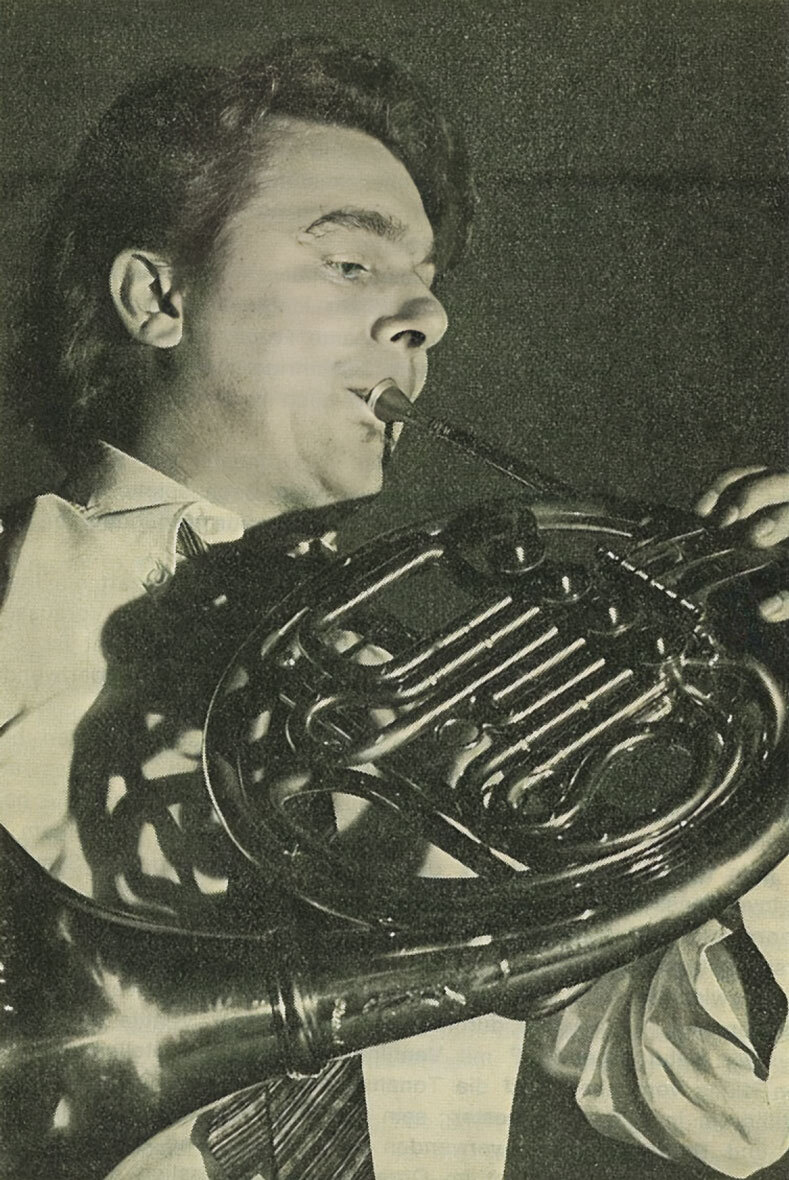
As an orchestral instrument, the horn has had a 300-year tradition, during which period it has often undergone changes. Even today this development has not come to a close. Unlike the 19th century, when the orchestral hornist had only the F horn at his disposal, with which he even — if ever — played Bach, today finds the hornist confronted by a rich selection of horns built according to widely differing principles of construction, even going as far as traditional historical instruments.
Should today's hornist avail himself, then, of a corno da caccia for Bach, an invention horn for Mozart, an F horn for Brahms? I do — but only on the condition that the rest of the ensemble is likewise using historical instruments. Otherwise, the same effect would result as when a carriage of the turn of the century were to be coupled to a modern diesel locomotive...
Only he who has become familiar with historical instruments and has played them as well, gaining knowledge about their tonal volume and timbre, will be able to choose properly the appropriate modern horn. The hornist will learn that the high Bach parts can be more easily realized on a historical natural horn — perhaps this is the only way they can be realized. Let one make the comparison between an invention horn in G, a modern Bb horn, and the F horn for the trio from Mozart's G Minor Symphony, K. 550. The invention horn will sound the best, will be the best in tune, and will have the surest response.
Between 1830 and 1850, the horn reached a crucial turning-point in its development. Through the incorporation of three valves it attained full chromaticism. If we compare natural horns in F with valve horns in F, we find that the valves make the tone darker and hinder the response. C. M. von Weber did not tolerate valve horns in his orchestra; he wrote his Concertino for natural horn. Robert Schumann and Richard Wagner still used natural and valve horns together. After 1850, and into our century, the F horn was used exclusively in the orchestra. The horn group, now swelled to four such instruments, forms the « pedal (range) of the orchestra »; Schumann described it as « the soul of the orchestra ». The dark, mellow tone of the F horn corresponds to a Romantic ideal. But the instrument has also grown more ponderous, more susceptible to cracked notes than its predecessor. It is no longer a virtuoso instrument, for which reason as well no solo literature was written during this period.
At the turn of the century, Richard Strauss above all, but also Gustav Mahler, then Stravinsky, Alban Berg, and others extract highly virtuoso performances from the orchestral hornist. In order to counteract the clumsiness and deficient accuracy of the F horn, horns are built in ever higher pitches. The double horn in F and Bb is developed. The striving for perfection is far-reaching, leading to the use of the single Bb horn, as well as to the banishment of the F horn from the orchestra. In the past 15 years, the F-high F horn and the Bb-high F horn have come to enjoy more and more favor among high hornists.
Which of the horns in use today correspond to historical ones, both in respect to the possibilities of technical execution and to timbre?
Corno da caccia
Baroque composers employed the corno da caccia in pitches from C basse to C alto. The various keys possessed widely differing timbres, since the long, low-pitched horns have a relatively dark sound, the high-pitched ones a very bright, trumpet-like sound. The corno da caccia is built with a very narrow bore, has a small bell, and is played with a shallow mouthpiece with a wide rim.
The high F horns often used for Baroque music are an octave shorter, but quite similar in sound to a corno da caccia in F through their wider bore, bigger bell, valves which influence the tone, and a deeper mouthpiece. Very high parts in F major or higher should be played on the high F horn with a shallow, wide-rimmed mouthpiece, possibly without the hand in the bell. For lower-lying parts (for example, those in D major, or second horn parts), the Bb horn should be chosen; here a Bb-high F horn gives the possibility of having a whole palette of different timbres in one's hand.
Invention horn
The invention horn, which supplanted the corno da caccia about 1750, is already much more similar to our present-day horn. It is played with a deep funnel-shaped mouthpiece with a narrow rim, with the hand introduced into the bell. Here, too, we note the same great differences in tone color between horns in low (Bb basso) and high (C alto) pitches. Here the rule applies of taking a somewhat shorter valve horn than the natural horn originally written for. One thus attains a greater degree of accuracy, together with a sound more or less approximating the original. The F horn proves to be optimal for parts written from Bb basso to Eb, the Bb horn for parts from Db to A; here the ideal is an F-Bb double horn. For the high hornist, the F side of a Bb-high F horn is very valuable for the transpositions G to C alto, as far as accuracy and similarity of sound to the high natural horns is concerned.
F horn
Only the Vienna Philharmonie holds fast to the tradition of playing F horns today. This is possible, since they are opposed to a modernization of some of the other instrumental groups as well, and perform chiefly music of the 19th century. In this respect, they give us an ideal tonal picture of this music.
When today the high hornist reaches only for his Bb-high F horn for reasons of security, he succumbs to the same danger as the F horn player 100 years ago: he makes an absolute norm out of one particular type of construction.
Certain exceptions in Romantic music aside, where a Bb-high F horn is advisable — although it does not blend well with the sound of the horn section (double horns) —, he should return to an F-Bb double horn. I also prefer this horn to the single Bb horn for first-chair players.
Today's conscientious hornist, therefore, is faced with the obligation of being in shape on several horns. Consistent and economical practicing on the various instruments will help him thereby.