Brass Bulletin 19, III / 1977 (page 29–30) · 1 min. read
All content is protected by copyright © Brass Bulletin 1977–2026

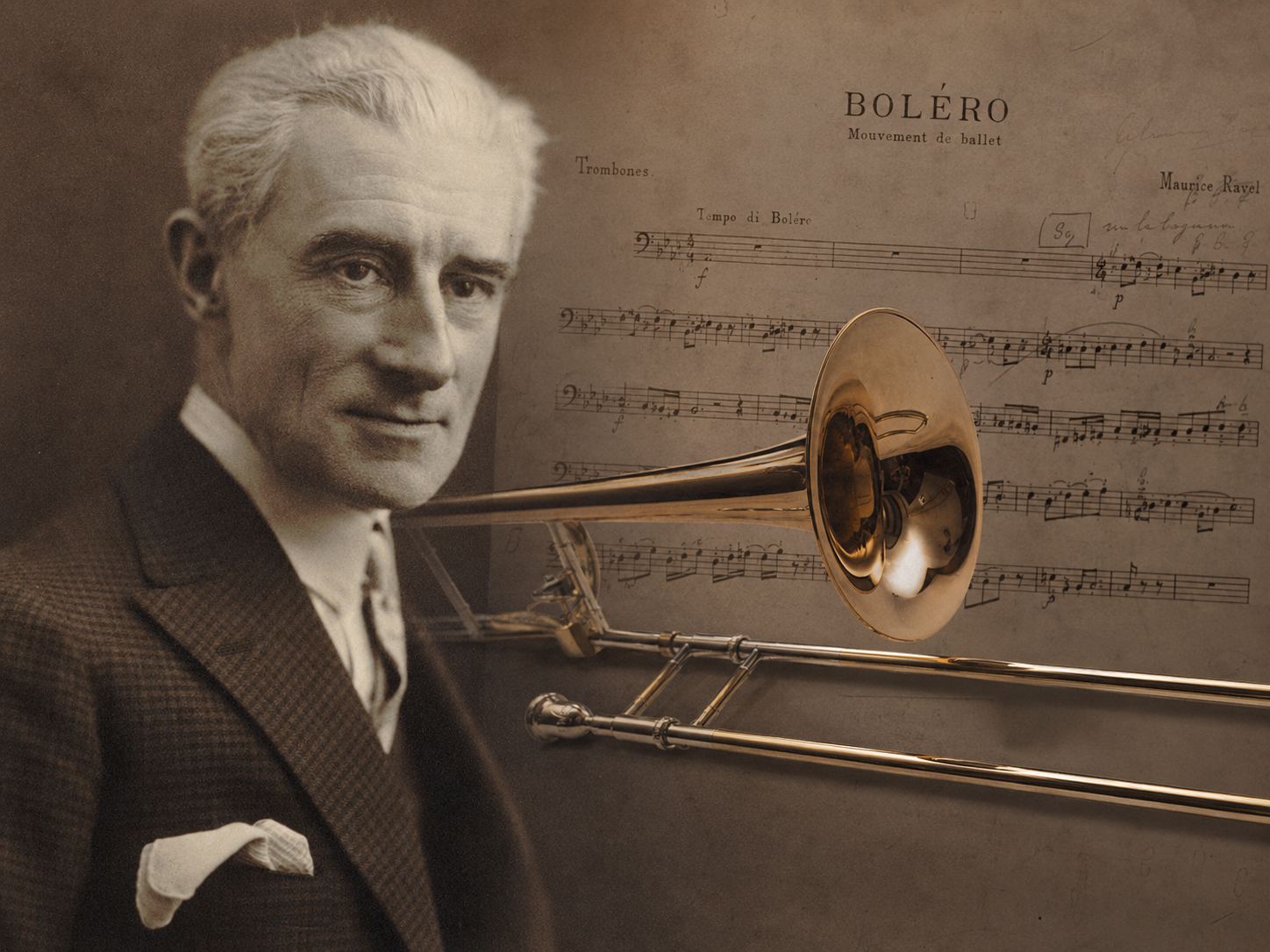
The trombone in Maurice Ravel's Boléro

Part 2 – End

By Jean Douay

Search in this article

In the first part of this article (Brass Bulletin 13) Jean Douay dealt with general aspects of this subject, here he reports on his own personal experiences. Finally he will be talking about the execution of this orchestral solo (Ed.).

Recently I had the opportunity of listening to the recording of Bolero which I had played on a concert tour about ten years ago. While I did this, I became aware of a certain stylistic development and change in sound. Not only is my instrument different, but also the execution of this solo has changed. Through time and experience one grows to maturity. This is also true here, especially when you have to play this piece frequently, on foreign tours or in France under the direction of various conductors, each with his own interpretation of the work. I played my first Bolero during a gala concert at the ceremonial opening of a concert hall in front of numerous music critics and distinguished personalities. Therefore it was a question of holding one's own against the most demanding reviewers. On that day I was successful in carrying it off. Nevertheless a bitter taste was left in my mouth: the memory of the worst stage fright of my career.

Bolero was on the program of my first concert tour with the Orchestre National as first trombonist. According to the effect the news of this had on me, I was able to ascertain that there was a great danger of being afraid of playing this solo every time it came around. Accordingly I had to choose: either I accepted this post with all its risks and duties and subjected myself to the corresponding psychological and artistic preparation involved (see part 3 of this article in a coming issue), or I relinquished it... You know what I decided to do... Luckily I have, in the meantime, gotten over this fear. I was especially glad of this when we had to play Bolero with Leonard Bernstein. He had intended to play the piece as an encore. But because he didn't like it particularly, he assured us before every concert that it wouldn't be played. Under the pressure of the successful performance and the wishes of the audience he first of all hesitated and then finally announced it to the delight of the audience. Such situations are difficult for the trombonist, especially when the concert has already been so demanding, and you have already given your best. In a few minutes you have to get all your power of concentration together again. Bernstein's direction is pleasantly comforting for the performers: his bearing does not betray any tension, one even has the impression that the progression of the orchestral playing releases him. He allows the Bolero to develop with the orchestra, as opposed to Paul Paray whose main interest is the tempo which he forces on everyone. It is «his» Bolero, in his hands the orchestra is only a tool.

Other conductors, for example Jean Martinon, beat a very comfortable tempo, between the extremes of Pierre Dervaux and Paul Paray. Jean Martinon really knew how to impose a rhythmic unit on everybody, which was especially convenient for the trombonist because he is the last one to make his appearance (after the Eb clarinet, the bassoon and the saxophone). A central conception of the work is necessary if one intends to attain a synthesis of sound balance and a musical uniformity. If the trombone solo wasn't at the end of the piece, then the problem would probably be different.

The responsibility of the solo trombone is very large in this piece. If it is played successfully then the whole orchestra shares in it — but the opposite is also true.

Series in this article

The trombone in Maurice Ravel's Bolero

Part 1
Subscriber access
Part 2 – End — Currently reading
Free access

Share this article

Loading…