Explore institutional access Explore institutional access
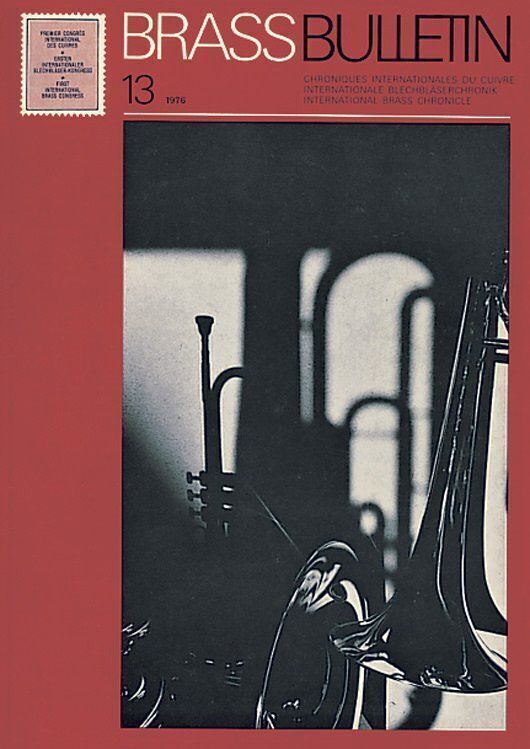
Brass Bulletin 13 - 1 / 1976
Issue
Brass Bulletin No. 13
Date
I / 1976
Pages
148
Contents
9 articles

Out of print

All issues

Brass Bulletin No. 13

I / 1976

Contents

9 articles

Editorial

Jean-Pierre Mathez

pp. 2–3

1976: Brass Bulletin transforms. A4 format, three languages side by side — and already readers in 41 countries. A real turning point.

Jean-Baptiste Arban (1825-1889) Biography

Part 5

The Arban-Cornet

Jean-Pierre Mathez

pp. 11–14 Cornet à pistons History

At 55, Jean-Baptiste Arban sets out to reinvent the cornet and impose it on conservatories. A relentless quest for perfection… ending in failure.

A scientific study of pulmonary function

As applied to wind instrument playing, with emphasis on the study of lung function in trumpet playing

William W. Bing

pp. 15–26 Health

Do trumpet players breathe differently? William W. Bing shows not really—except for greater lung capacity tied to endurance, with no harmful effects.

The tuba in France

Fernand Lelong, Robert Coutet

pp. 26–35 Tuba History Equipment

How did the tuba emerge as an orchestral force? Fernand Lelong and Robert Coutet trace its path—from serpent to Sax—and its rapid rise.

Low register development for the trombone

James Fulkerson

pp. 35–43 Trombone Technique

Should you really drop the jaw for low notes? James Fulkerson challenges this idea and proposes a more stable approach to extend the low register.

Collective improvisation in instrumental classes with different instruments

Roland Böckle

pp. 43–52 Teaching

What if learning an instrument meant more than playing pieces? Roland Böckle promotes collective improvisation to develop listening, taste, and creativity.

My new developed descant double horn

Theo Westhof

pp. 52–55 Horn Equipment

Why does the ideal horn not exist? Theo Westhof designs a new descant double horn to solve tuning and tone issues—without compromise.

Piston or rotary valve system?

Robert Ischer

pp. 55–58 Equipment

Pistons or rotary valves: which system is superior? Simplicity and silence vs mechanical complexity—an ongoing debate among brass players.

The trombone in Maurice Ravel's Bolero

Part 1

Jean Douay

pp. 59–62 Trombone Repertoire Technique

How should Boléro’s trombone solo be played? After 100 performances, Jean Douay challenges conventions and argues for a more supple, controlled approach.

Loading…

Questions & Answers

How the Digital Edition works

What does the Digital Edition include?

The Digital Edition brings together the articles already digitized as searchable online texts—not simply as scans or PDF files—along with their original illustrations, notes, authorship, issue information, and available translations. Related-article suggestions currently include only this digitized material.

Are the digital articles identical to the originals?

We preserve the original text, language, illustrations, captions, footnotes, and editorial context as faithfully as possible. The presentation is adapted for comfortable online reading, and obvious transcription or scanning errors may be corrected. The substance and character of the published article remain unchanged.

Which languages are available?

Brass Bulletin was published in English, French, and German throughout its history. Italian and Spanish translations were added from issue No. 60 onward.

On the Italian and Spanish sites, articles from issues 1–59 are therefore shown in English by default.

How often are new articles added?

New articles are added almost daily, with approximately one complete issue digitized each week. The pace may vary depending on the preparation, image work, and editorial checking required.

Why aren’t all articles available digitally?

The complete Brass Bulletin collection contains 1,246 articles published between 1971 and 2003. The full index is already available online, allowing readers to discover every article in the collection, including those whose complete text has not yet been digitized.

Digitization began in February 2026. Each article is carefully prepared for online reading, checked, and connected to its issue, authors, subjects, and illustrations. At the current pace of digitization, the complete collection is expected to be available online by February 2028.

Why do some references mention articles that are not available yet?

References in the original articles are preserved even when the material they point to has not yet been digitized. This keeps the historical and editorial record intact. As more issues are added to the Digital Edition, an increasing number of these references will lead to articles that can be read online.

Can I suggest an article or report a transcription error?

Yes. If there is an article you would particularly like to see digitized, or if you notice a possible transcription error or missing detail, please contact us. Reader feedback helps us improve the Digital Edition and prioritize useful connections within the archive.

How can I support Brass Bulletin?

Your support helps fund the preparation, verification, and online publication of the complete collection.

Subscribe to the Digital Edition

Prefer to support us without subscribing?

Make a donation

Search Brass Bulletin.