5 min de lectura
Jazz and the Horn
John Clark
Por Jeffrey Agrell
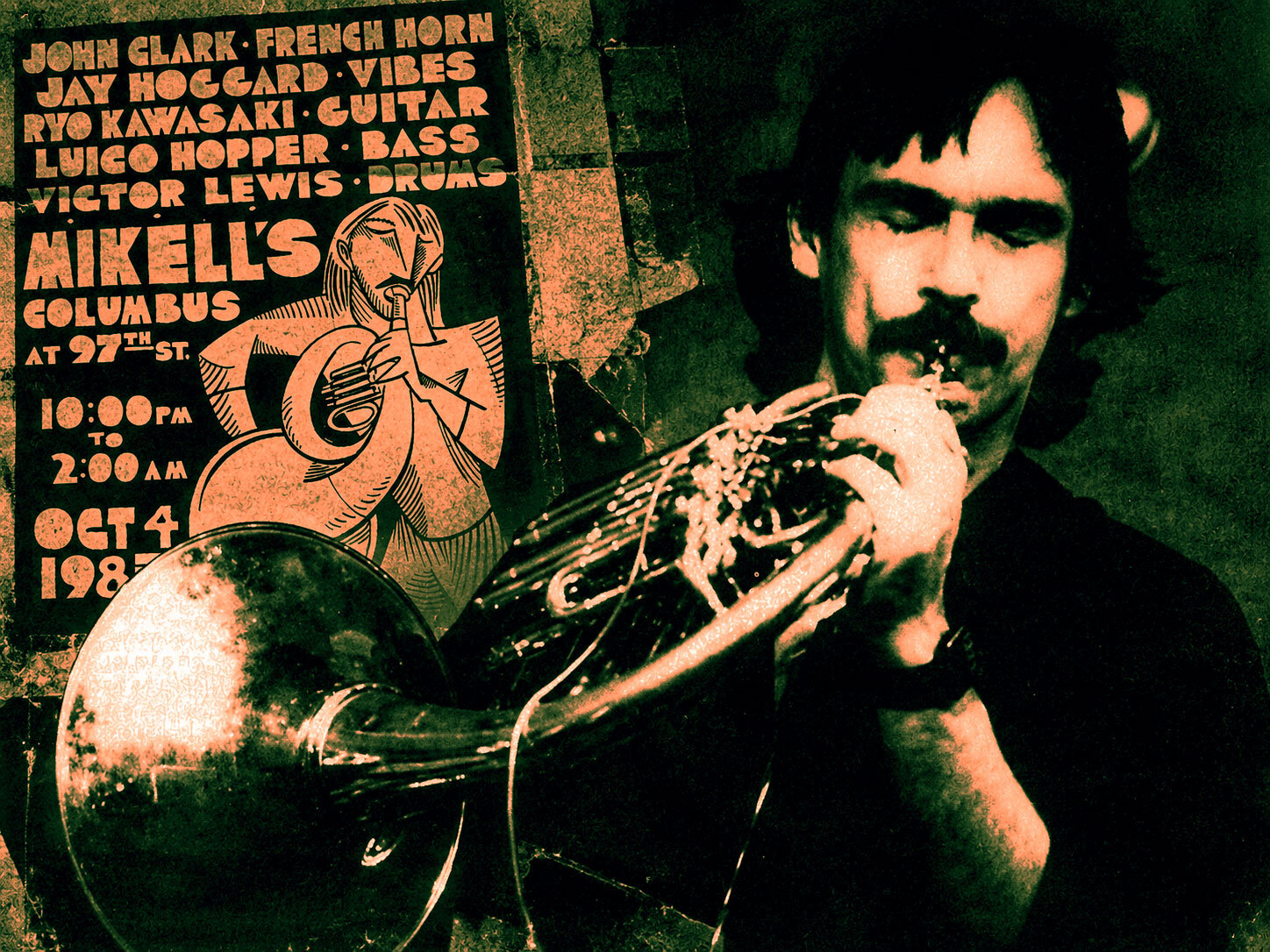
John Clark
New York jazz horn player John Clark has been a musician for 33 of his 40 years. In the last thirteen years he has concentrated on playing jazz, and is now considered the best horn player in jazz, and certainly the best known since Julius Watkins. He obtained mention in the Downbeat Critic’s Polls of 1979, 1980 and 1981, and was a winner in 1982, no mean feat for a player whose instrument is not even considered a jazz instrument by most people.
Clark began his music making early: piano at seven, trumpet at nine, horn at ten, and guitar at fifteen. Most of his performing during his teens was in school bands and rock bands on trumpet and guitar. He played both horn and guitar during his four college years at the University of Rochester, where he studied horn with Verne Reynolds. He performed with many groups, but his interest in jazz was only in its beginning stages.
After college he spent four years in the Coast Guard Band in Connecticut, studying horn with Yale’s Paul Ingraham. Then, after a summer at the Tanglewood Music Festival, he entered a Masters Degree program at the New England Conservatory in Boston, with the intention of some day becoming a professional orchestral player.
His experiences at NEC however led him to work for a completely different goal. Although Clark was doing a fair amount of classical playing, he was now in an environment where he could hear, play, and study jazz constantly. “We used to have jam sessions all night long, every night. After about a year of this I sort of drifted away from playing classical music and realized that improvising was what I wanted to do.” Studies with and support from Gunther Schuller, George Russell, Ran Blake, and Jaki Byard were also important in his decision to pursue a career as a jazz musician.
How did he learn to improvise?
“Besides studying George’s theory [George Russell’s ‘Lydian Chromatic Concept’], I would take private lessons with Jaki. I would learn tunes, listen a lot, transcribe and memorize solos, learn patterns in all keys. I used to practice a lot in those days. Sometimes I would spend 4, 5, 6 hours in a practice room — I would play horn a while, play piano a while, go back and forth. I never was too conscious of the fact that the french horn was a difficult instrument to play. No teacher even told me it wasn’t possible to play jazz on the horn, so I just played... I still believe that most everything that can be played on the trumpet can be played on the horn... it’s just a little harder.”
Following graduation from the conservatory, Clark worked as a freelancer in the Boston area for a year. It was not until he moved to New York that he was able to establish himself as jazz horn player. Within a short time he was working in the big bands of Gil Evans, Carla Bley, and others, including Leroy Jenkins’ Mixed Quintet. And besides classical freelancing and Broadway shows, he gradually worked his way into the relatively small elite group of musicians who do all the studio work.
Continue reading
Accede a la edición digital completa.
Brass Bulletin 52, IV / 1985 páginas 61–65
Todo el contenido está protegido por derechos de autor © Brass Bulletin 1985–2026