1. Intervals, Scales, Finger Dexterity Drills and Melodic Studies
The staples in our training material, as they presently exist, are woefully inadequate as preparatory work for performing much of the music of today. Our present study books use as a basis the intervals of major and minor thirds, perfect fifths and octaves, major, minor, and chromatic scales, and similar chord studies.
However, composers of New Music generally go to great lengths to avoid such things. Intervals such as perfect fourths, tritones, the larger over-octave ninths, elevenths, etc., and tone rows are used extensively, and they can be extremely problematic when used in rapid passages. The performer must develop an ability to handle these musical situations with the same ease he is expected to display in the music of earlier periods.
For instance, a melodic passage based on these new fundamentals should be performed with the same musicality and phrasing one would show in a more traditional work. (Examples 1 and 2.)


II. Rhythms
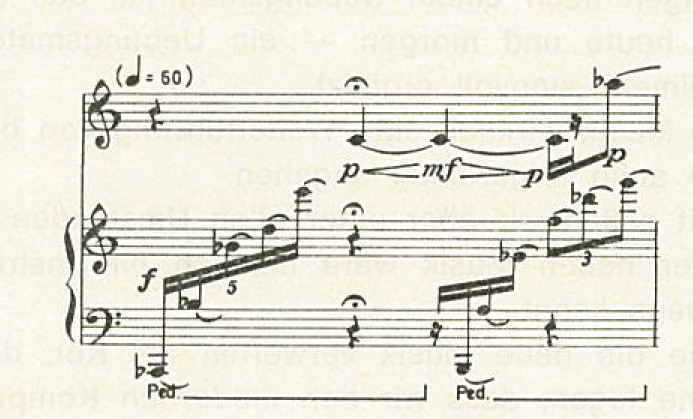
As a general rule, rhythms must be executed with the utmost precision and accuracy, from the simple quarter-note in 4/4 time to the most complex rhythmic configurations. Quintuplets (see Fig. 1) or septuplets (Fig. 2), for example, should not be approximate, nor should they be thought of as 2 + 3, 3 + 2, or 4 + 3, 3 + 4, but as either five or seven equal notes, unless specifically notated as being otherwise. The reason for such painful accuracy is because, in many modern works, the composer will have many different rhythmic figures occurring simultaneously, and the intended effect will not take place if any one note is not in its proper place. To further illustrate this point, I have chosen three examples from Iain Hamilton's Five Scenes for Trumpet and Piano. (Examples 3, 4 and 5.) In example three, the trumpet must play an exact eighth note on the second half of the last beat, which would fall between the second and third eighth-note triplets of the piano.

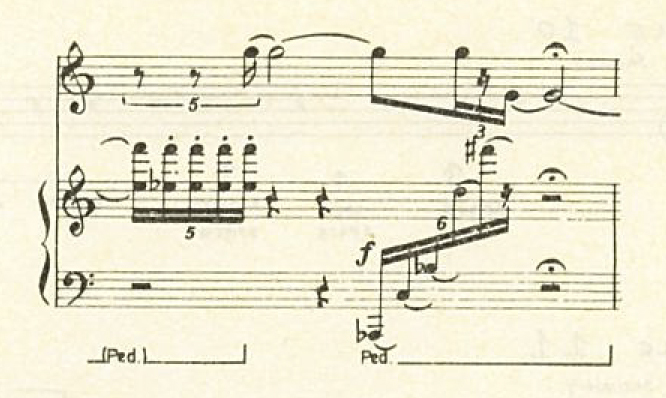
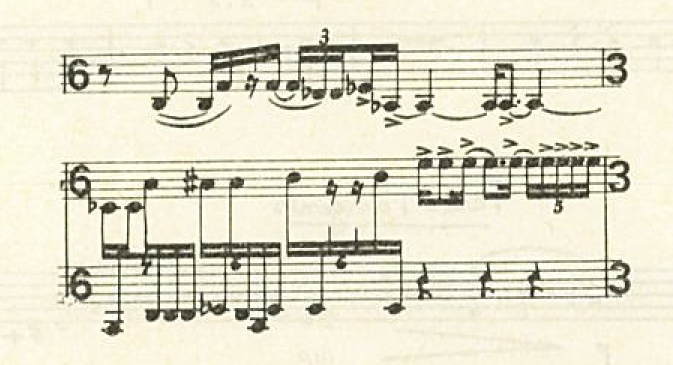
In example four, the trumpet must play exactly the fifth quintuplet sixteenth in order to coordinate with the piano which executes all five on the first beat of the measure. On the fourth beat the trumpet plays an eighth note followed by the first and third of sixteenth triplets against piano sextuplet sixteenths. If both these rhythms are performed accurately the result would be six even notes on that beat (Fig. 3).
In example five, both performers play independently, but again, if they are accurate rhythmically, the result will be a coordinated sixteenth triplet on the first half of the third beat succeeded by an independent second half of same.
It is interesting here to note the composer chose to publish the work in score form to enable the players to more easily understand the relationships of the two solo parts; however, one would hope that if the participants displayed the kind of rhythmic accuracy I have discussed here they probably could play most of the work just as successfully from individual parts.
Further, with regard to rhythmic figures, a significant modification in notation has evolved in many composers' works. In the interest of clarity, the intended figure is followed by the figure it is in place of, and these two figures are separated by a colon. For example, a sixteenth-note quintuplet on the first beat of a 4/4 measure would be notated thusly (Fig. 4). In other words, five sixteenths in the place of the usual four. In 6/8 time, quintuplets might be written as (Fig. 5), or five eighths in place of six. In 3/4 time, as another example, quintuplet quarters would be written as (Fig. 6), or five quarters in place of three, and so on. I once saw the notation (Fig. 7): seven sixteenths in place of four, and I believed the composer to be in error since it would have been more logical to have notated it as (Fig. 8), or seven thirty-second notes in place of eight.
Ill. Meters
The use of what have been called « odd » meters by some has become commonplace in New Music. (3/8, 7/16, 9/16, 7/32, 3½/4, etc.) Furthermore, we find in many instances rapidly changing meters which are made even more difficult to execute because of abrupt tempo changes, or accompanying accelerandi or diminuendi, not to mention note difficulty or dynamics.
Again, as in the case of rhythmic figures, complete accuracy is the rule. For example, even the basic 4/4 meter should be just that, with its inherent strong and weak beat relationships, and the same would naturally be the case of all other meters if the desired effect is to take place, not only in the case of changing meters, but also in cases of superimposed meters. An elementary example of the latter would be the first movement of the Hindemith Trumpet Sonata (1939), where we find 12/8 used against 4/4.
Many performers believe that the use of complex meters needlessly complicates matters of performance. They assert that the same effects could be accomplished by using accents and note groupings, as Bela Bartók did, for example, in his string quartets, or as Kent Kennan used in his Sonata for Trumpet and Piano. (195?) Examples 6 and 7 represent two notations of the same material.

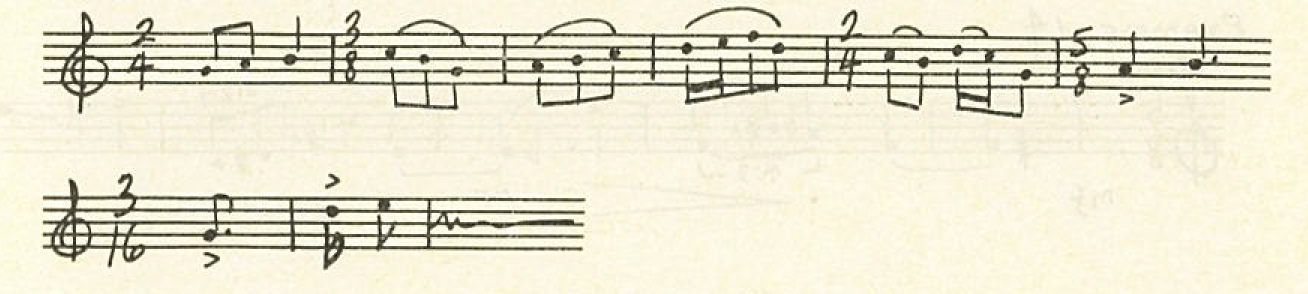
Many of today's composers not only prefer using complex and/or changing meters for reasons of rhythmic accuracy, but many will go to great lengths to write in the smallest denominations of the same (Fig. 9). This may appear frivolous to some; however, there are composers who point out that, other musical reasons notwithstanding, this approach assures a certain amount of tension will always exist in a work since the performers will never feel that comfortable with it. Examples 8 and 9 are two brief examples which illustrate this point further. Example 9, representing smaller denominations (3×) of the preceding example, seems to me more difficult to perceive. Of course, I'm certain that one could achieve a similar effect by writing in extremely large denominations.


IV. Aleatory Techniques
Often times new works will have explanatory notes accompanying the music which describe the composer's wishes vis-à-vis the execution of certain notation, symbols, diagrams, and the like. Since this approach usually involves the notation concepts of individual composers, or indeed might refer to particular individual compositions, an attempt to catalogue many of them here would be superfluous. However, certain new notation procedures have become standard and I will discuss one very important and significant area.
Aleatory (chance) music or effects can be written any number of ways. The space = time concept is one very frequently utilized. (Example 10) Basically, the space = time concept means the placement of notes is relative to the space existing between them; hence example 10, if notated in a more conventional manner, might sound approximately as in the case of example 11. Another example, this time a melodic passage, is example 12. This example (12) could sound as, but would not be limited to sounding as, examples 13 and 14.
Examples 10 and 12 display an inherent weakness of certain types of chance notation. Since there is no time limitation, the performer could take all day to play the passage because only the relativity of note placement is required. For this reason, certain composers will add the dimension of overall timing, i.e.: the time, usually expressed in minutes or seconds, the passage should take. For instance, examples 10 and 12 with suggested durations of six and eight seconds respectively. (Examples 15 and 16.)







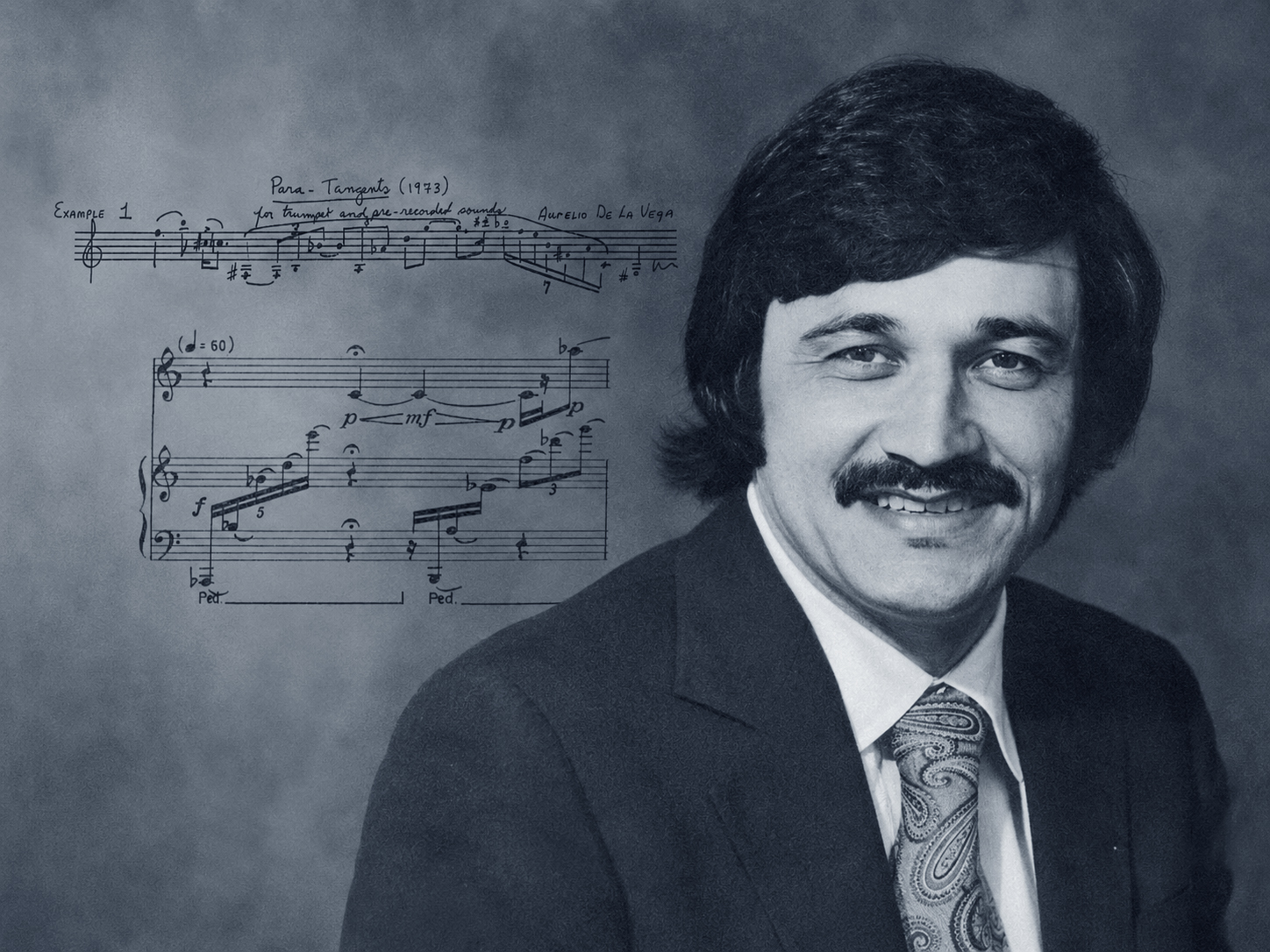
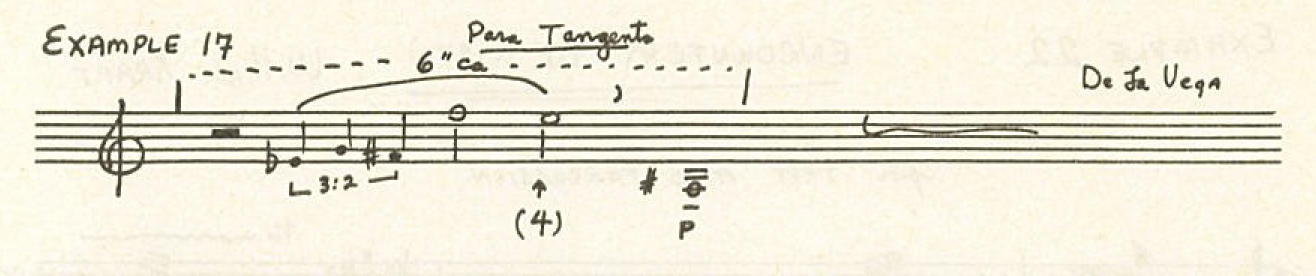
Developing this concept a step further is the case of example 17. The total elapsed time is approximately six seconds. The conventional-type notation used determines the note values as being relative to each other. For instance, the half notes and the half rest are equal, the quarter-note triplets equal one third of a half, the whole note is twice the duration of the halves, and so on. In addition, a composer could also show the approximate « second » placement by suggesting that the performer arrive at the « E » at about the fourth second (parenthesis). One might question De La Vega's notation in example 17 because it could have been written in 6/2 meter, as in the case of example 18.
However, when the phrase is seen in the total context of the work the original notation is more consistent with the rest of the composition. This does not preclude the performer from « thinking » in 6/2, which brings up a performance technique which some players prefer to use in chance music. Because of the approximate nature of aleatoric music, some prefer to « think » in conventional notation whenever possible because they feel more comfortable in that idiom. Others might prefer the exact opposite approach.
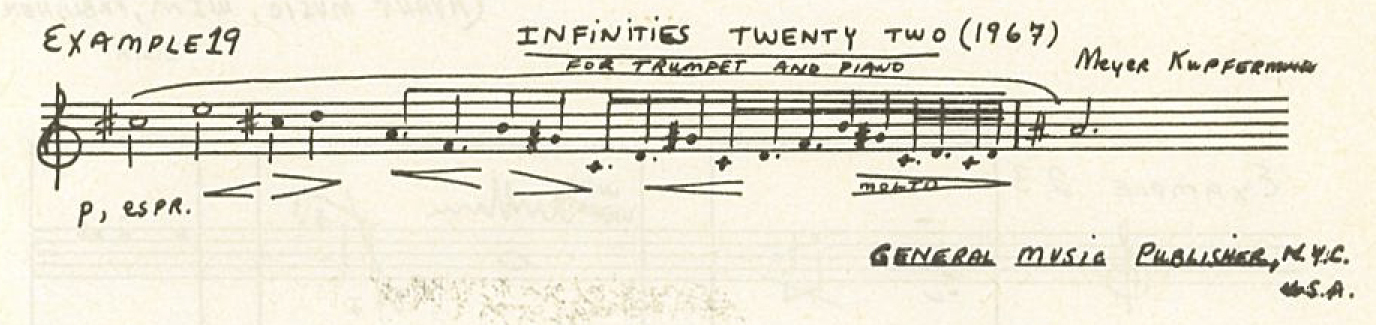
Example 19 illustrates this point. Certain performers might think of the above in space = time notation because it would be easier to play, as in example 20. This is not the time or place to discuss the propriety of performers « thinking » in different notation than is written, but it is a common practice and it should be at least mentioned here.


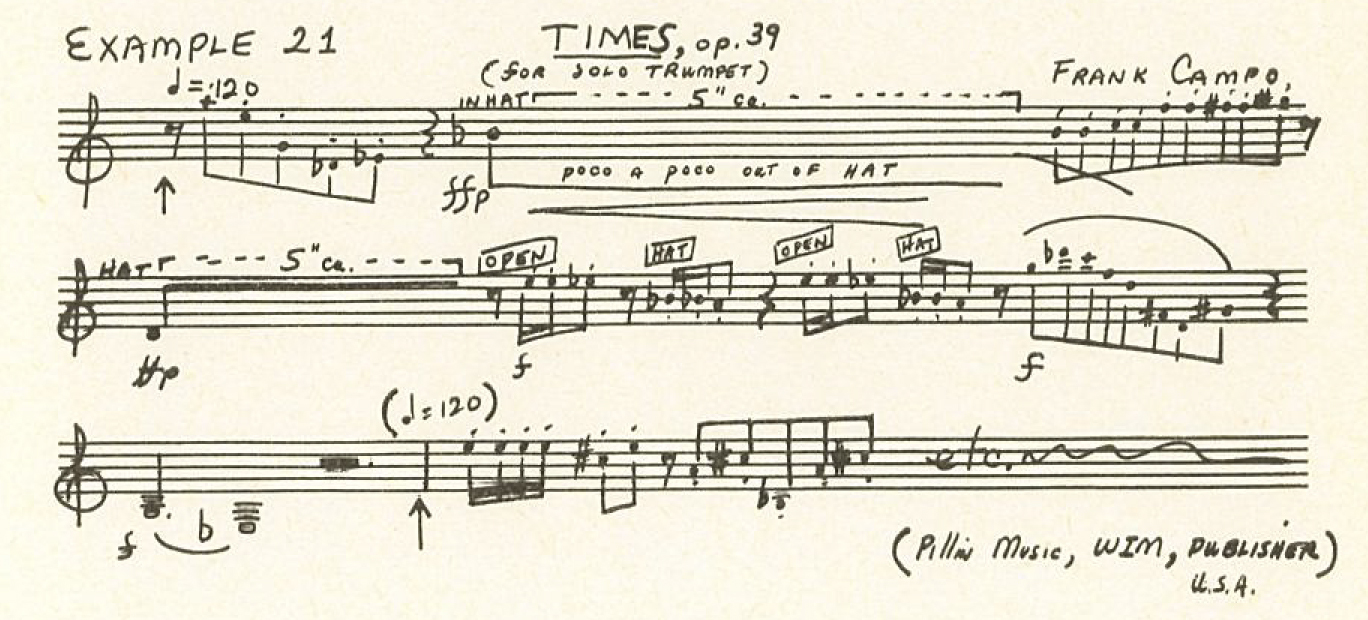
Other composers prefer to intersperse space = time with conventional notation in their works, to wit, example 21. Here we play in conventional 4/4 at ♩ = 120. We then perform the aleatory section; then return to the conventional time, matching the tempo which existed prior to the chance section.
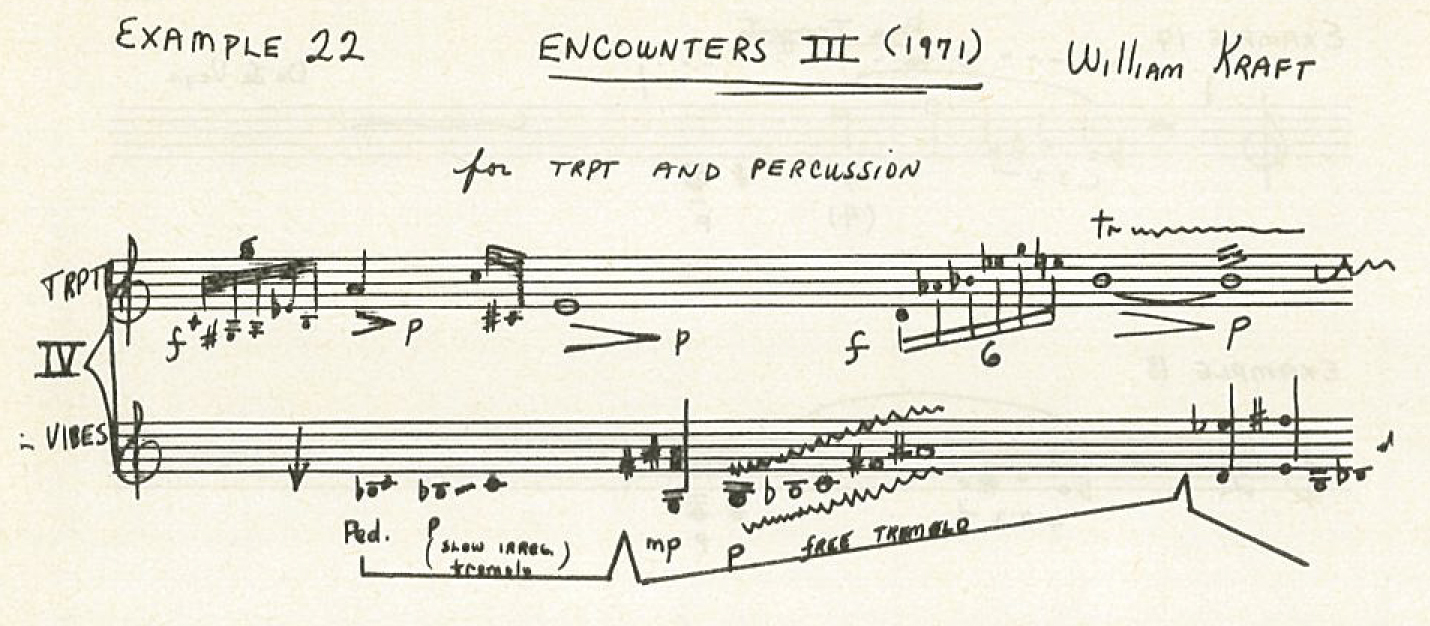
Finally, aleatory techniques can be employed to show the relationships of different voices in a composition, as in example 22. This music, written in score form, finds the performers executing their individual parts in relationship to each other, i.e.: the first entrance of the vibraphone is after the trumpet « A », and the trumpet again plays after the vibraphone « Bb - C » tremolo, and so on.
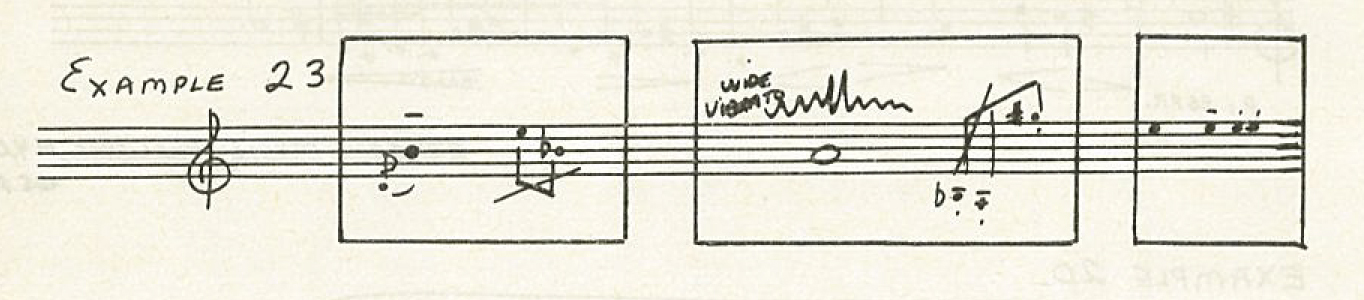
One positive aspect of aleatoric music is that the music will vary from one performance to another, and due to its improvisatory nature, the performer is given more of an opportunity to project his own personality into the music than he would have in the more traditional forms. On the other hand, a negative side to all of this is the problem created by recordings. There really should be no definitive performance of a work which includes a significant amount of aleatoric material. However, quite often, a recording is accepted as being just that. Many of today's performers, notably younger players, use recordings as their principal means of learning compositions, in many instances copying them to extremes by repeating every phrase and nuance of the recording artist. This should be avoided, especially in music containing chance elements, if for no other reason than fairness to the composer. There exists a yet to be published work for the solo trumpet which serves as an extreme example of this kind of situation. The soloist is given thirty-four musical « events », each containing chance elements, the delineation of events by means of boxes, as in example 23. The performer may play the events in any order he so desires. He may further determine not to play any or all of them; however, the composer admonishes the player to think about the material in performance and to make his decisions at that time. Needless to say, if someone recorded the work and omitted many of the events, and if other players used his recording as an example, the world might never hear a good portion of the work.
Aleatory music represents an interesting dichotomy. On one hand, because of the approximate nature of the music, a performer can more easily « get through » a piece by « faking and fiddling » along. On the other hand, if a player sincerely attempts to make the work « come off », it can be much more difficult to accomplish than would be the case in a more conventional piece. Indeed, a new dimension of virtuosity is needed if one is to perform works which require such techniques as using « clock » time, creating melodic lines from random pitches, playing quarter-tones at a time when many performers and/or their instruments aren't accurate enough in « conventional » intonation, and so on.
V. Special Effects
Most performers familiar with New Music are acquainted with the myriad of special effects that can exist in new compositions, some of which seem to be of questionable artistic merit. Blowing air through the instrument, buzzing on the mouthpiece, making the sound by slapping the palm against the mouthpiece, and hitting the bell with the mouthpiece are some that come to mind. As a general rule these situations should be dealt with individually as they arise.
Other so-called special effects are simply more advanced forms of conventional techniques. Extreme changes in the bell direction can be a valid effect since it can change the tonal color of the instrument, and most players should practice this technique since it can upset the stability of the embouchure. Extremely rapid mute changes can also be a problem. I believe there is a need for a type of mute stand or rack which would hold the different mutes, thus permitting the trumpeter to place the bell over the mute, rather than placing the mute in the bell. This would not only make it easier to accomplish quick mute changes, but would not have a negative effect on the embouchure since both hands would remain in position on the instrument.
VI. Conclusion
I have made an attempt to outline some of the many performance problems of New Music. Admittedly, I have committed the academic sins of over-simplification and exaggeration; however, this is not intended as a treatise, but rather to point out the need for such.
Those performers familiar with New Music, by and large, have experienced a « learn as you play » type of training. But now, as certain basic standard practice norms have evolved, we can address ourselves to the need for study material which will prepare us for the music of today and tomorrow, not to substitute for our present books, but to supplement what we already have. If New Music indeed represents an extension of what has taken place before, then we must approach it accordingly. The one thing we should avoid is the specific training of New Music specialists because, in my opinion, the result would be having performers with a limited knowledge of the musical alphabet, say Q to X, playing the new works. And this, to my way of thinking, is not what it is all about. And for those who think of New Music as being non-musical garbage, I would like to say that, even though older music can be much more gratifying in terms of ego-fulfillment, we really should give today's composers a chance. Only after we have been properly trained for the task, and have given satisfactory performances of new works, should we pass judgment on them. And, from what I have heard, such performances have been very few and far between.
Onward, and Upward, and Forward!
The Author
Mr. Stevens is Co-principal Trumpet with the Los Angeles Philharmonic Orchestra, and a founding member of the Los Angeles Brass Quintet. He has had a considerable amount of experience in New Music, both as a solo performer and as an ensemble musician. He has performed and/or recorded New Music in chamber groups conducted by such distinguished persons as Pierre Boulez, Robert Craft, the late Ingolf Dahl, Lukas Foss, Lawrence Foster, William Kraft, Zubin Mehta, Gerhard Samuel, Igor Stravinsky, and Michael Tilson Thomas.