Explore institutional access Explore institutional access

15 min. read

My Experiences with Colleagues and Pupils

in 50 Years as trumpet player and trumpet teacher

Across five decades, Heinz Burum links trumpet embouchure, mouthpiece design and teaching practice to concrete cases from orchestras, pupils and colleagues.
My Experiences with Colleagues and Pupils

When I finished studying at the State Music College in Cologne in autumn 1929 (my trumpet teacher was Chamber Musician Ludwig Werle) almost all the students from the music college had to earn their living playing in dance halls or cafes.

From Cologne I then moved, with various dance bands and light music orchestras, via Hamburg, Bremen, Hanover, Breslau (now Wrocław in Poland), Düsseldorf, Zürich and St. Moritz in Switzerland, etc. to Berlin. As I wanted to stay in Berlin, I stayed there as a freelance musician.

I always appeared as a soloist in these orchestras and so I had four solos prepared: Carnival of Venice and Napoli by Staigers-Bellstedt, Zigeunerweisen by Sarasate and Csárdás by Monti. Since I had most success with Carnival, it was latterly the only one I played—sometimes three times in an evening.

Among professionals this sort of thing soon gets around and young trumpet players were always coming to me and asking how to get such a good embouchure. With many of these young colleagues I noticed that they were placing the mouthpiece wrongly on the lips and rolling the lips in or out.

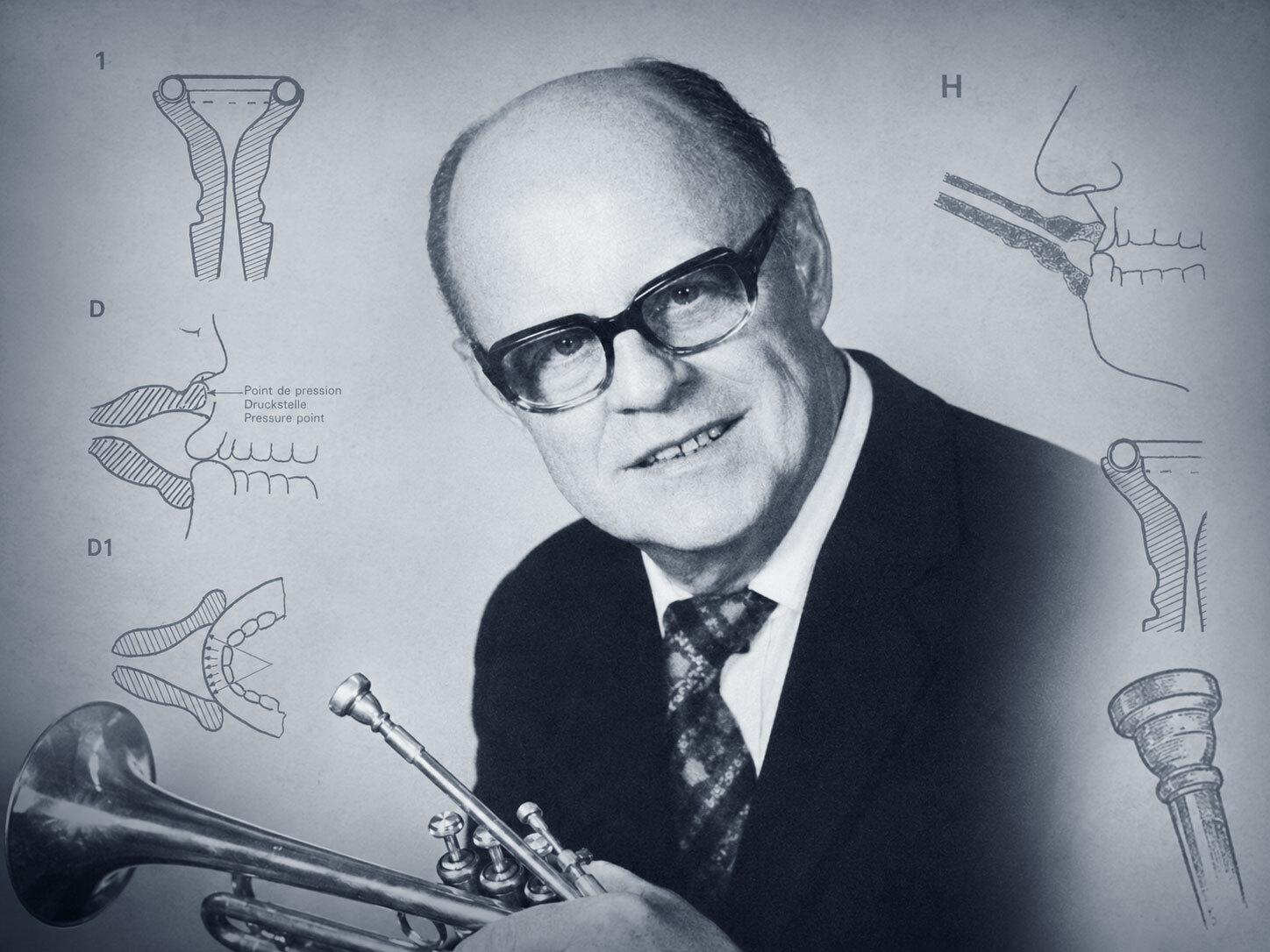
I well remember a case in Hamburg of a young Belgian trumpet player of 19 or 20 who came to me; the build of his jaw was very unsuitable for playing the trumpet (Illustration A) in that his lower jaw lay well back so that he had a receding chin. He played 2nd trumpet in a dance band and was very musical but could reach G above the stave only with great difficulty. He held his instrument pointing downwards like a clarinet. I told him he should get himself a mouthpiece made with the lower half of the rim projecting 4 to 5 mm (Ill. B) so that the lower lip would get a better grip on the mouthpiece. About two years later I met him again in Bremen and he told me he could play much better with the mouthpiece I had recommended. He was playing 1st trumpet in a seven-piece band.

Another colleague in Hanover had in his youth had an accident to the right-hand side of his lower lip, damaging the muscle which encircles the lips. When he played the right-hand side of the lower lip bulged out like a large red knot. My recommendation (Ill. C) was to have the mouthpiece rim widened at the side so that the lower lip would be restrained.

Continue reading

Access the full Digital Edition.

Brass Bulletin 37, I / 1982 pages 58–67

All content is protected by copyright © Brass Bulletin 1982–2026

Share this article

Facebook LinkedIn
Loading…

Questions & Answers

How the Digital Edition works

What does the Digital Edition include?

The Digital Edition brings together the articles already digitized as searchable online texts—not simply as scans or PDF files—along with their original illustrations, notes, authorship, issue information, and available translations. Related-article suggestions currently include only this digitized material.

Are the digital articles identical to the originals?

We preserve the original text, language, illustrations, captions, footnotes, and editorial context as faithfully as possible. The presentation is adapted for comfortable online reading, and obvious transcription or scanning errors may be corrected. The substance and character of the published article remain unchanged.

Which languages are available?

Brass Bulletin was published in English, French, and German throughout its history. Italian and Spanish translations were added from issue No. 60 onward.

On the Italian and Spanish sites, articles from issues 1–59 are therefore shown in English by default.

How often are new articles added?

New articles are added almost daily, with approximately one complete issue digitized each week. The pace may vary depending on the preparation, image work, and editorial checking required.

Why aren’t all articles available digitally?

The complete Brass Bulletin collection contains 1,246 articles published between 1971 and 2003. The full index is already available online, allowing readers to discover every article in the collection, including those whose complete text has not yet been digitized.

Digitization began in February 2026. Each article is carefully prepared for online reading, checked, and connected to its issue, authors, subjects, and illustrations. At the current pace of digitization, the complete collection is expected to be available online by February 2028.

Why do some references mention articles that are not available yet?

References in the original articles are preserved even when the material they point to has not yet been digitized. This keeps the historical and editorial record intact. As more issues are added to the Digital Edition, an increasing number of these references will lead to articles that can be read online.

Can I suggest an article or report a transcription error?

Yes. If there is an article you would particularly like to see digitized, or if you notice a possible transcription error or missing detail, please contact us. Reader feedback helps us improve the Digital Edition and prioritize useful connections within the archive.

How can I support Brass Bulletin?

Your support helps fund the preparation, verification, and online publication of the complete collection.

Subscribe to the Digital Edition

Prefer to support us without subscribing?

Make a donation

Search Brass Bulletin.