4 min. read
Mouthpiece pressure in Horn Playing
Graduation project in technical method
By Edgar Bürger
Introduction
In the autumn of 1977, when I started to study horn at music college in Augsburg, a number of rumours were circulating about ‘‘miracle horn players’’ (particularly in the United States) who were said to be able to play without any mouthpiece pressure. This refers to the force with which the mouthpiece is pressed against the player’s lips, a force exercised on the instrument by the player’s left arm. My teacher at the time, Georg Schmiedt from Augsburg, always said he could not believe this and that every player needed a certain amount of pressure, at least enough to provide a seal between mouthpiece and lips. My present teacher, Professor Gottfried Langenstein from Würzburg, is of almost exactly the same opinion. It must be said of course that there really are horn players who can lay their instrument down, on a piano for example, and, without touching it with their hands, and thus for all practical purposes without pressure, play top C. (I have heard that Peter Damm from East Germany can do this, for example.) Of course a single note is not an orchestral passage, far less a whole concert. I also feel that a note played like this will neither sound full and round nor be playable in fortissimo. I have consulted the following tutors to see what they had to say about pressure:
- Hermann Neuling: Grosse Hornschule (no information on pressure)
- Oscar Franz: Waldhornschule (no information on pressure)
- Fritz Huth: Schule für Horn (no information on pressure)
- Otakar Tvrdy and Vladimir Kubat: Schule für Waldhorn (no information on pressure)
- Michael Höltzel: Hornschule (Professor Höltzel writes: ‘‘Excessive pressure with the arm should be avoided by using the lip and mouth muscles as well as diaphragm support.’’)
- Philip Farkas: The Art of French-Horn Playing. The Art of Brass Playing. (Professor Farkas is one of the few teachers who has really dealt thoroughly with the problem of pressure in horn playing. To reproduce all his writings on the subject here would be excessive but they may be summed up briefly as follows: ‘‘A certain amount of pressure in playing the horn is unavoidable. It should be kept as low as possible, however, otherwise the player will tire too quickly and the lip muscles may be damaged.’’)
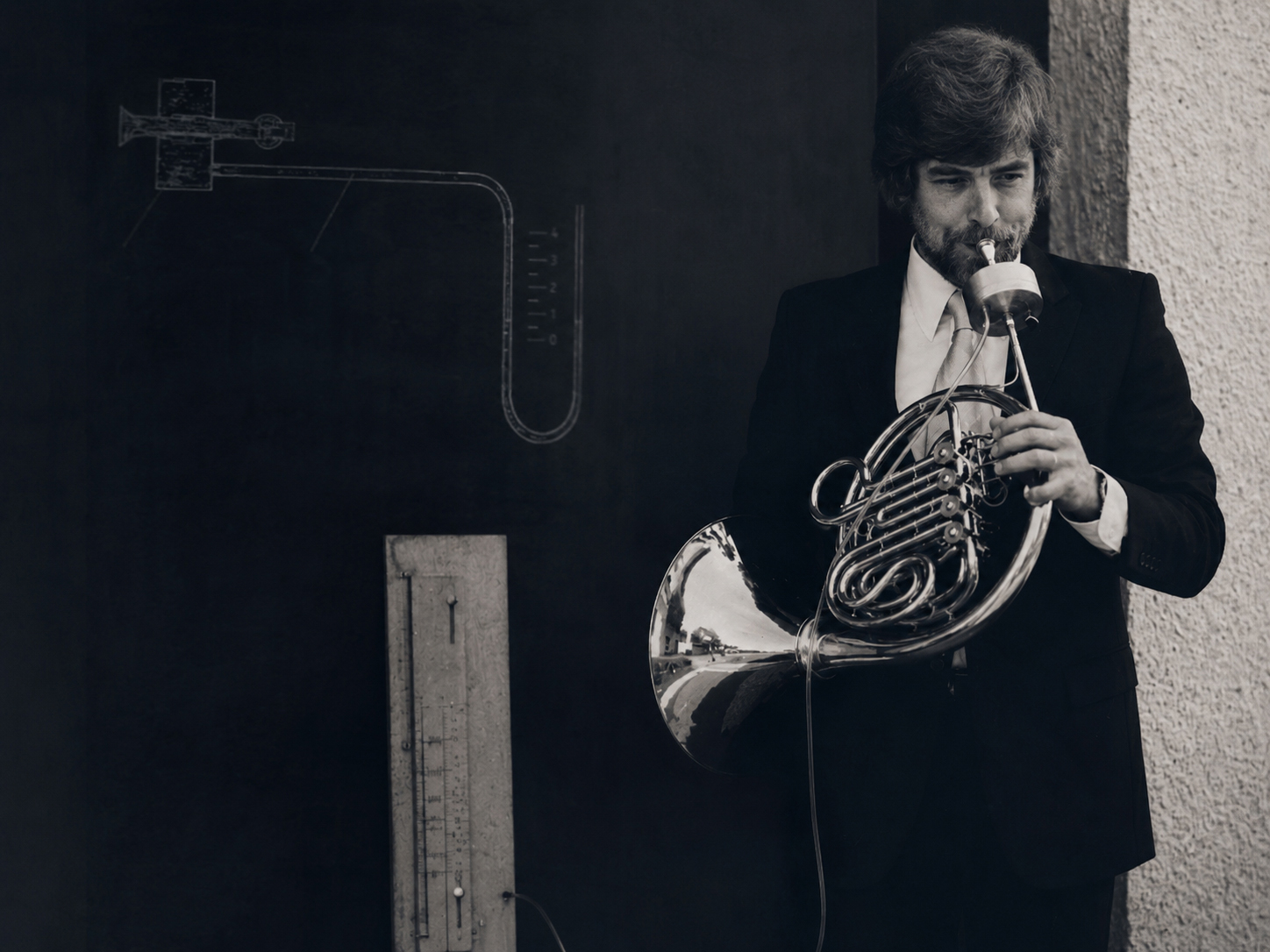
So — much is said and written about this pressure, but what is ‘‘a lot of pressure’’ and what is ‘‘little pressure’’? Ever since I began to study I have been thinking of ways of making this force visible. I recently succeeded in personally developing and building a device which shows fairly accurately (in grammes-force) how much force is used in playing certain pitches, volumes, slurs and staccato exercises on the horn. I then made up a test sheet containing almost the complete compass, the volume levels and several effects of the horn. With my device and my test sheet I then tested a selection of people (teachers, students and beginners) and displayed the results in diagram form. I consulted music colleges in Cologne, Munich and Würzburg. My aim in taking these measurements was to obtain comparative values and so be able to draw inferences about possible effects of excessive or inadequate embouchure pressure.
Brass Bulletin 40, IV / 1982 pages 27–31
All content is protected by copyright © Brass Bulletin 1982–2026