Brass Bulletin 36, IV / 1981 (page 3–6) · 2 min. read
All content is protected by copyright © Brass Bulletin 1981–2026

Editorial

International Competitions - Time, a perishable commodity...

Search in this article

International Competitions

Short-sightedness or Hardening of the Arteries?

Further to the more detailed accounts and observations, appearing in this issue's Separate Newspaper, of the Geneva and Munich competitions (trumpet and trombone respectively) I would like, in this column, to open a debate on the burning issue of these instrumental competitions.

Analysing the results of recent years one starts to wonder whether the juries in these organisations are really capable of detecting and uncovering the great soloists of tomorrow. Do they know what form it should take? By comparison with whom, or with what?

It would seem that some juries have a mental block and have been struck blind! Is not Guy Touvron, one of the most musicianly, artistic, sensitive virtuoso trumpeters of his generation, building for himself a brilliant international career, as he deserves? Neither the Geneva nor the Munich juries have ever been able to perceive this nor credit him with it, never having awarded him more than second prizes. This is particularly true of Geneva where, on two successive occasions, for four years, he was judged "not in keeping with the desired form". Fearing no shame, the organisers finally bowed before the weight of evidence and invited this same unsuccessful candidate to sit on their jury. Exactly the same situation has arisen with Branimir Slokar at Munich. What, then, are the criteria which Guy Touvron and Branimir Slokar must apply in order to award a first prize in such a difficult jury? We would be glad of an answer to this question!

These two examples are not unique. We might mention Bernard Soustrot, not even admitted to the final at Geneva but well on his way to an acknowledged international career. And Michel Becquet, who only got a second prize at Munich and whose career and esteem in professional circles are already making a fool of the people whose job it was to judge him.

In short, however, all this may not be too serious.

With few exceptions international competitions suffer from short-sightedness and these ageing organisations would do well to try and recover some openness of mind, some sensitivity and the courage to take risks if they still wish to act as a catalyst for young soloists' careers.

Brass Bulletin would like to take this enquiry further and asks the following questions:

— Are international competitions still appropriate to our age and genuinely useful in the promotion of young musicians?

— Are these institutions more concerned with their own image and with their prestige? Or, to put it another way: are the candidates the fall-guys?

Those of you — jury members, candidates (successful or otherwise) or organisers — who have some experience in this area, or who have observations to make, or arguments for or against, write to us. The debate — which must above all be constructive — is open.

Time

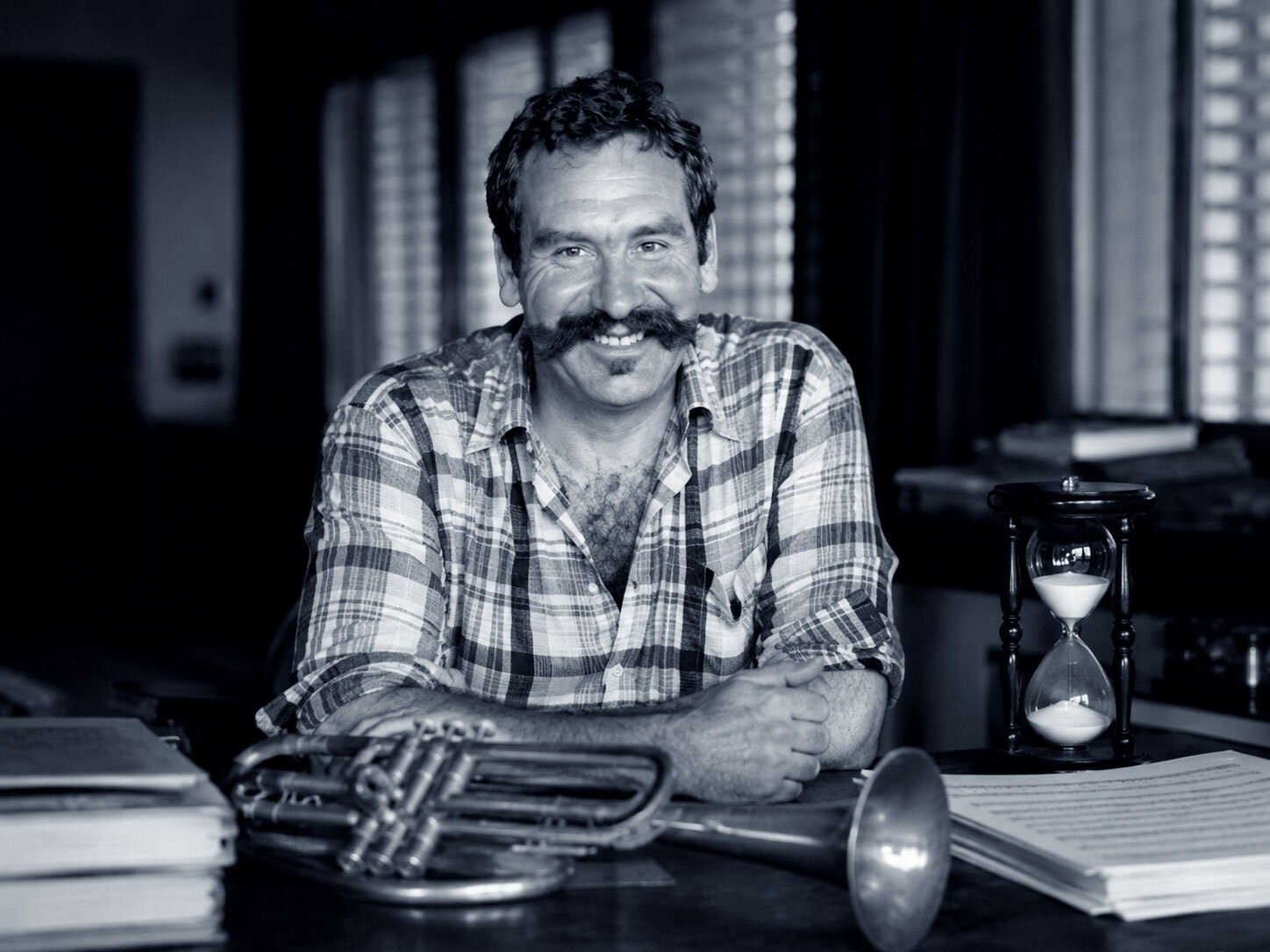
A Perishable Commodity, Vital to the Musician

The classical structures of western music are based on a temporal symbolic system of "beginning-middle-end" which we have no doubt inherited from the bases of the philosophy and beliefs peculiar to our civilisation.

But our daily lives are beginning to take on the appearance of an apocalyptic race against the clock. Accumulated fatigue renders people insensitive to calm (they go to sleep) and so also to slow, meditative, profound, timeless music (they go to sleep). The tempo has become infernal, just so that we can keep going, stay awake, have the illusion of a full active life. This is the reign of technology, of the frenzied pumping out of notes which bombard our ears and our senses.

Our eyes acquire the vacant look of exhaustion. Do you think I am exaggerating? Look around you — look at yourself!

We are waging an absurd war against passing time with ever smaller-scale weapons.

The great French singer Léo Ferré once said in an interview that people were intent on wanting to live with their eyes on the hundredths-of-a-second hand on the chronometer dial. What a nightmare!

We musicians have a vital need of calm and of having time at our disposal so as to accomplish our art. We must fight to keep some time for ourselves — earning our living already takes such a large part!

Because time, contrary to what businessmen say, is not money — it is LIFE!

My wish for you all, Brass Bulletin readers, for 1982 is therefore a rich and generous measure of time, with plenty of general pauses!

Jean-Pierre Mathez

Share this article

Loading…