15 min. read
Part 1
A study of musical intonation
Christopher Leuba was born in Pittsburgh, Pennsylvania. From 1968 to 1979, he was horn instructor at the University of Washington. Among his students are principal horn players in the Boston Symphony Orchestra, La Scala Opera Orchestra in Milan, and many others in the United States, Canada, and Mexico. Mr. Leuba was principal horn player in the Chicago Symphony from 1960 to 1968 during which the late Fritz Reiner was principal conductor and the orchestra was at its finest. At various times from 1954 to 1967 Mr. Leuba played with the Minneapolis Symphony, mostly during the tenure of Antal Dorati. He was a founding member of the famed Philharmonia Hungarica which was formed in the Spring of 1957 after the unsuccessful Hungarian uprising of the preceding year. This association lasted until 1978 including participation in the now legendary series of recordings of all 107 Haydn symphonies for Decca/London Records. Mr. Leuba is heard in twenty of the symphonies including the high horn part in concertante-like symphony No. 31, the "Horn-Signal". Christopher Leuba has also played and recorded with the Philadelphia String Quartet and Soni Ventorum Wind Quintet. He has guest conducted under the auspices of the Minnesota Orchestra and the Shenandoah Festival, and presently coaches wind players of the Oregon Symphony, the Portland Opera and the Victoria (Canada) Symphony.
© by J. Christopher Leuba, printed with permission, translated into French and German by Brass Bulletin.
Introduction
"Good Intonation" is certainly one of the most discussed subjects among musicians, though, like the weather, much is said but little is done about it. Perhaps one of the most frustrating experiences in a young musician's life is to be told by the teacher, "You're out of tune... listen... play in tune" or, by the more perceptive teacher, "You're playing that D too high: lower it".
A little later, the student finds that in another context this lowered D is also just as badly out of tune. Why? No explanation is provided by the teacher. Repeated often enough, this pattern leads to hopeless frustration for the conscientious player, and complete disregard for the subtleties of good intonation by the callous. The wind player has the stringed instruments as a scapegoat — the string player hides in the anonymity of the group.
Intonation as a "science" is berated by the musician, who feels most often that it is against his "artistic sensibilities" to bring a mechanistic approach to this, or any other aspect of the Art. There seems to be little progress in the direction of teaching concepts of better intonation by the intuitive methods of our teachers (yet, consider that the science of tuning a piano is imparted with regularity to many persons completely lacking in musical gifts) so the following ideas are proposed to aid in the achievement of this goal.
This paper will discuss first the physical and acoustic phenomena relating to problems of intonation. Following will be some suggestions concerning the use of mechanical aids in training the musician's perception, and some practical applications.
Part One
In order to arrive at a concept of "Good Intonation", let us examine several acoustic phenomena, well known to those who have studied the physics of sound but, unfortunately, ignored in our conservatories of music.
The most important of these phenomena will be referred to in this paper as the "resultant tone". Any two notes, played simultaneously by two instruments, or as a double-stop on a stringed instrument, will produce a third note — to be called the resultant tone. The frequency of this note is the difference of the frequencies of the two notes being played. That is, a note of 1000 cycles per second (cps. or Hz.) played with a note of 1100 cps. will produce a resultant tone of 100 cps. This note will not be of the same intensity as the generating tones, but it will often be audible¹. Carl Maria von Weber utilized the resultant tone principle in the cadenza to the Concertino for French Horn, where the player plays one tone, hums another at the same time, and a third clearly audible tone is generated.
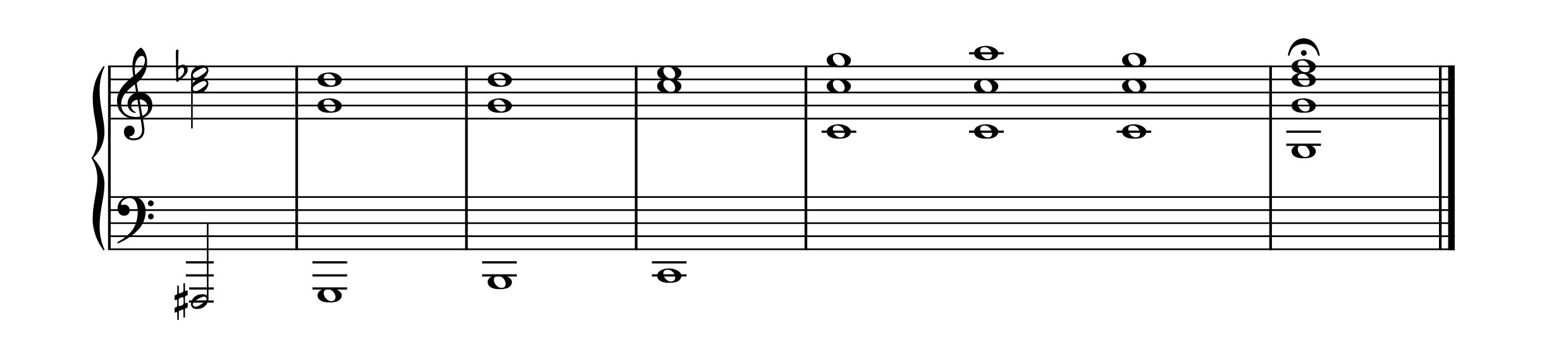
Paul Hindemith, Craft of Musical Composition (Associated Music Publishers, New York 1945) Vol. 1, p. 57 ff.
This resultant tone itself reacts with its generators to produce further, but weaker, resultants of the second order². The resultant tone principle is also used by organ builders. In order to produce certain qualities of sound, or perhaps as a space-saving device, organ builders have utilized two very small pipes producing frequencies above the range of human hearing, tuned in such a manner that when played together, they produce one very deep, and audible tone³. This effect can also be discovered by blowing together two high-pitched whistles which, if tuned closely together but not at an exact unison, will produce a clearly heard resultant⁴.
When three notes are played together, three resultants are produced. For example, in the triad G-B-D, the resultant tones would be produced by each of the pairs, G-B, B-D and G-D. It follows that in large ensembles the number of resultant tones at any given moment is quite large, since every single note played interacts with every other one, and with the resultants as well.
Now let us examine the harmonic series, which is the sequence of notes which can be produced by a column of air or by a string under tension, as it vibrates in progressively smaller segments. The ratio of frequencies of the tones in this sequence always remains the same: each step, or "mode", of the series is separated from the adjacent modes by the frequency of the fundamental tone of the series (produced when the column of air or the string vibrates as a whole), and each octave in a given series has a frequency double that of the octave below it.
Brass Bulletin 32, IV / 1980 pages 59–74
All content is protected by copyright © Brass Bulletin 1980–2026