To begin to increase awareness of relaxed and tense feelings, lie on the floor on your back. Your arms should be extended down your sides with your palms down. Send a message to each toe to tense, then relax. Work this way up your ankles, legs, buttocks and back. Continue feeling tenseness, then relaxation up to your head and down your arms to the fingers, then back to your toes.
To help you relax more fully, you may wish to do the following while you are still lying down. Think of a place where you can relax by yourself, be it at the seashore or in a forest or in a particular room. Close your eyes and go to that place, being aware of the utter relaxation of the environment. In particular, feel how calm and steady your breathing is. Should you experience chest or throat tension as you proceed through the following breathing process, try to recapture the calm, steady breathing you associate with your particular relaxing location.
Now sit in a chair with both feet flat on the floor. Lean over and tense your body as you would if you were experiencing difficulty in achieving a bowel movement. The resultant feelings of tension in your throat and chest are to be avoided when playing. You should now have some specific understanding of tension and relaxation.
Now stand still without holding your instrument. Feet should be approximately shoulder width apart. Your shoulders and hips should be in the same plane but not pulled back. In fact, lean forward at the waist very slightly, so that you feel well "grounded".
Place one hand on the body just below your belt buckle. Slowly inhale with a "low" breath that forces your hand away from you. You can think of your waistline circumference as an expanding barrel. Fill the "barrel" with air from this low area (just below your waistline).
Slowly exhale a concentrated, directed stream of air by moving your hand in slowly, but quite forcefully. As you exhale, first move the air up through your chest as if it were a current of fast-moving water. Then, as the air comes out of your body between your lips, think of projecting your air away from you as if you were causing the flame of a candle across the room to flicker. This idea of "focusing" the air is to funnel it into an intense, centered stream.
Slowly repeat the inhalation-exhalation processes without fear of exaggerating any of the physical movements. Move your free hand to your sides and your back; feel the expansion and contraction all the way around your waistline as you inhale and exhale. Breathe with a slow but steady rhythm.
Place some of your fingertips over your collarbone at the front of the base of the neck. As you exhale, make it rise and expand as much as possible. Think of this area as being an indicator of how forceful and steady you are moving up the current of air. The air should be moving up so constantly that it feels as if it is concentrated in the front of your mouth.
Continue breathing steadily. Place your hand lightly over your throat. It is without tenseness, and thus feels totally opposite to how it felt when you were leaning forward in the chair, tensing your whole body. This clear, open feeling will be duplicated when you play.
Is this way of breathing different from the way you were breathing? What kinds of comparisons are you making?
As you begin to apply this method of breathing to the following exercises, as well as to all your playing, you will find that playing phrases, as opposed to merely articulating isolated pitches, comes more easily. In addition, the quality of your sound will reflect more accurately the kind of sound you wish to produce. You are controlling the instrument; it is not controlling you.
Sound exercises
- Play the following on any low note that you feel comfortable playing. Think about your breathing, and try to make sure the articulations, lengths of notes, and volume are consistent throughout. Each note is sustained until the next note begins, unless you are taking a breath. It is recommended that you perform this exercise on only two pitches per day.
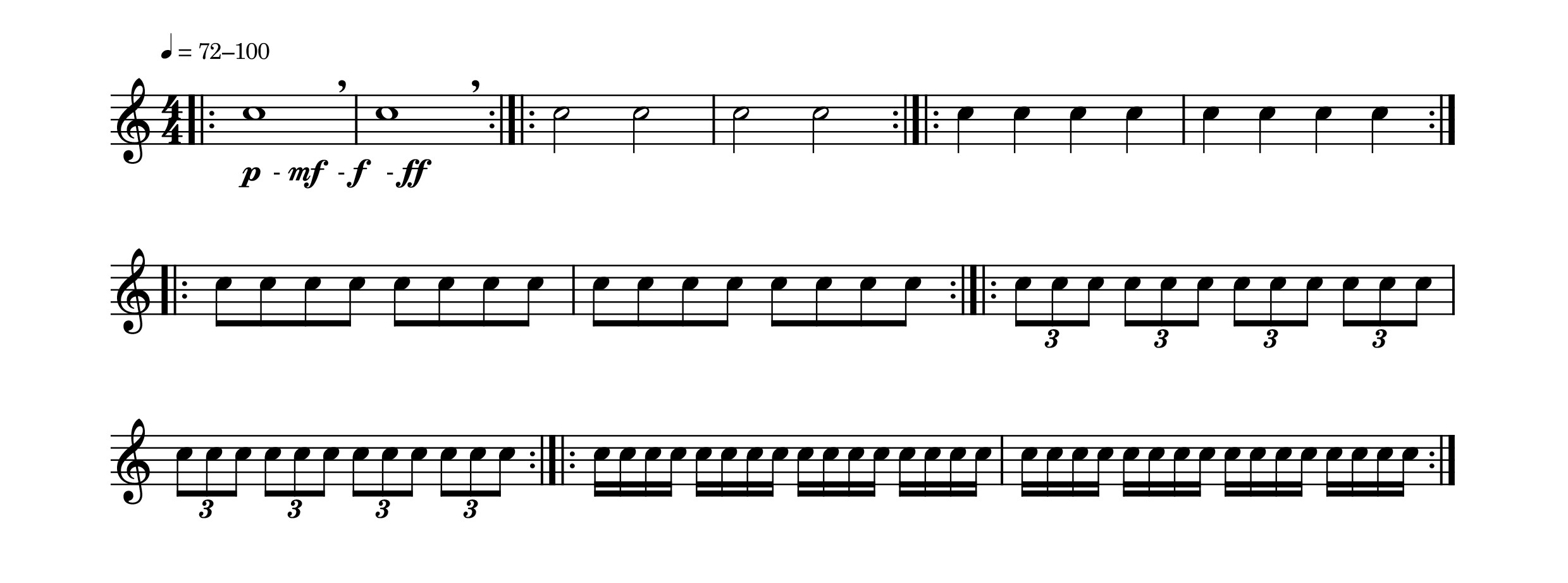
Did your sound improve as you played through the exercise? As you play the exercise at different dynamics, what do you do differently and what does that feel like?
2. Play the following at a tempo and dynamic that permits you to play all the way through in one breath. Repeat in all keys.

As you practice, be conscious of playing with the beat — "on top" of the beat — and you will not be guilty of playing "behind" others in an ensemble. This is not an uncommon fault in brass players (lower brass in particular), yet it is perhaps the least excusable.