Notwithstanding his enormous workload (work at the theatre, study, thesis), he worked continually to improve his skills as a soloist, working on the most difficult horn repertoire and appearing in concerts at the Conservatoire, on radio and television and at the city's other concert venues.
Consequently, at the next International Competition in Vienna (1959) he won the gold medal and the first prize. This was a major victory in an international context — not only for him personally, but also for the whole Russian and Soviet school of wind playing which, before the Revolution, foreign critics and theorists dismissed without a word, as unworthy of their attention.
In 1955 Vitaliy Mikhaylovich, already an experienced orchestral musician and a world-famous recitalist, won a competition for the post of soloist at the Leningrad Philharmonic Orchestra where he continues to play as well as ever.
In over twenty years playing in this orchestra he has performed the solo parts of all the major works for symphony orchestra, amongst which one ought to mention almost all the symphonies of Shostakovich, Prokofiev, Mahler, Brahms, Mozart, Beethoven, Berlioz and many, many others.
He has been fortunate enough to work with such distinguished present-day conductors as Mravinskiy, Britten, Sanderling, Cluytens, Kondrashin, Maazel (this list could be continued indefinitely) whose influence also furthered his development as a musician and artist.
With the orchestra Vitaliy Mikhaylovich has toured all the major cities of the world and his mastery of his instrument has invariably found favour with audiences and musical colleagues alike, as has been seen repeatedly both in personal utterances and in the press.
Thus one reviewer, writing of a London performance of Shostakovich's first cello concerto, mentioned the very difficult horn part which he considered had been given an excellent virtuoso performance in spite of incredible technical difficulties.
Reviewing a performance of Tchaikovsky's Fifth Symphony (in 1956) a Viennese newspaper mentioned V. I. Gensler and V. M. Buyanovskiy as "excellent young soloists, masters of the art of music, virtuosos who have at their command tonal and dynamic nuances ranging from the most delicate pianissimo to a full and mighty fortissimo", as well as superb phrasing.
There are similar reviews of concerts in the USA, Australia, Austria, Finland, Japan and on many other foreign trips.
Experienced musicians have expressed themselves frankly delighted on hearing Vitaliy Mikhaylovich and have invited him and still invite him to report and appear as a soloist at various symposiums, teachers' lectures and conferences.
Thus he is a member of the International Horn Society and of the International Brass Players' Society, where he has often appeared as a lecturer and a performer to share his rich experience with his foreign colleagues.
He has often appeared lecturing, performing and giving demonstration lessons at Norwegian and Finnish horn seminars which are well known in Europe and to which horn players come from all over the world.
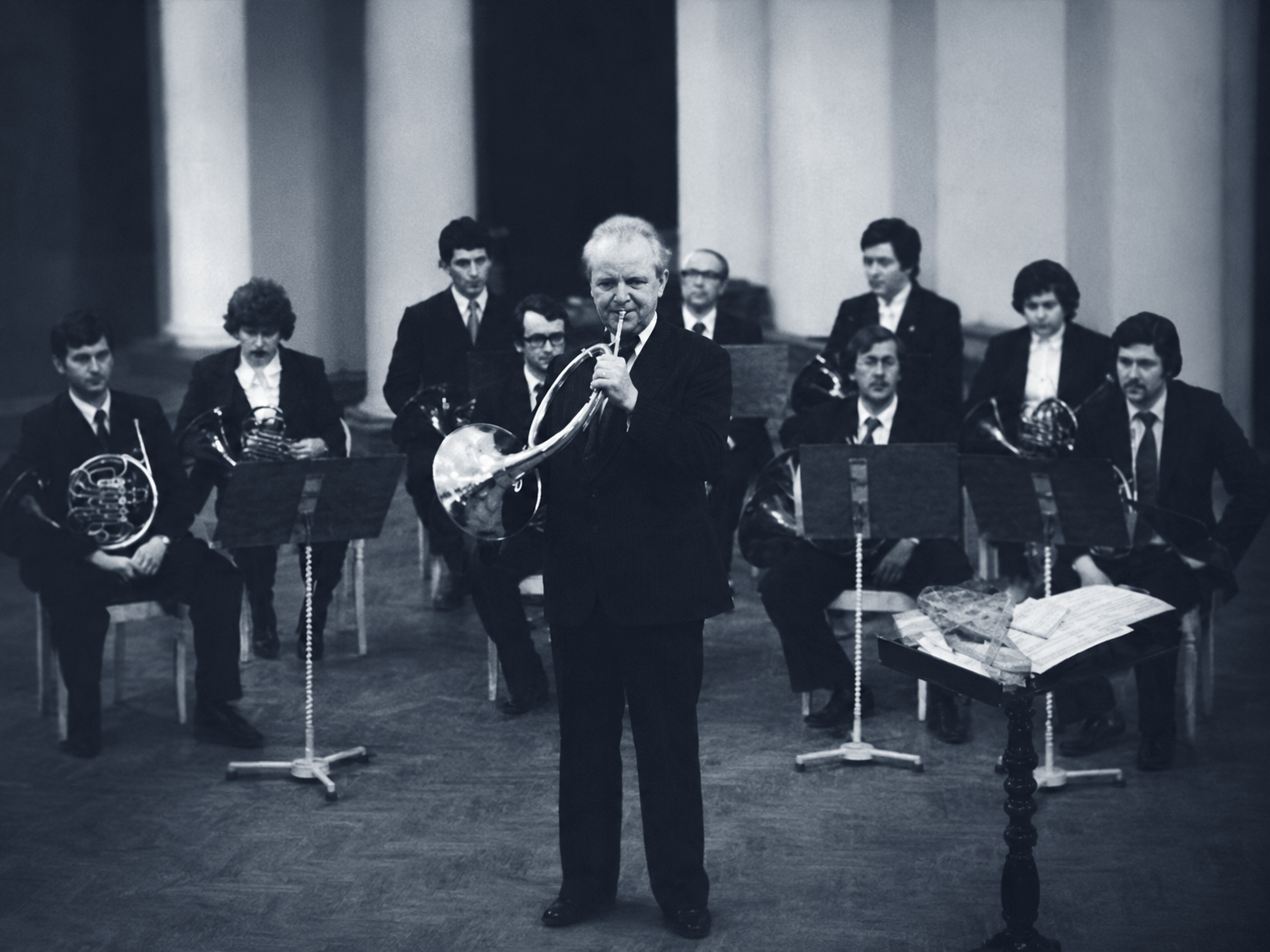
At the final concerts of these seminars he generally appears as soloist and conductor, directing a horn choir which may sometimes number thirty or forty players. The programme for these vast horn ensembles generally consists of his own arrangements or compositions.
He also organises similar meetings, lectures and concerts in this country, and in the last three years he has held similar meetings in Moscow (where there was a large concert in the Central Club for Workers in the Arts, with students from the Moscow Conservatoire and the Gnesin Institute), Novosibirsk and Petrozavodsk.
In January 1973, together with Professor P. K. Orekhov, he organised in Leningrad the first all-union horn seminar, which was a great success.
Vitaliy Mikhaylovich spends a great deal of energy on his solo playing. He has played with orchestra all the concertos of Mozart, Haydn, Goedicke, Hindemith and others. His solo repertoire is huge and a listing of it would run to several pages.
His concert appearances always arouse interest in his audiences, whether in the concert hall of the Glazunov Conservatoire in Leningrad, in the Philharmonic Hall or in the concert halls of provincial cities.
One such concert took place in February 1977 in Petrozavodsk, when Villanellas was performed by the Karelian Radio and Television Orchestra conducted by Eduard Chivzhel', holder of an All-Union Competition diploma.
This was an unparalleled revelation of the artist, so powerful was its effect, and aroused a whole range of feelings in the audience. The beautiful flowing sound, the virtuosity in handling intervals, the difficulties of which only an expert could guess at, and the fascinating presentation and artistry won the audience's highest approbation on that unforgettable evening.
The audience, taken aback by such clear and exceptional playing on such a difficult instrument, would not let their beloved artist go for a long time.
The next day there were splendid artistic performances of two sonatas for horn and piano by Hindemith (with N. Bol'shinov, piano).
Chamber music occupies a special place in Vitaliy Mikhaylovich's performing life. He organised and founded the classical wind quintet within the Leningrad Philharmonic and has now successfully directed it for more than twenty years.
The original members of the quintet were prizewinners at the 1953 International Reicha Competition in Prague: Lev Perepelkin (flute), Vladimir Kudin (oboe), Mikhail Izmaylov (clarinet), Lev Pecherskiy (bassoon) and Vitaliy Buyanovskiy (horn). All are first-class musicians and all except Perepelkin (who is a soloist at the Kirov Theatre orchestra) are soloists at the Leningrad Philharmonic.
From its very first concerts the young ensemble attracted the attention of discriminating audiences in Leningrad and soon became a favourite.
There are probably no works in the world-wide classical and contemporary store of music for this combination which are not included in its repertoire.
The work of this quintet, together with personal contacts with Vitaliy Mikhaylovich, has inspired many Soviet composers to write pieces especially for them, taking the individual artists' capabilities into account.
Thus, at his request, V. Savel'ev adapted for quintet his suite for woodwind quartet, and then wrote a Second Suite for this ensemble; S. Slonimskiy wrote Dialogues; Y. Falik wrote his chamber ballet The Clowns; and there are quintets by Prigozhin, Manevich, Taranov, Ots, Kapp and many others.
Throughout history great wind players have inspired composers to write pieces which subsequently became the jewels of the repertoire: there was Mozart's famous friendship with the clarinettist Stadler and the horn player Ignaz Leutgeb; Brahms' friendship with the clarinettist Mühlfeld; Weber's with Baermann, and many others.
A similar friendship has produced a large number of scores which have become models of modern chamber music for wind quintet.
On this point the composer of The Clowns, Yuriy Falik, has the following to say:
"It was with great pleasure that I started work on the Wind Quintet, looking forward to the pleasure of working with this ensemble. The fact that it was set up and remains so busy is due to Vitaliy Mikhaylovich Buyanovskiy.
Buyanovskiy is not only a distinguished soloist, chamber musician and teacher; he is also an untiring campaigner for music. He is a musician who is full of the most interesting ideas and plans.
He did a great deal, for example, to set up the Leningrad 'Chamber Ballet', a new ensemble combining wind quintet music with choreography (it was at his request that I wrote the chamber ballet The Clowns).
Also characteristic of Buyanovskiy is his extensive and varied educational work, something which is characteristic of all great artists."³
He is no less gifted as a teacher.
His father, Mikhail Nikolayevich Buyanovskiy, a senior professor at the Petrograd-Leningrad Conservatoire, himself came of a musical family, being the son of a flautist at the court symphony orchestra; inheriting from him the best traditions and achievements of the playing and the musical education which was established in Russia towards the end of the 19th century, Vitaliy Mikhaylovich has been able, as his teaching career of more than 25 years demonstrates, to add to the fame of the Leningrad horn school.⁴
Over the years he has trained a whole string of remarkable musicians who are now successfully promulgating the art of horn playing at home and abroad.
Among his best known pupils we should mention the solo horn at the Shostakovich Orchestra of the Leningrad Philharmonic and prize-winner at the Geneva International Competition, Andrey Glukhov; the prize-winner at the Baltic Horn Competition, soloist at the Estonian Radio and Television Symphony Orchestra and teacher at the Estonian Conservatoire, Uve Uustalu; the solo horn at the Kirov Theatre Orchestra, P. Yevstigneyev; the solo horn at the Leningrad Philharmonic second orchestra and International Competition certificate-winner Anatoliy Sukhorukov; prizewinner at the Prague International Competition, Stanislav Tses, and many others.
Before the October Revolution most teaching institutions and artistic groups in Russia were staffed by highly trained experts from various other countries as we did not have our own.
Nowadays there are young musicians from almost every country in Europe trying to get into Vitaliy Mikhaylovich's classes (and he is not the only one). Many have received training at the Leningrad Conservatoire under his direction and are now continuing their musical career in their own countries and spreading Soviet horn teaching methods.
But Vitaliy Mikhaylovich is particularly fond of his teaching work with the younger generation at the secondary school attached to the Conservatoire, where he has quite a large class.
Notwithstanding the heavy commitments we have already mentioned, he still finds time to pass on his great experience to the younger generation.
His teaching principle of a strictly individual approach to every student, taking account not only of his age but also of his psychological and physiological characteristics, and the great fund of teaching technique which he so perfectly masters, enable him to achieve great success.
The enthusiasm for different kinds of ensemble and class work — traditional in the Russian and Soviet school of teaching and playing — lives on in the work of Vitaliy Mikhaylovich.
And this is no coincidence. At the pre-revolutionary St. Petersburg Conservatoire a wind ensemble class was set up under the excellent cornet player and conductor Professor V. V. Vurm.
The aim of ensemble playing is to provide professional training for future orchestral players and this governs the selection of pieces in building a suitable repertoire.
All subsequent teachers in the wind department at the St. Petersburg-Leningrad Conservatoire have continued this tradition whereas in other music colleges chamber ensemble is generally taught in a chamber ensemble department usually staffed by pianists who know neither the orchestral repertoire nor the nature of orchestral playing.
When training his students in ensemble playing Vitaliy Mikhaylovich deliberately starts off by using groups of like instruments (duos, trios and quartets of horns), gradually introducing new instruments, as early as the secondary school.
Thus throughout the whole of their studies (secondary school, music college, post-graduate) students are occupied in acquiring the basic habits of ensemble playing so necessary to the orchestral musician.
To this end he has done a great deal of work in selecting repertoire and preparing for publication various kinds of collections and individual works hitherto unknown, or not well enough known, to a wide circle of teachers and musicians.
When studying and compiling teaching material and artistic work for the horn, Vitaliy Mikhaylovich, as a musician and teacher, is probably aware of the mistakes which abound in some editions of scores, tutors and textbooks.
This has given rise to the idea of pooling all the teaching experience which has been accumulated in the Leningrad horn school over more than a century, starting with Professors Homilius and Tamm and continued and extended by Professors Buyanovskiy and Orekhov.
The two last named are now putting this idea into practice and are writing a horn tutor.
Vitaliy Mikhaylovich's working life is so varied that it is sometimes difficult to imagine how one man can cope with so much — and with so much that is artistic in nature.
To take just one working day (a non-working day, in the normal sense of the word, is something he never has), a day which ought to be free according to his Philharmonic timetable: 8 till 10 a.m. — at the instrument factory, where he is a consultant and, in his other capacity, a buyer for the secondary school, for whose pupils on this particular day he was getting mouthpieces and completing all the formalities that entails; 10 till 11 — breakfast, and the trip to the secondary school; 11 till 4.30 — teaching; 5 p.m. till whenever — recording session at Melodiya (he has made about 30 records). And almost every day he works similar hours.
But how he finds time to indulge in another of his great interests, composition, is presumably a trade secret.
He has written pieces for trumpet and for horn; sets of pieces and many arrangements for horn ensembles of anything from 2 to 18 players; a sonata for solo horn, dedicated to the well known West German horn player Hermann Baumann; a piece for horn and piano, dedicated to the East German player Peter Damm; a sonata for four pedal timpani, and many other instrumental compositions and arrangements which are performed both here and abroad.
Some of his works have been published: Five Pieces for Horn (published by Muzyka); The Hunt, a fantasy on themes from Der Freischütz, dedicated to Peter Damm (published by Sovyetskiy Kompozitor, Leningrad, 1976).
His most important works to date are clearly the two chamber ballets Polyphemus (produced in the Lenfilm studio by the choreographer Georgiy Aleksidze) and Legend (on Japanese themes).
Vitaliy Mikhaylovich's career as a composer, successful from the outset, will thus probably continue to give pleasure to the listening and viewing public, and we are delighted with his new works.
He has written a book on the horn (published by Muzyka in 1971) and an article entitled "M. N. Buyanovskiy as a Horn Player and a Teacher" (in Teaching Method for Wind Instruments, Moscow, 1976).
One cannot disagree with the view of him expressed by the distinguished modern composer Shostakovich:
"His art is sublime and strict; he has impeccable artistic taste, nobility of sound, emotional restraint and the subtle ability to convey the forms and ideas of a work in accordance with its style and character. ... And he is currently at work in a wide variety of artistic endeavours."⁵