Explore institutional access →

1 min. read

Japanese painting from the 18th century

Japanese painting from the 18th century

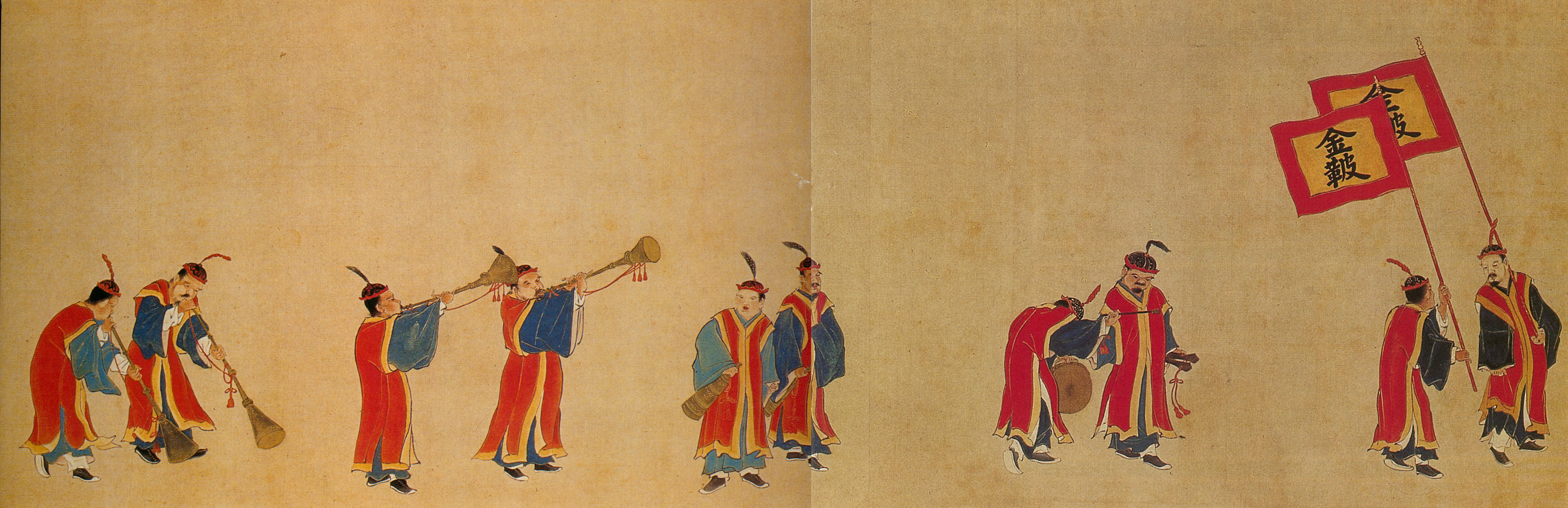
Okinawa was a small kingdom founded around the 12th century. It had commercial relations with China in the Ming period (1368-1644) and was considerably influenced by Chinese culture. In the 15th century it took up relations with Japan and became officially subject to the Japanese government in the 17th century. Since then many Okinawan kings and ambassadors have visited Japan, introducing their music and their dances both at the Emperor’s court and among the country’s leading figures.

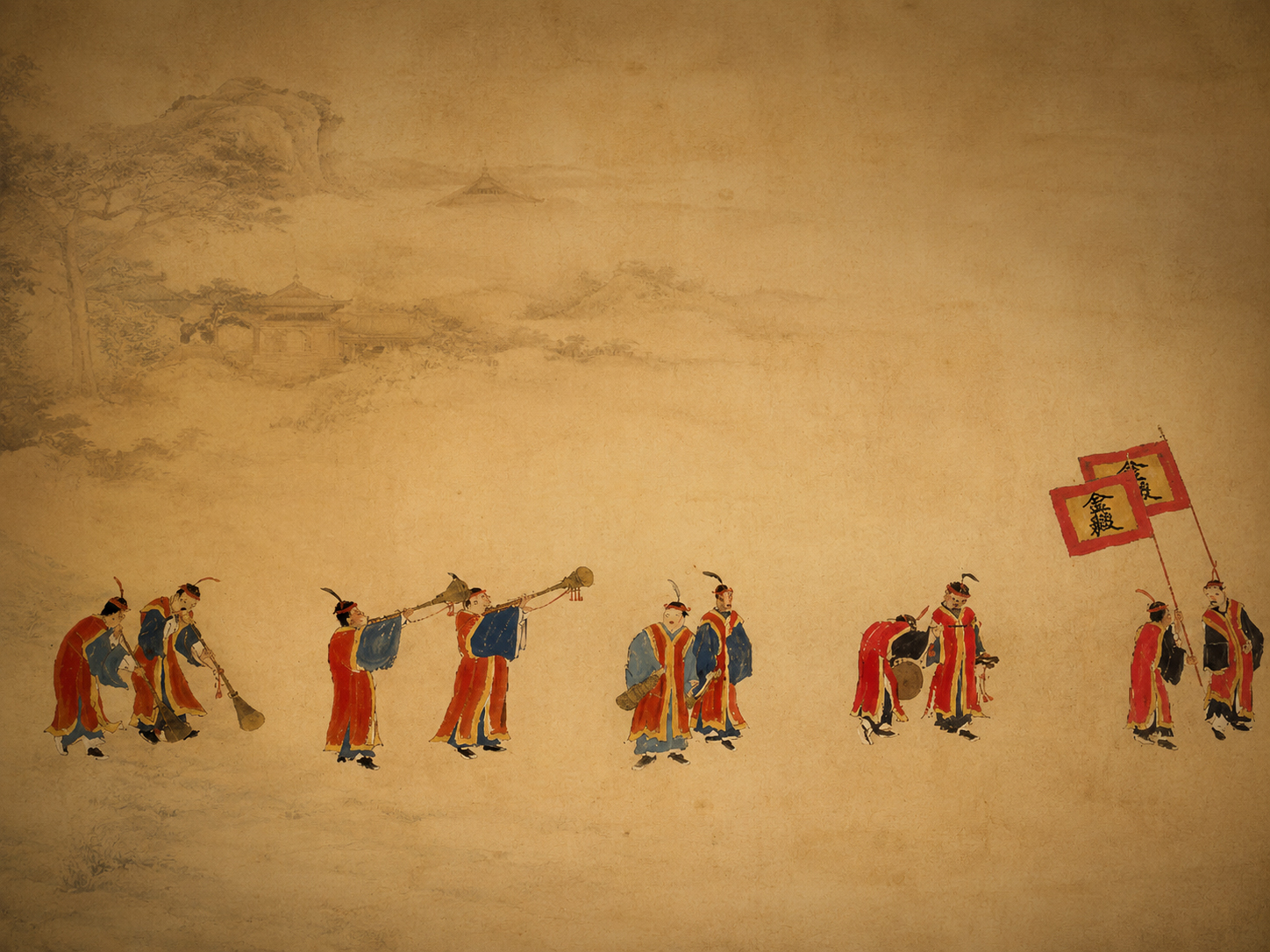
These missions sometimes numbered 170 people and they performed their music during their official procession. This painting shows a part of that procession. The participants are wearing Chinese dress and playing Chinese music. Almost all these instruments were imported into Okinawa from Central Asia via China.

The trumpet (Rapa) was used during the official procession but little is now known about this musical ritual. These historical instruments have now disappeared although it may still be possible to find some in Fukien and Sechuan in China, as is the case with the Dung-Chen (Tibetan trumpet) used by Lamaists in Tibet.

Some imitations, made in China, can be found today on the occasion of the Grand Feast of the Dragon Dance (Ryu-Odori) which takes place in Nagasaki in Japan but which came from China in the 17th century. This is an excellent opportunity to see and hear this trumpet. Its sound is shrill and powerful and is said to represent dragon cries.

The procession was painted in water colours by Tohshu Ishiguro (died 1785), an 18th-century painter, on a piece of silk approximately 20 metres long. This roll is kept in Okinawa by Mr. Kohjiro Takakura, a descendant of one of the members of the former delegation.

(This photograph was made available by the Chikuma-Shobo library.)
Brass Bulletin image

Brass Bulletin 35, III / 1981 pages 44–45

All content is protected by copyright © Brass Bulletin 1981–2026

Share this article

Facebook LinkedIn
Loading…

Questions & Answers

How the Digital Edition works

What does the Digital Edition include?

The Digital Edition brings together the articles already digitized as searchable online texts—not simply as scans or PDF files—along with their original illustrations, notes, authorship, issue information, and available translations. Related-article suggestions currently include only this digitized material.

Are the digital articles identical to the originals?

We preserve the original text, language, illustrations, captions, footnotes, and editorial context as faithfully as possible. The presentation is adapted for comfortable online reading, and obvious transcription or scanning errors may be corrected. The substance and character of the published article remain unchanged.

Which languages are available?

Brass Bulletin was published in English, French, and German throughout its history. Italian and Spanish translations were added from issue No. 60 onward.

On the Italian and Spanish sites, articles from issues 1–59 are therefore shown in English by default.

How often are new articles added?

New articles are added almost daily, with approximately one complete issue digitized each week. The pace may vary depending on the preparation, image work, and editorial checking required.

Why aren’t all articles available digitally?

The complete Brass Bulletin collection contains 1,246 articles published between 1971 and 2003. The full index is already available online, allowing readers to discover every article in the collection, including those whose complete text has not yet been digitized.

Digitization began in February 2026. Each article is carefully prepared for online reading, checked, and connected to its issue, authors, subjects, and illustrations. At the current pace of digitization, the complete collection is expected to be available online by February 2028.

Why do some references mention articles that are not available yet?

References in the original articles are preserved even when the material they point to has not yet been digitized. This keeps the historical and editorial record intact. As more issues are added to the Digital Edition, an increasing number of these references will lead to articles that can be read online.

Can I suggest an article or report a transcription error?

Yes. If there is an article you would particularly like to see digitized, or if you notice a possible transcription error or missing detail, please contact us. Reader feedback helps us improve the Digital Edition and prioritize useful connections within the archive.

How can I support Brass Bulletin?

Your support helps fund the preparation, verification, and online publication of the complete collection.

Subscribe to the Digital Edition

Prefer to support us without subscribing?

Make a donation

How is the digitization progressing?

We’re gradually making the Brass Bulletin available online, article by article. You can read newly digitized articles as soon as they’re ready, even before an entire issue is complete.

Visit our Digitization Roadmap to browse recent additions and see estimated availability for upcoming issues. These estimates follow our recent pace and may change.

Search Brass Bulletin.