9 min. read
Blowing as a body function
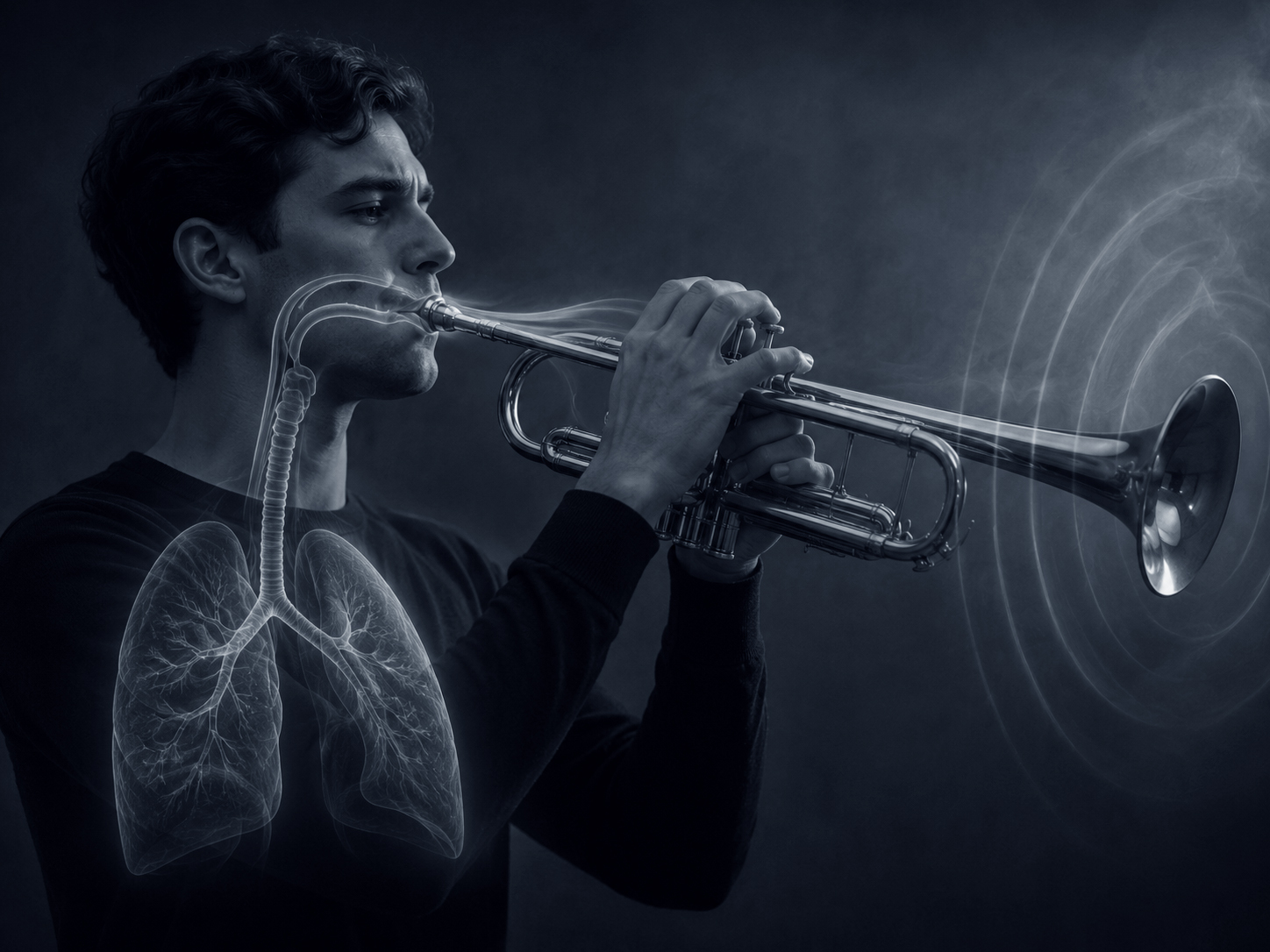
So much has been written on the topic of breathing and its control that apologies seem to be in order for adding to that literature. Nevertheless, the very existence of that much material seems to indicate that the question is not settled to everyone's satisfaction.
This article is therefore an attempt to draw together some ideas which will help teachers and students lay down a course of action which will result in a more satisfactory performance.
Breathing is, of course, a natural and involuntary action. As such, it is purely passive and serves only to supply the physical body with sufficient oxygen to keep it alive. Blowing, on the other hand, is a very purposeful activity, undertaken to set the vocal cords or the lips in vibration or to move some object outside the body by the force of the ejected air stream.
Contrary to popular opinion, the muscles which are used for breathing are not those which are used for blowing. If you examine any external motion of the body, you will observe that one muscle causes movement in one direction and another muscle reverses that direction. The raising and lowering of the arm employs opposing muscles, each of which acts as a control on the other. In a similar manner, the acts of breathing and blowing, if done purposefully, should employ opposing sets of muscles.
Inhaling is done for the purpose of taking in sufficient air to carry a full musical phrase, and the business of acquiring oxygen is purely secondary. Blowing is accomplished for the purpose of expelling that air and setting the vocal cords or the lips in vibration to produce sound.
Three different breathing and blowing techniques are possible, though it is doubtful that any one of the three is used to the complete exclusion of the other two. In any of these techniques the individual is attempting to enlarge the trunk of the body beyond its normal point of repose so that air will then rush in to occupy the space thus created.
The first of these techniques is that commonly known as diaphragmatic breath control. In this instance the diaphragm muscle, a convex dome-shaped muscle separating the rib cage from the abdominal region of the body, contracts with a downward motion, creating a space within the rib cage so that air may rush in to fill the lungs. The same downward motion of the diaphragm muscle also forces the viscera down and out, thus causing the abdominal wall to distend.
Brass Bulletin 34, II / 1981 pages 29–36
All content is protected by copyright © Brass Bulletin 1981–2026