Explore institutional access Explore institutional access

1 min. read

Editorial

Editorial

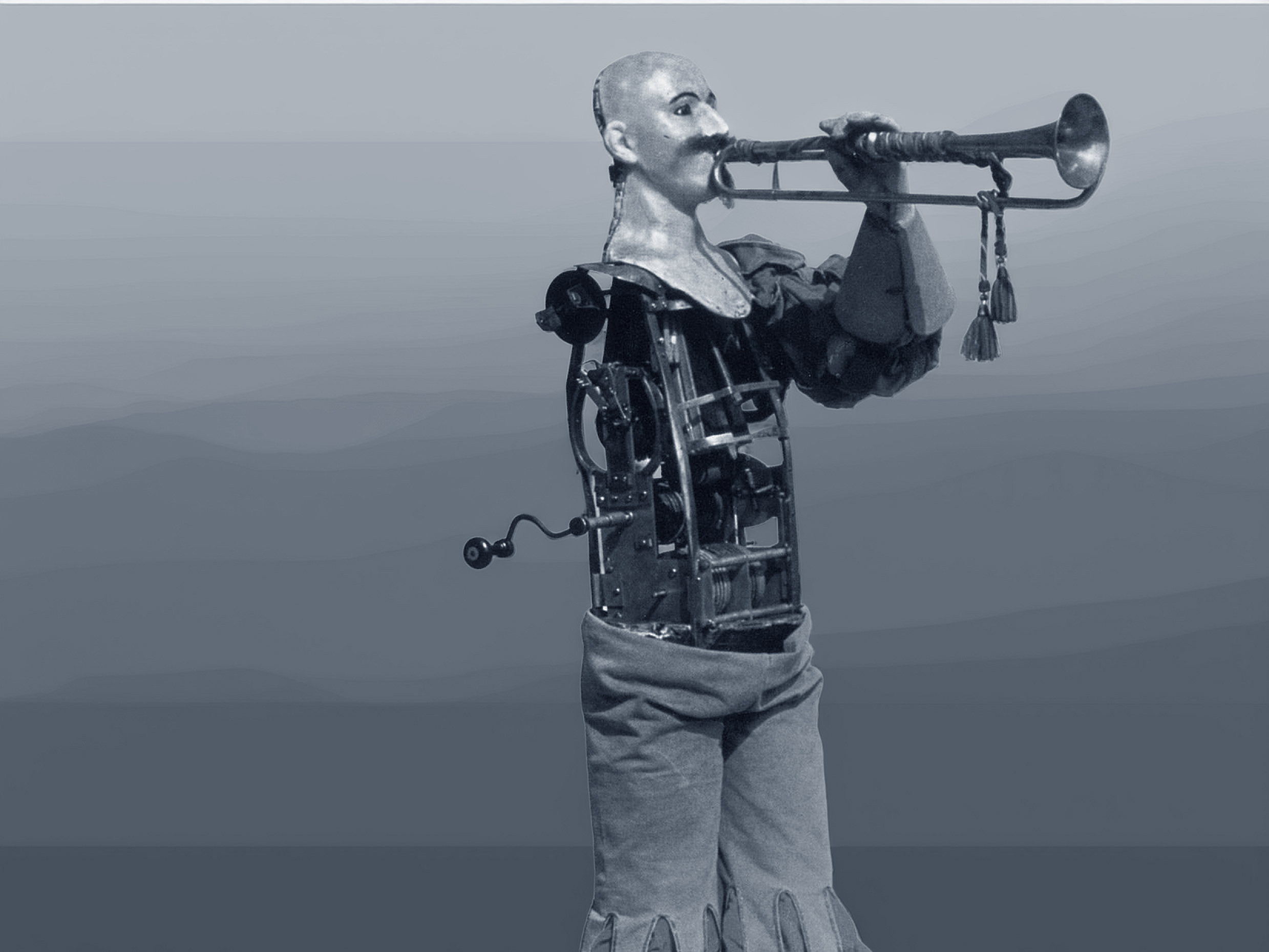
Kaufmann’s robot is an admirable museum piece, but it is also perhaps — since 1810! — a subtle warning for mankind on the subject of his evolution.

I would like to invite you to contemplate the extraordinary photo of Kaufmann’s robot which decorates the cover of this edition.

A robot musician! What a dream for the conductor! It is a pity that technocratic society has not developed these splendid copies. The musicians of flesh and bone would perhaps today have more of a chance of participating actively in the evolution of their art rather than just becoming docile officials.

Who has not noticed with some disquiet the mechanisms which routine brings. Our existence is thus gnawed at by gestures, by attitudes determined most often by our civilisation whose machinery bathes more in sand than in oil. The mechanical reproduction of music or magnetic recording of lost folklore are preserves. Is there here sufficient cultural nourishment? Is it healthy? Every one replies to this question according to his convictions. As for me, I have the impression that technology and science are in the process of strangling living art, or rather the art of the living. How everything becomes serious and austere! Oil against blood? The cliché against imagination? The calculated expansion of a spring against the unaccountable pulsing of the cardiac muscle?

The sounds which we produce do not become music until they have been fertilised by strong thoughts and sensations. These elements only develop if the individual succeeds in increasing his internal liberty.

Kaufmann’s robot is an admirable museum piece, but it is also perhaps — since 1810! — a subtle warning for mankind on the subject of his evolution. And where is the hope in all this? If you feel a smile coming to your lips when looking at the trumpet player with an iron heart, then set your mind at rest, because it is an obvious sign that you haven’t yet become one of the robots of the 19th century which are being prepared...

Jean-Pierre Mathez

P. S. Definition of the word robot in the dictionaries: machine which imitates the movement of a live being. Fig. Man without will who can be made to act in any desired way.

Brass Bulletin 25, I / 1979 page 3

All content is protected by copyright © Brass Bulletin 1979–2026

Share this article

Facebook LinkedIn
Loading…

Questions & Answers

How the Digital Edition works

What does the Digital Edition include?

The Digital Edition brings together the articles already digitized as searchable online texts—not simply as scans or PDF files—along with their original illustrations, notes, authorship, issue information, and available translations. Related-article suggestions currently include only this digitized material.

Are the digital articles identical to the originals?

We preserve the original text, language, illustrations, captions, footnotes, and editorial context as faithfully as possible. The presentation is adapted for comfortable online reading, and obvious transcription or scanning errors may be corrected. The substance and character of the published article remain unchanged.

Which languages are available?

Brass Bulletin was published in English, French, and German throughout its history. Italian and Spanish translations were added from issue No. 60 onward.

On the Italian and Spanish sites, articles from issues 1–59 are therefore shown in English by default.

How often are new articles added?

New articles are added almost daily, with approximately one complete issue digitized each week. The pace may vary depending on the preparation, image work, and editorial checking required.

Why aren’t all articles available digitally?

The complete Brass Bulletin collection contains 1,246 articles published between 1971 and 2003. The full index is already available online, allowing readers to discover every article in the collection, including those whose complete text has not yet been digitized.

Digitization began in February 2026. Each article is carefully prepared for online reading, checked, and connected to its issue, authors, subjects, and illustrations. At the current pace of digitization, the complete collection is expected to be available online by February 2028.

Why do some references mention articles that are not available yet?

References in the original articles are preserved even when the material they point to has not yet been digitized. This keeps the historical and editorial record intact. As more issues are added to the Digital Edition, an increasing number of these references will lead to articles that can be read online.

Can I suggest an article or report a transcription error?

Yes. If there is an article you would particularly like to see digitized, or if you notice a possible transcription error or missing detail, please contact us. Reader feedback helps us improve the Digital Edition and prioritize useful connections within the archive.

How can I support Brass Bulletin?

Your support helps fund the preparation, verification, and online publication of the complete collection.

Subscribe to the Digital Edition

Prefer to support us without subscribing?

Make a donation

Search Brass Bulletin.