We performed a concert at the Gnessin State Musico-Pedagogical Institute, a conservatory that trains students (most between 17–23 years of age) in folk instruments as well as for teaching careers. The Gnessin students were very interested in trying out our instruments and conversing with our students after the concert.
The Rimsky-Korsakov Conservatory in Leningrad, certainly one of the finest in the world, offered the greatest opportunity to spend time with students with similar interests. Communicating with brass players at the conservatory, I observed that they use smaller bore instruments than I am used to seeing in the States, but in comparison the mouthpieces are larger (cup and depth). Most instruments are Russian-made, with some American (usually Bach, also some Conn).
As brass players anywhere, they were most curious and anxious to trade mouthpieces and try instruments. Several students used Schilke mouthpieces that one of the conservatory teachers had bought while on tour in Chicago years ago. The professor of horn at the conservatory was most anxious to see if any of our students had a Holton Farkas model to try (we did!).
The master class schedule for lessons at the Rimsky-Korsakov Conservatory is quite different from lessons in the US. Most lessons in the US are private, weekly sessions. At Rimsky-Korsakov, the trombone lessons were all group lessons, given two and sometimes three times a week. All trombone students attend, and one class may consist of playing orchestral excerpts, with each student (there were nine in the class) taking turns playing different parts — sometimes first, other times bass. The students often switched between tenor and bass, as the tenor instruments did not have F attachments. I might also add that the main goal and training of the Russian instrumentalist is solely for orchestral playing. Apparently all are placed in an orchestra (symphony, ballet, opera) upon graduation.
Another master class was what is called repertory class in the US, where all attended and solo literature was played by each student. The solos were all 19th-century or Russian literature. They were memorized and performed with piano. French literature (Saint-Saëns and the test pieces of the French conservatory) was popular. In fact, to my knowledge, the entire general literature used by Russian students (especially trombone) consists of Russian music, French Conservatory music (available as Alphonse Leduc publications), and some Eastern European music (e.g. Serocki in Poland). The master Russian teacher Blazhevich has left a rich literature of 12 concertos and numerous methods and etude books that are all valuable. It was amusing to see some students give me a thumbs-down (symbol for disapproval) when the Rimsky-Korsakov Concerto was played!
The third master class consisted of etudes and technical exercises, sometimes played in unison. I did notice that there were many technical etudes but little legato material. I have sent some Concone and Bordogni-Rochut melodious studies to players I met, in the hope that they might fill a gap in their study literature.
I was deeply impressed by the seriousness of the trombone students and particularly by their overall musicianship, ear training (they solfège all material as well as play it), accuracy and endurance. The players I heard tended to play loudly and with a robust, biting projection — a very exciting concept. But I heard little indication of subtlety or legato.
The students at the conservatory are highly selected and have been studying for musical careers in special schools since an early age. This appears to be a significant advantage over the often too generalized music training for the masses practiced in the States by many schools.
The USSR does not have wind ensembles as we do, but there are military bands and the important and popular circus bands. Professors at the conservatory were fascinated and surprised at the wide variety of literature our wind ensemble performed (small jazz groups, chamber music, Hindemith Symphony in B-flat, Porgy and Bess by Gershwin — always our best received work — Sousa, as well as Russian music by Prokofiev and Miaskovsky) and wondered at the dynamic range and control of our students, particularly the brass players.
I went out of my way to try and find some jazz (and even met one of the few jazz critics in Leningrad), but what I heard was generally 1955-style swing-dance jazz. One group I heard consisted of alto sax, trumpet, organ, Fender bass and drums. Most musicians were knowledgeable about some of the famous jazz innovators and were eager to hear about their popularity in the US.
My warmest memories were shared with Victor Venglovsky, professor of trombone at the conservatory and solo trombone of the Leningrad Philharmonic Symphony Orchestra. It was frustrating trying to meet Victor, as it took me four days to make contact (the phone situation is unbelievable!), and we did not meet until my last night in Leningrad. Victor and I exchanged music and records. He is quite active in Leningrad musical life and gave me four recordings of his playing that may be of interest to other trombonists:
Darius Milhaud — Concertino d’Hiver with orchestra (c. 01363-4)
Solo record with piano: music by Poot (Impromptu), Bozza (Ballade) and the Russian Angelov (Scherzino), plus transcriptions by Rachmaninoff and Weber (cm. 01921-22)
The Leningrad Trombone Quartet: suites by Dondeyne and Serocki, three pieces by Bozza, Defay’s Four Pieces, Tomasi’s Être ou ne pas être and a Russian work by Kladniski (cm. 04239-40)
Various brass ensembles including Poulenc (Trio) and Speer (Sonata) (cm. 02955-56)
All records are on Russian Melodiya.
I was very much impressed by the friendship and warmth of the Russian people and musicians that I had the pleasure to meet. Mutual interests help to break down language barriers (I speak only a few words of Russian), and so I hope that more BRASS BULLETIN readers may travel to the USSR for sightseeing, research, musical contacts and a rare, unique experience.
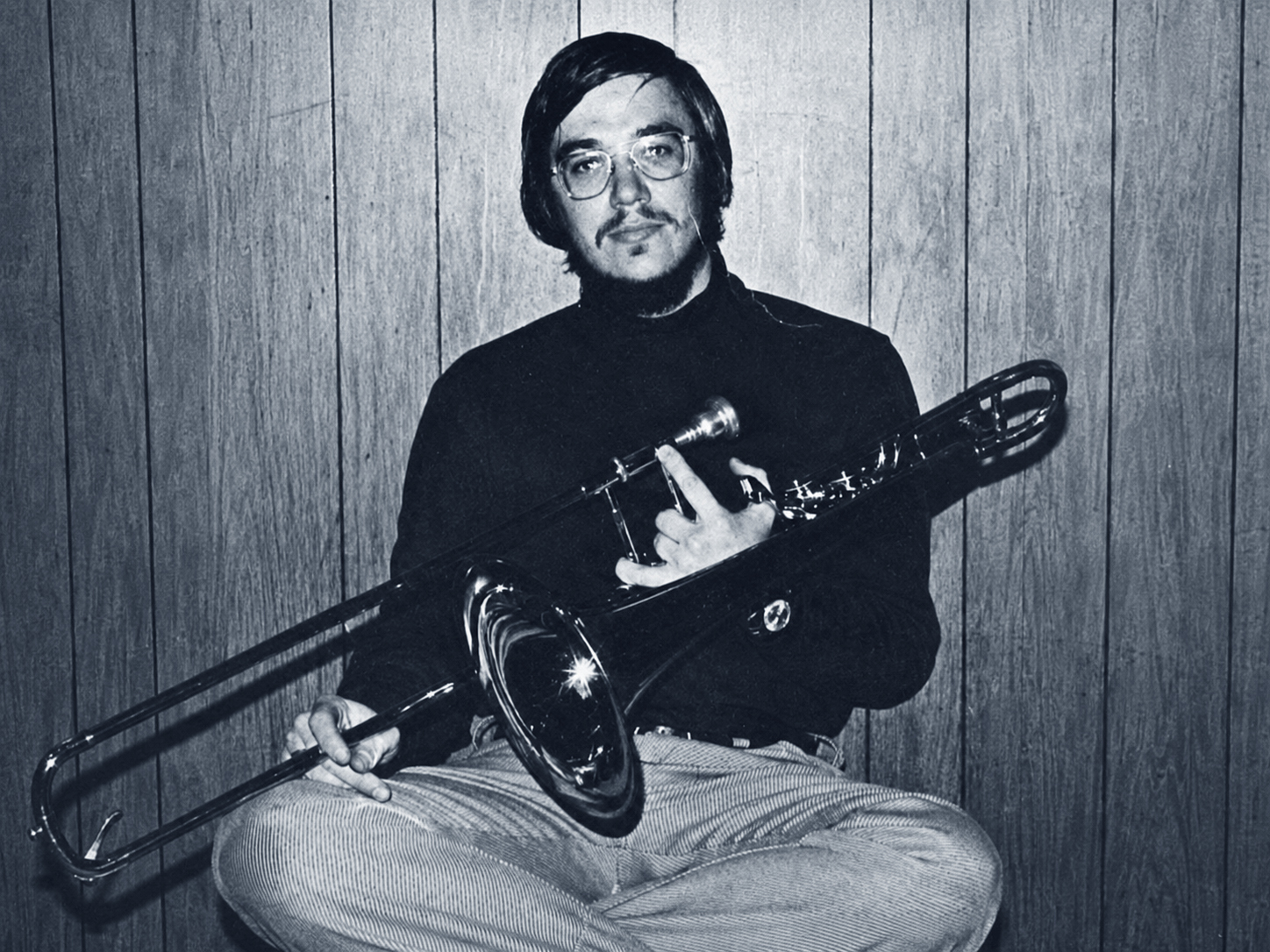
Tom Everett, who was kind enough to send us the following interesting and lively description of his USSR tour, is a bass trombonist and recitalist (Boston Ballet and Opera Orchestra) and teaches at the New England Conservatory, Harvard University and Brown University. He is President of the International Trombone Association.