The introductory bars to the cadenza have died away — what now? To underline the extempore character of the cadenza, it is advisable to pick up the orchestra's last motive and to use it as an introduction. Then the main theme should follow, whereas the middle part should bring the second theme or a motive from it, which can be treated in a sequential way. Broken triads and a trill will bring the cadenza to its end. Perhaps it would be good to remember every now and then the harmonic scheme of a cadenza. About evasions or temporary modulations Türk writes (op. cit.): «One should never modulate into tones that the composer himself never used as such. This rule is based on the Law of Unity of a Work of Art.» In these evasions I also include modulations into keys that were almost impossible to play on the early horns, although now they cause no difficulty at all.
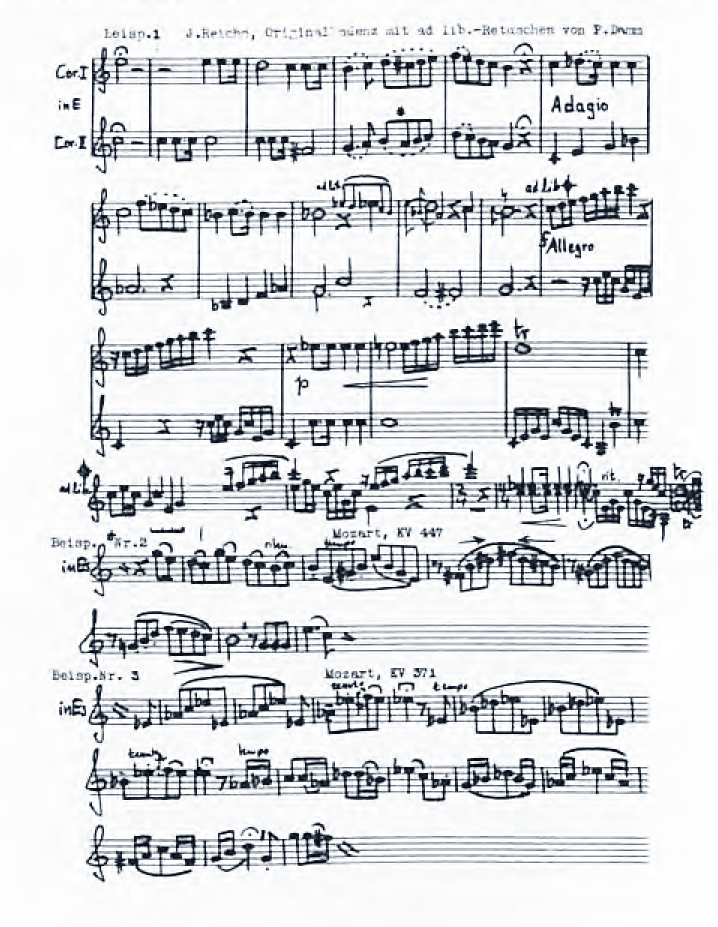
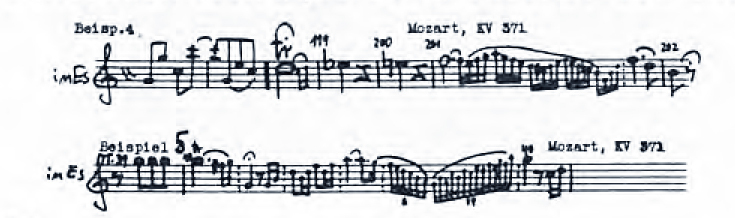
In my cadenza essays — that I do not at all consider perfect — I have f. i. in the KV 447 concerto treated the harmonic material of the bars 104, 109—111 in the middle part of the cadenza (ex. 2). The harmonic substance in the cadenza to the Rondo KV 371, however, is different (ex. 3): Mozart himself modulated in this work from E flat major to C flat major, thus making use of the mellow timbre caused by the multiple application of hand-stopping (bars 86—98). I terminate my cadenza after the broken cadenza with an entrance into bar 201 (ex. 4). I shall refer to these entrances later.
Once more I have to let Türk speak (op. cit.), this time of the extreme virtuosity, especially when used in the cadenzas of slow movements: «The cadenza — like every other ornament — should not be made up of extreme difficulties but should in its themes and character be in harmony with the work it was made for.»
The technical performance of the cadenza too should be in accordance with the style of the concerto although here one must be prepared to compromise. For instance a d’ or f’ will not be found in Mozart’s concertos — and yet one will hardly be able to manage a cadenza without them. (The f’ in the Rondo KV 371, bar 187, might be an error — or a completion — in the copy used by Rudorff for his «Alte Mozart Ausgabe»). Technique of scales and chords are abundant in the classical works. One may use them freely in the cadenza and yet stay in accordance with the spirit of the concerto.
About the interpretation of a cadenza Türk says (op. cit.): «Moreover, every cadenza — also the one prepared in advance — should be performed in such a way that it gives the impression of a Fantasy invented on the spur of the moment.»
Finally I want to refer to the entrances mentioned above. They are not cadenzas, but short introductions used especially in Rondos, f. i. as a connecting passage to the Recapitulation. Another difference is that the entrances do not change harmonies but are played on the dominant of the following key. It is their task to connect two «sharply separated parts of a movement by a short solo» (Türk, op. cit.). The entrances generally have no relation to the thematic material but consist of broken chords and scales. Their character is transitional.
Entrances to some classical concertos have been written by the editors lately, whereas many of the post-classical concertos have them fully composed. As an example I should like to mention the Rondo in Strauss’ second horn concerto. Here we find entrances after fig. 39 (bar 6-8½) and 8 bars before, till 2 bars after fig. 47 (the latter leading from the horn to the orchestra).
I here discussed in great detail the classical cadenza and — though I am not at all averse from the new and contemporary style — I presented myself as an advocate of the cadenza in style of the work, also quoting «chief witnesses». Yet I would never think of «pretending to be Mozart». To find the right solution for one’s cadenza, much intuition and sensitiveness as well as a knowledge of good examples (also from pianists, violinists, etc.) is required.
Expressing one's thoughts on paper «will cause criticisms from many people whose opinions upon the right way of playing will also be very different one from the other...» as Duvernoy wrote in the preface of his «Méthode pour cor» and I think that the same words could be applied in the case of «Copy of style — or chance?»
B. Krol to P. Damm, Jan. 17, 1976:
Dear Peter, thanks for sending me your critical reply to my article on the cadenza (BB 12/75). I must say I admire your thorough work. — The only thing I should like to add is: your chief witness Türk surely did not know my chief witness, i. e. Beethoven's cadenza to Mozart's d minor piano concerto (KV 466) when he wrote down his rules for the cadenza. You certainly know it and will have to admit that it has nothing to do with Mozart's style. The cadenza is written in Beethoven’s very own style, powerful and wilful ... Beethoven surely did not pretend to be Mozart.