7 min. read
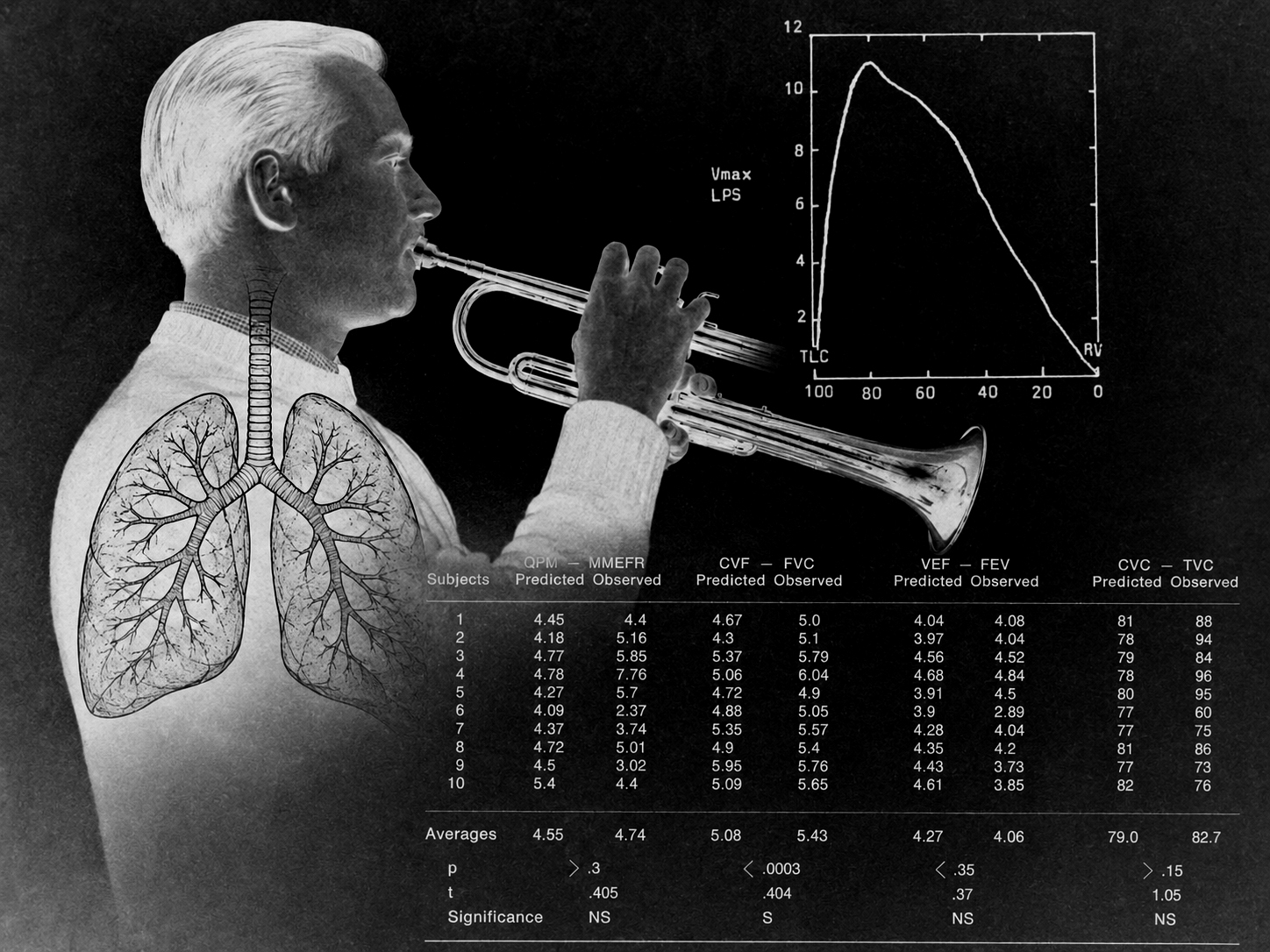
A scientific study of pulmonary function
As applied to wind instrument playing, with emphasis on the study of lung function in trumpet playing
Processes and research
When I first began this study, it was my intention to show the various aspects of breathing, and the mechanics of breathing, as applied to wind instrument playing, and in particular, to trumpet playing. Also, I hoped to determine if trumpet players breathe any differently than non-trumpet players.
As a result of these studies, I have come to the conclusion that playing a wind instrument requires three important processes:
- Inhalation
- Exhalation
- Lots of practice.
I feel that, although these may seem like obvious steps to playing well, it was not without a great deal of scientific study that I finally came to these conclusions.
Included in this test are many of the finest symphony and studio musicians in Los Angeles.* The musicians were asked to fill out a two-page form which revealed various aspects of their playing and medical history. They were then told about the test and given instructions on how to breathe into the respirometer. The Collins respirometer is the simplest and most practical answer to the problem of measuring and recording respiratory excursions, lung volumes and oxygen uptake.
Essentially, the system involves rebreathing into an inverted, counterweighted, water-sealed container with a pen arranged to record its movements. The musicians were asked to take as large a breath as possible, and then to exhale as quickly and completely as possible. There were at least two tests taken of each individual, and the test with the best score was used.
Each test would reveal four measurements as measured on the graph paper. The four tests computed were:
- Forced vital capacity (FVC) — The greatest volume of gas that can be expelled by voluntary effort after a maximal inspiration.
- Forced expiratory volume (FEV) — The volume of air expelled in the first second of exhalation.
- Timed vital capacity (TVC) — The percentage of vital capacity removed in the first second of exhalation compared to the total exhalation.
- Maximum midexpiratory flow rate (MMEFR) — Calculated from the volume of air expired during the middle 50% of expiration. As expressed in litres per second, this is a flow measurement rather than a volume measurement.
All of the above measurements were made with the adjustments necessary because of different air temperatures, air pressures, and bell factors. It should be noted that the mouthpiece used with the respirometer is the same one used by pulmonary technicians in hospitals, and is larger in diameter than a trumpet mouthpiece. Therefore, it offers much less resistance. For the purposes of this test, and to make the experiment scientifically valid, I used the mouthpiece which fits the respirometer.
Brass Bulletin 13, I / 1976 pages 15–26
All content is protected by copyright © Brass Bulletin 1976–2026