6 min de lectura
Good intonation on the trombone
Por Raymond Fonseque
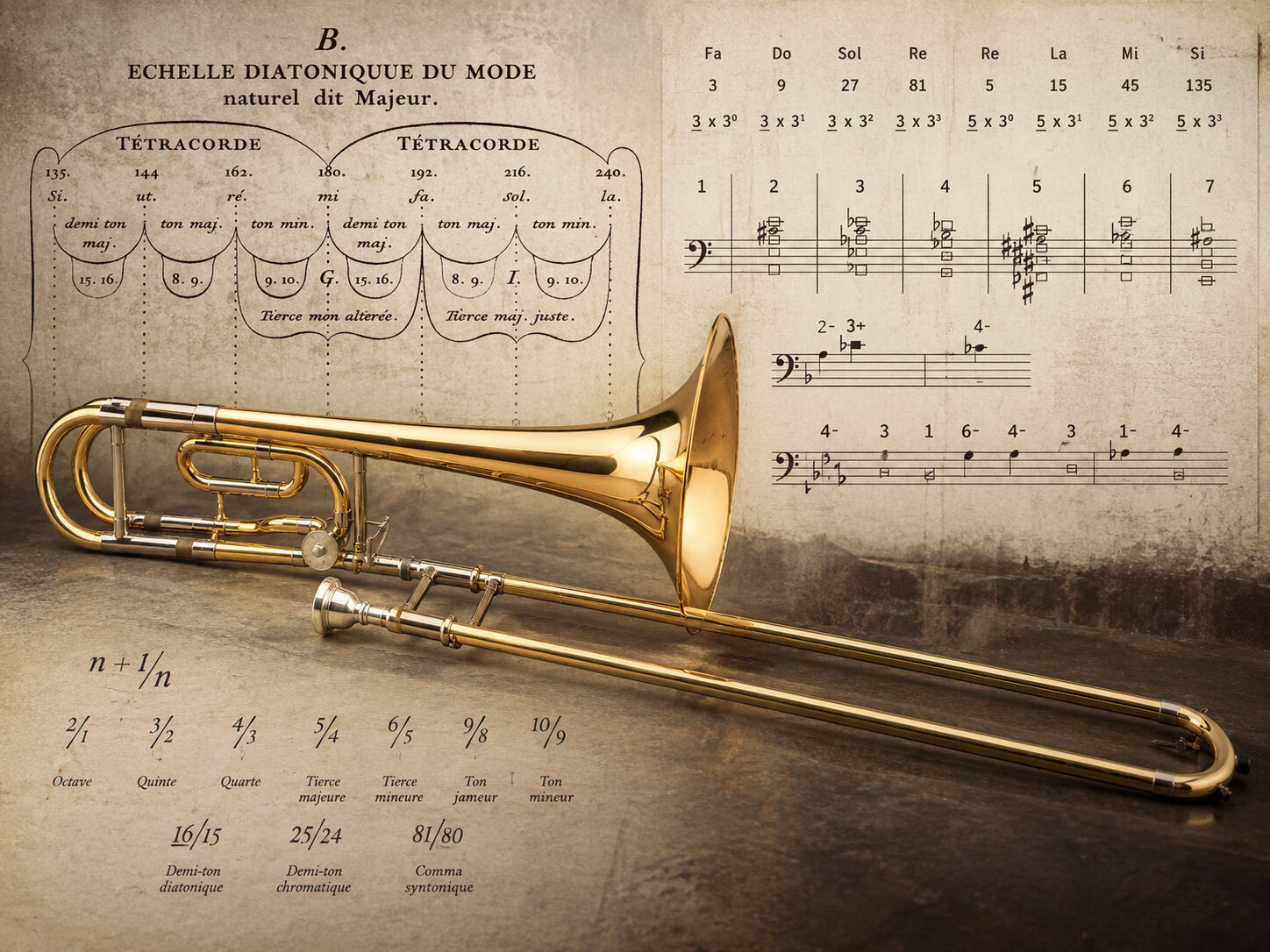
In BRASS BULLETIN no. 32 Julian Christopher Leuba reminds us that one of a musician’s most worrying problems in good intonation. In BRASS BULLETIN no. 46, in connection with the same problem, Jack Holland presented a device enabling trumpeters to modify the pitch of individual notes. It is easy to see that, once this problem is resolved, it makes possible a wider range, greater flexibility, more precision and increased endurance. Messrs. Leuba and Holland play horn and trumpet respectively. Personally I play mainly the slide trombone and the same concerns have led me to discover what I consider the solution to this ubiquitous problem: good intonation.
The diagram opposite (fig. 1) represents the typical series of harmonics obtained by blowing into a cup-mouthpiece instrument. This immutable fact is linked with the laws of physics. With the exception of numbers 7 and 11 the series is completely satisfactory at the level of musical perception.
Figure 1
| 12 | G | 6 | G |
| 11 | ? | 5 | E |
| 10 | E | 4 | C |
| 9 | D | 3 | G |
| 8 | C | 2 | C |
| 7 | ? | 1 | C |
Unless we are accustomed to them, our senses are shocked by these two sounds, lacking as they do numerical compatibility with the more elementary 2, 3 and 5, which are able by themselves to support all musical organisation, even going so far as unexpectedly to provide 24 notes per octave. The basic intervals of musical construction correspond to the formula n + 1/n applied to double, triple and quintuple combinations. Notice that fig. 1 consists of a succession of relationships of this kind. We find in turn 2/1 (octave), 3/2 (fifth), 4/3 (fourth), 5/4 (major third), 6/5 (minor third), 9/8 (major tone) and 10/9 (minor tone). Taking the harmonic series further, one can pick out 16/15 (diatonic or major semitone), 25/24 (chromatic or minor semitone) and finally 81/80 (syntonic comma).
It is interesting to note that close study of fig. 1 also reveals the relationships in current usage combining double, triple and quintuple proportions, i.e.: 5/ (major sixth) and 8/5 (minor sixth). No doubt this observation lies behind the declaration of the great theoretician Jean-Philippe Rameau that “the order of the origin and perfection of these consonances is determined by that of numbers”: first the octave 1-2, then the fifth 2-3, the fourth 3-4 etc., “admitting the sixths only in last place”. It is in picking up this distinguished musician’s work that one eventually comes on the solution, dismayed all the while by the intellectual poverty of his successors. In fact — did he have any successors?
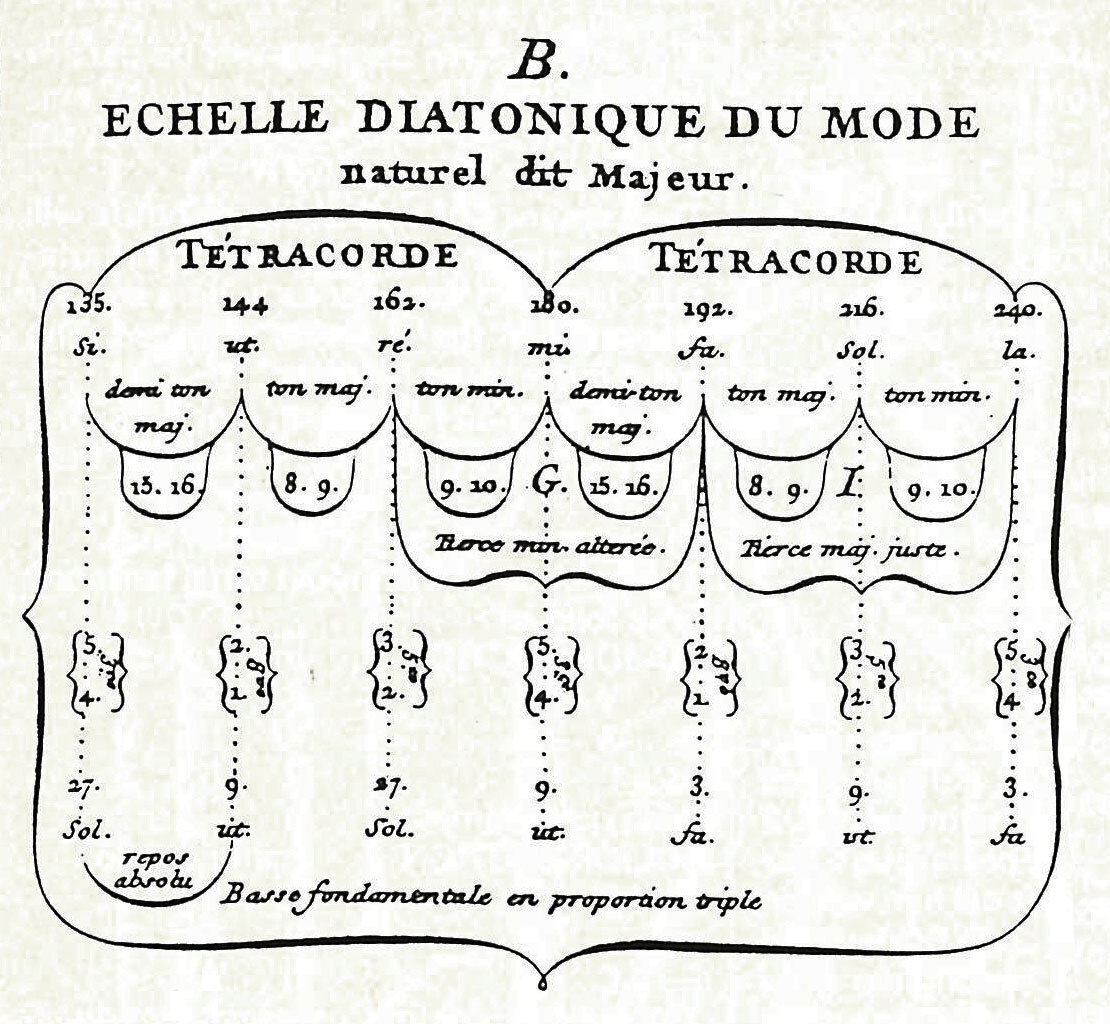
Figure 2
According to Rameau (fig. 2) a melodic succession (borrowed from the scale of the ancient Greeks) coincides with the fundamentals of the major mode.
Continue reading
Accede a la edición digital completa.
Brass Bulletin 52, IV / 1985 páginas 47–52
Todo el contenido está protegido por derechos de autor © Brass Bulletin 1985–2026