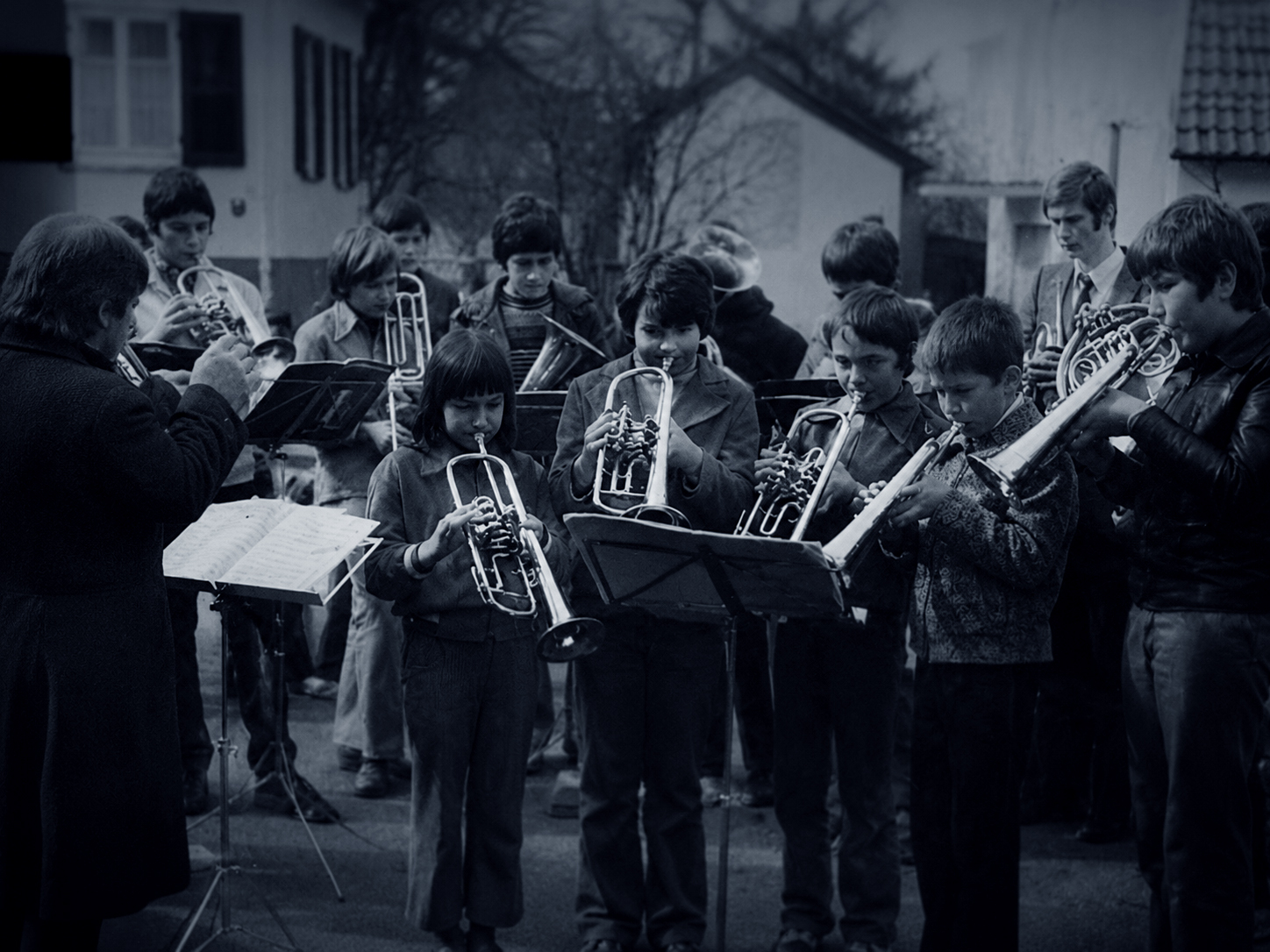
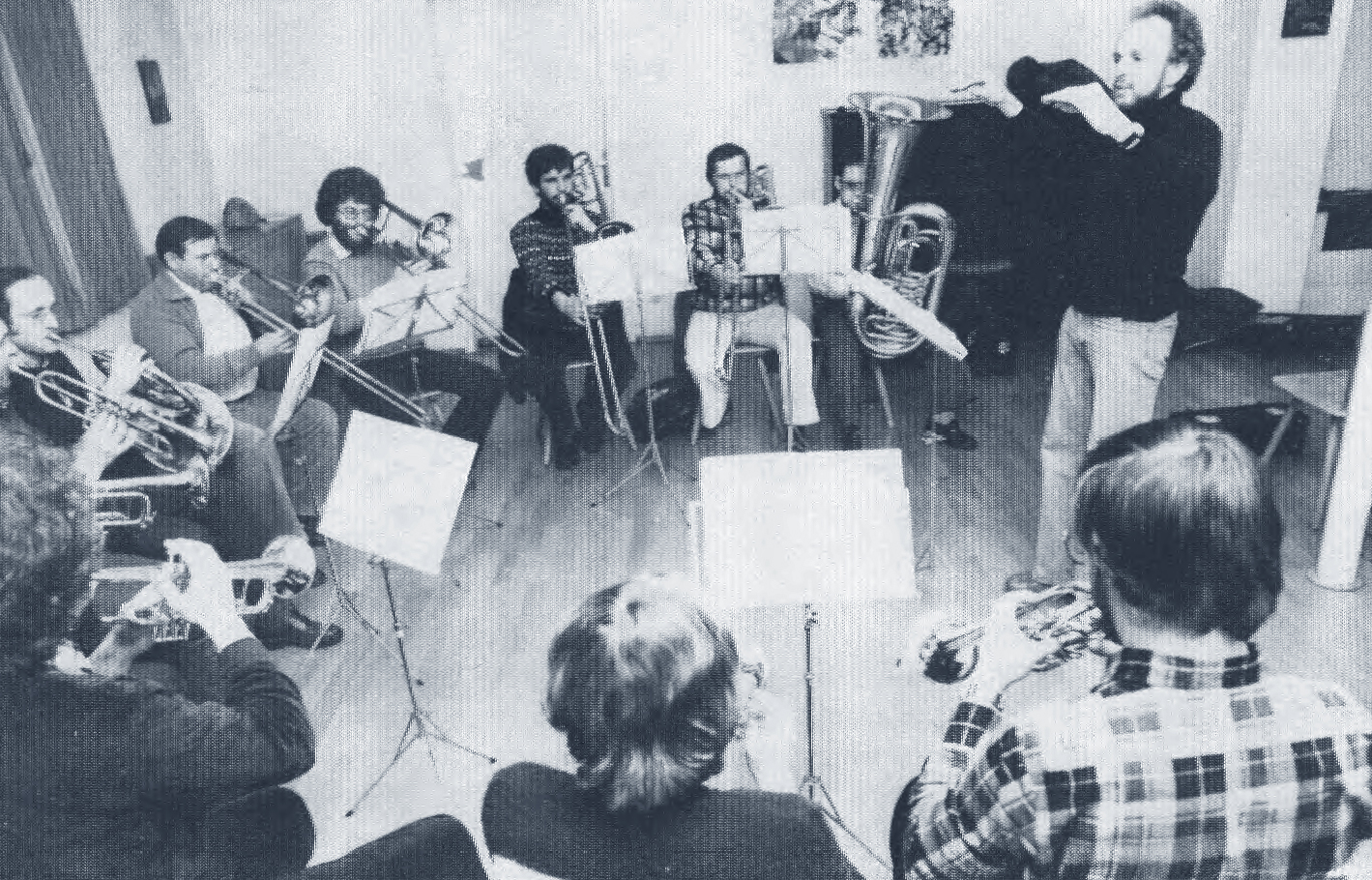
The most important Christian brass movements were the German Posaunenchöre, promoted by Pastor Kuhlo from 1843 onwards, and the bands of the Salvation Army, founded in 1878 by William Booth. What is common to both is that they regard playing as a form of service, serving God and serving their neighbour, and that they devote a great deal of their resources to training the younger generation of brass players (which they also do with missionary zeal).
But whereas the Salvation Army has produced some more or less professional élite bands not averse to international fame and stardom, Posaunenchor players do not go in for anything so spectacular (even though several players who later achieved prominence had their earliest training there). On the contrary, the Posaunenchor sees itself as a specifically amateur institution and, in accordance with its Christian mission, as a mass movement in the best possible meaning of the word.
"The important thing", writes Helmut Schweiker, "is that we are here and that we are thus able to reach sections of the population which can never ever become professional". What is more — in a truly Christian spirit, everyone is accepted and no-one turned away: "We are concerned to train people properly, but everyone can join in for everyone has a gift."
A maxim both straightforward and impressive — and apparently a recipe for success. The Posaunenchor has survived in every German-speaking community in East and West, and Helmut Schweiker's brass "parish" of Württemberg alone numbers no fewer than 15,000 souls, more than a third of them youngsters — no worries about new blood there.
The job of coaching these "juniors" falls to Helmut Schweiker, who is also responsible for training the "Young Players' Leaders" who are amateur musicians like himself and want to stay that way.
There is no amateurism about Schweiker's teaching work, however. The aims and methods which underlie the Method for Posaunenchöre and its associated worksheets, which he compiled together with Hans-Jürgen Hufeisen, demonstrate a more devoted and up-to-date knowledge of the subject than many a college-trained teacher can claim.
The introduction to hearing, reading and playing music is careful, imaginative and childlike in the best sense of the word. It is a long way from the shirt-sleeve methods of the fathers of the Posaunenchor movement, who simply handed the beginner a book of chorales, a battered old instrument and a fingering chart.
The whole point of this teaching method is group work (not to say group dynamics) which is regarded as being of general educational value. There is no demand for classroom teaching. "Being together in the group is itself a factor in education," they believe.
"Human conflicts should not be suppressed or 'played away' in notes; they should be faced up to and worked off. Education starts when diffident children and star players, aggressive types and 'slow learners' are brought together in a community."
This does not involve glossing over the religious aim of this type of work, "Posaunenchor work". "The young Posaunenchor player should be told from the very beginning what the purpose of the playing is and what duty lies behind it," is the unmistakable message; "our brass players play on the basis of the service of music to the community".
And again: "The joy which comes from music-making should be expressed by the player in 'Praise to God' and 'Service to Others'."
The role of "preaching" plays a particularly important part here. The fact that Pastor Kuhlo called his brass groups "Posaunenchöre" is no coincidence. He did not mean that trombones would be the main instruments (Posaune, in modern usage, means "trombone"); he wanted to refer to the use of the word in Luther's translation of the Bible (in the biblical context it means "trumpet") where it denoted the trumpets of Moses or of the archangels, the heralds of God.
Strangely enough, in Kuhlo's Posaunenchöre it was neither trumpets nor trombones that gave the tuning note, but the flugelhorn family, full in sound but completely without brilliance.
In the present-day Posaunenchor all instruments in B♭ pitch are represented. They stick steadfastly to one peculiarity which instantly identifies the Posaunenchor player: from the very beginning even the high B♭ instruments read from parts notated in concert pitch (i.e. written C is fingered 1+3 or 1; G is fingered 1+2) because the immediate objective in training the juniors is, as always, to play chorales from the hymn-book during the service.
The fact that the juniors are thus to some extent isolated from the rest of the brass-playing world (they could not, for example, join a band or orchestra straight away) is not a serious objection.
All this is not to say that the Christian brass community is averse to the joys of secular music. Secular pieces, old and new, as well as folk music, constitute a substantial part of the repertoire.
Helmut Schweiker lays particular emphasis on improvisation, playing from diagrammatic notation, and all kinds of learning games. The presentation of "playful", "enjoyable" learning, "like a hobby", which should be "fun", runs like a continuous thread through all his writings, even when there are difficulties to be faced and overcome, and limitations to be coped with.
There is no doubt about it: Helmut Schweiker has recognised the signs of the times. He would like to offer young people, away from the demands of school and job and the stultifying "supersell" of the consumer society, space for active and unmonitored personal development.
Then "brass-playing" becomes almost an alternative life-style, one to which a considerable portion of free time is devoted, as if in an attempt to preserve something of that Golden Age which the veteran Henri Renart reminds us of (BB 33) — when "people made music for their entertainment".
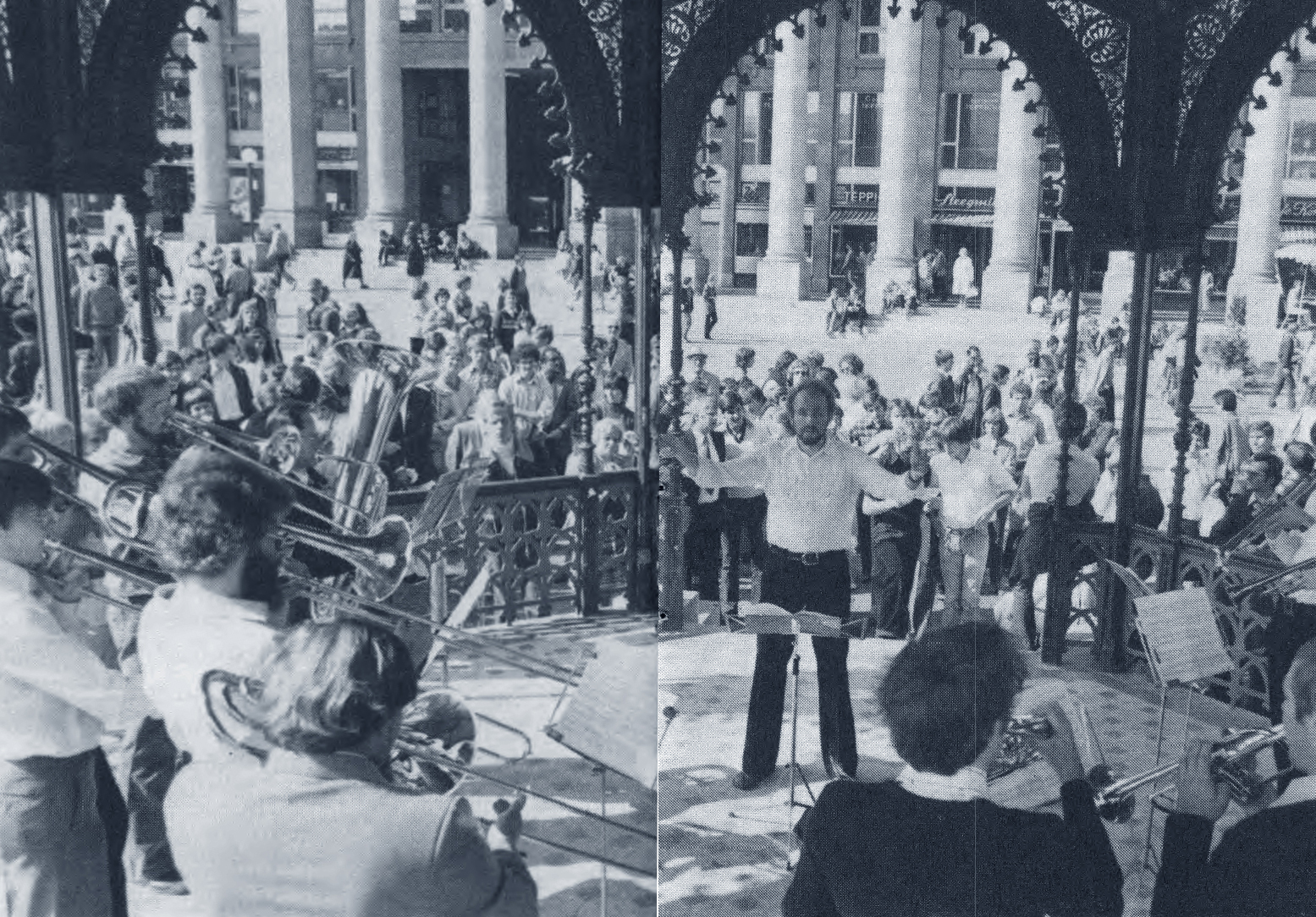
A high point for the Württemberg players is the biennial "State Posaunenchor Meeting" in Ulm, when the players gather on the cathedral square for a real "Symphony of a Thousand".
"Posaunenchor work": is that not an excellent generic term for what we brass players all do, or would like to do? People like Helmut Schweiker are doing it with skill and devotion where it is most necessary: at the foundations — not to say, on the streets.
To say that the international brass community would be both poorer and smaller without them is certainly the least recognition that one can give them. In their Posaunenchor work may they, and others, long continue!