9 min de lectura
A study of musical intonation
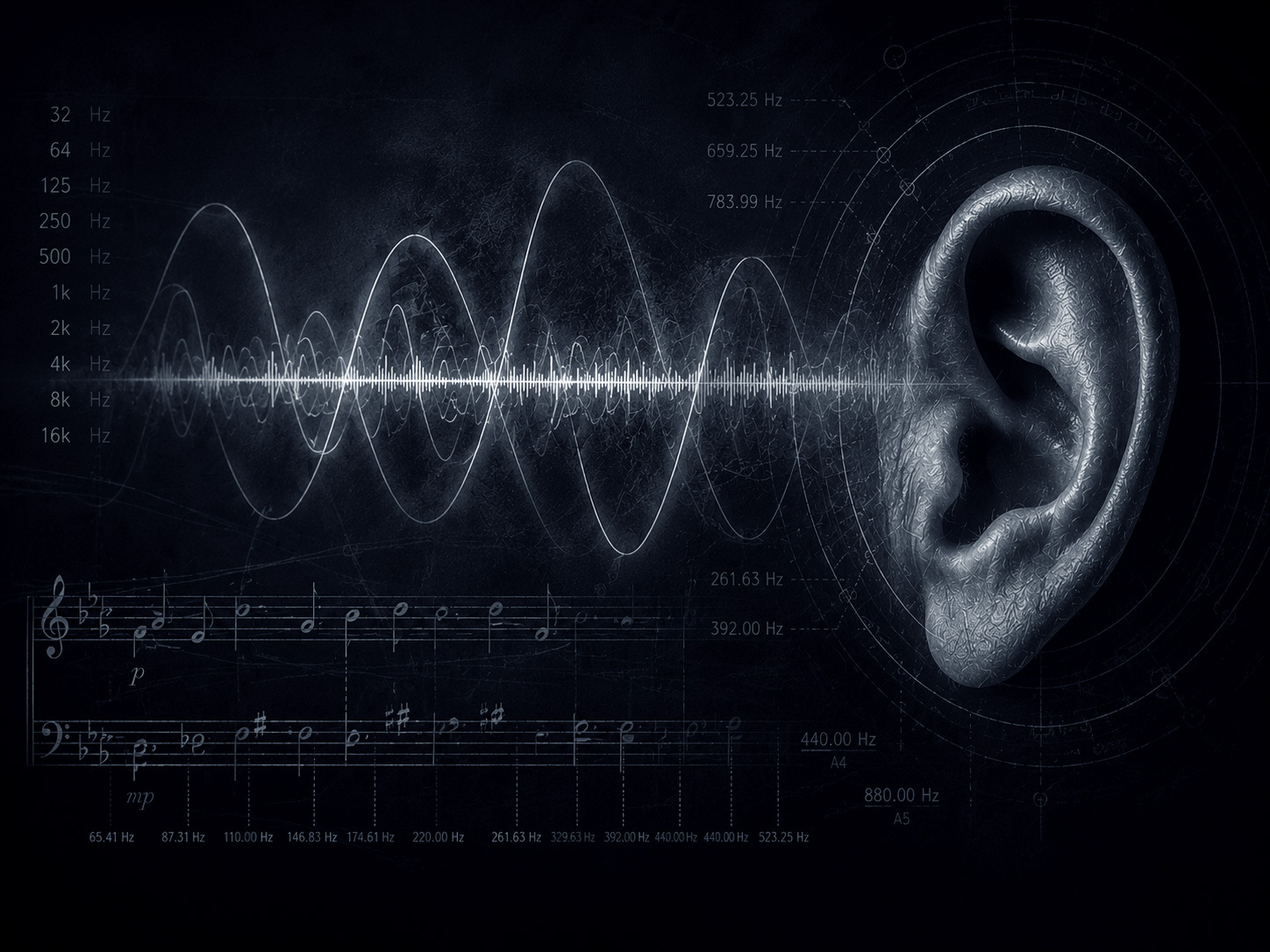
The first part of this paper discussed the theoretical justification for adhering to the just diatonic scale, rather than that of equal temperament. This second part will undertake to show some methods by which the instrumentalist may relate these theoretical concepts to his practice.
The player's initial problem is to learn to differentiate between the "sonorities of intonation" and the characteristic sonorities of the instrument. An analogy may be found in painting: the differentiation of color relationships when compared with the effect of various media, i.e., water, oil, canvas, board, on these color relationships.
To acquire this ability, the writer feels that the player will gain understanding more rapidly through the instrument (by playing), than by learning concepts in the isolation of the solfeggio class and later applying them to the instrument.
The player should first seek the "center" of each tone the instrument is able to produce. The center of the tone refers to the frequency at which the greatest resonance is produced on a given note. Instruments vary greatly in the amount that notes may be raised or lowered with a given fingering. Adjacent notes often respond in quite dissimilar ways, and frequently it will be found that the spacing between the centers of notes is unequal. It is of the greatest importance that the player learn the relative positions of every note on the specific instrument being played1.
In this, the player can be assisted by using the Stroboconn or similar devices, in the conventional manner recommended by the manufacturer since, as a standard, the Stroboconn and other stroboscopic tuners use the scale of equal temperament. Using the tuner, the player must learn to recognise the change of tonal quality which ensues when the note is altered, up or down, a specific amount.
Following is a practical example of the manner in which a teacher could work with the student on this problem. Played "D" below the treble clef (illustration a) fingered first valve on the F horn is often flat. For the octave above (illustration b) the usual fingering is B♭ horn 1&2, seldom a flat note. Octaves so fingered, regardless of the key, often cause difficulty.

With a Strobotuner set to G (played D), the teacher can have the student compare the two octave Ds. Playing the lower one, F horn, it may be necessary to open the hand slightly in the bell, "lip up" slightly, or both. The teacher should then play the upper D, having the student join in with the lower octave, playing this lower octave both in tune with the upper note, and low on purpose, in order to learn not only the amount needed to adjust, but also to learn to distinguish between the characteristic qualities of this octave relationship when the lower note is played flat or in tune.
The teacher should also alternate with the student, playing the lower octave while the student plays the upper note, while listening for quality changes. The teacher should explain to the student that, in this instance, a low note on the instrument is being compensated for, though in some instances, it may not be as necessary as in others.
Of course, as the teacher notices other specific notes which are far off on the student's instrument, other more in-tune octaves on the instrument may be used as a guide, with a Strobotuner as an aid, in a manner similar to that outlined above2.
The student should prepare, with the assistance of the teacher, a chart showing the placement of each note on the instrument, including common alternate fingerings. (A sample chart is shown in Appendix E, see BB 34). A new chart should be prepared if the player purchases another instrument, changes mouthpiece, or makes an important change in playing technique.
The Strobotuner has other applications suitable to this discussion. Those who have used a Strobotuner (the writer refers to the "portable" Conn Model SR2, showing only one note at a time, although the larger model functions in exactly the same manner) will have noticed that the Strobotuner set to "A" will respond, not only to A, but also rather strongly to several other tones; it is usually explained that the machine "is so sensitive" that it responds "even to the overtones of the note being played". This is, at best, but a partial explanation and, the writer thinks, misleading.
To begin, the writer was rather surprised to learn that the French horn, generally considered to have a tone quality rich in overtones, when played into a sensitive microphone feeding into an oscilloscope3 produced, from middle C upwards almost pure sine-wave patterns on the screen, indicative of a lack of overtones. In the range below middle C, not considered "characteristic" of the French horn, there was an indication of overtones.
However, the same tones which produce virtually pure sine waves on the oscilloscope will, when fed into the relatively insensitive crystal microphone of the Strobotuner, indicate considerable activity other than the note being played. Another explanation must be sought.
Careful observation of the Strobotuner will show that the notes producing the strongest response at any given setting lie in the harmonic series of that setting. For instance, if the Strobotuner is set to A, there will be indicated a strong response to E (third harmonic), C♯ (fifth harmonic), G (seventh harmonic) and B (ninth harmonic), even if these tones are sounded by harmonic-free tone generators.
If the Strobotuner is set to A, and A49 = 440.0 cps. is played, the response will be seen primarily on band 4 (cf. drawing C below). Response shown on other bands may indicate other harmonics inherent in the tone of the instrument, room resonances, self-induced microphone resonances or other factors.
Keeping the tuner set to A, if E56 = 660.0 cps. is played, the response will be seen, not primarily on band 4 (which indicates the octave of A49 = 440.0 cps.) or band 5 (which indicates A61 = 880.0 cps.) but rather on band 3, which indicates A37 = 220.0 cps. This happens to be the nearest A which could generate an E56 in its harmonic series (as the third harmonic).
Similarly, playing C♯53 = 550.0 cps., the response is seen not on band 4 or 5, but on band 2, that of A25 = 110.0 cps., the nearest "generator" of C♯ as its fifth harmonic.
Likewise, G47 = 412.5 cps. produces its response not on band 3 or 4, but rather on band 1, that of A13 = 55.0 cps., which is the nearest A which could generate G47 as the seventh harmonic of its series.
Playing G an octave higher (G59 = 825.0 cps.) produces its strongest response on band 2 (that of A25 = 110 cps.). A25 is the nearest A which could generate G59 as its seventh harmonic.
Following the drawing of the Strobotuner indicator are examples showing the relationships of various notes to the A series which would generate them.(illustration c)
Continue reading
Accede a la edición digital completa.
Brass Bulletin 33, I / 1981 páginas 59–67
Todo el contenido está protegido por derechos de autor © Brass Bulletin 1981–2026