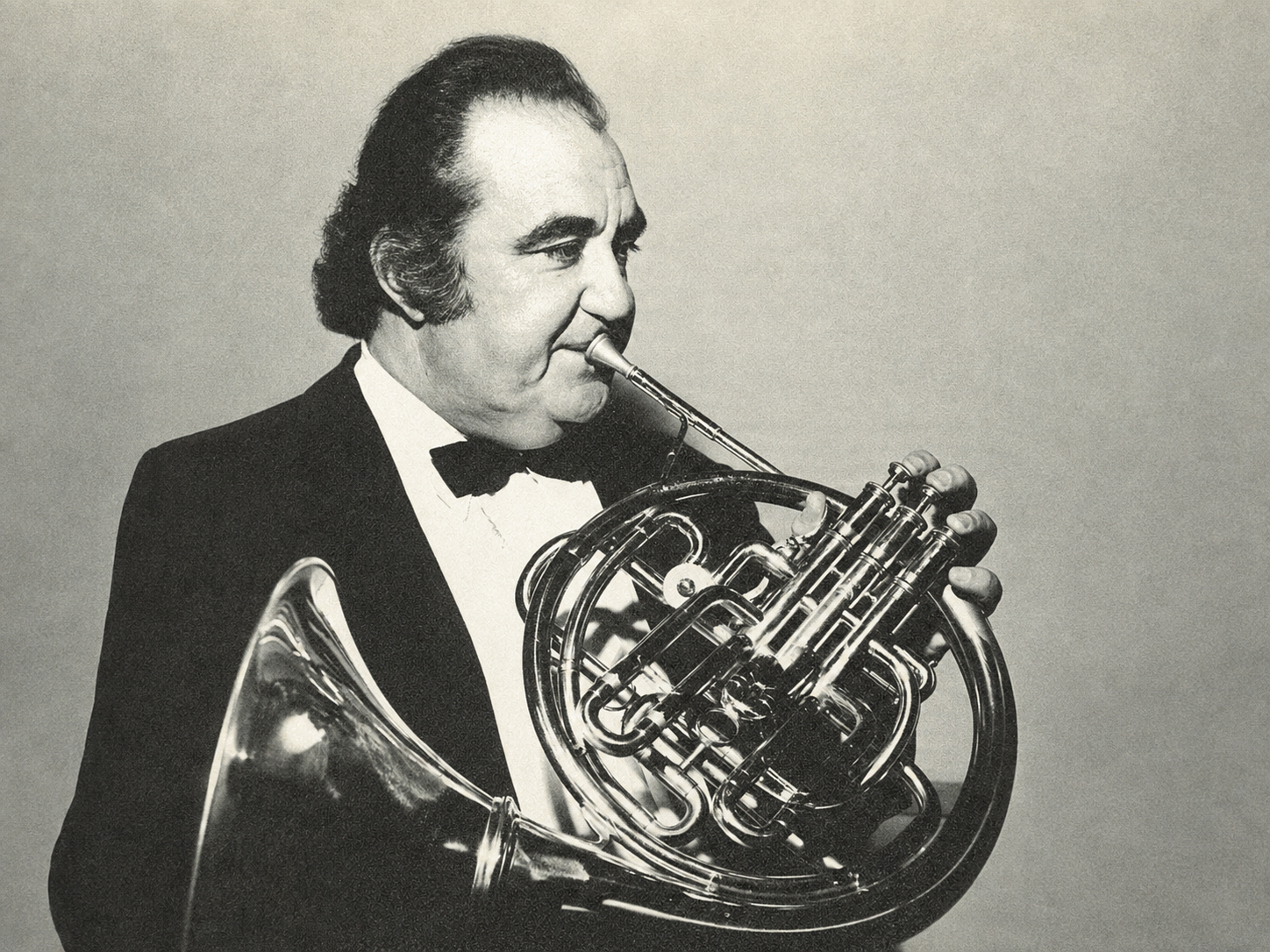
I then decided to enlarge my knowledge of music and studied harmony, counterpoint and fugue. Also I began playing double bass, which enabled me to find my way into jazz music, an exciting experience, especially rhythmically. I made musical arrangements and started composing, which still is one of my most cherished hobbies : it is fascinating to discover and make use of the innumerable possibilities my instrument, the Horn, offers me!
In 1948 I was at last able to go to Paris and to enter the ORTF orchestra, with which I made my first concert tours in Canada and the US, under the baton of Charles Munch. Later on it was Europe and its festivals with the Orchestre de la Société des Concerts du Conservatoire. And finally in 1950 my great wish to become a pupil at the Paris Conservatoire National Supérieur was fulfilled and I won my Prix d'Honneur in the same year, followed next year by the (unanimous) First Prize at the international competition of music in Geneva. It is here, after hearing the different styles of playing the horn, that I realized how imminent it was for us hornists to find a synthesis of the different methods, for the benefit of our own technique and interpretation.
In France at the time it was the great fashion to play « vibrato », so that when we heard f.i. German and Austrian hornists, who had no continuous vibrato, we thought their way of playing rather curious ! It is the great hornist and teacher Edmond Leloir, Geneva, who helped me to face and solve this problem and who made me see that to find the synthesis we, French hornists, had to break with the vibrato habit, as a solution that is too artificial and too simple. It is really the English with Denis Brain as their leader, who were the first to find a synthesis, combining their own style with the best of the French and German method.
For recording it became indispensable to have the full and round tone that was internationally recognized, yes, it even became a « must » to own a German valve horn !
In spite of the excellent qualities of that horn and its great success in France, I still am convinced that it is not so much the make of the horn that matters as the way one plays it. I myself have always played a French instrument, as well in concerts as for recording, as well as a soloist as in orchestras or smaller groups, as well in classical as in « light » music. I have made recordings with Duke Ellington ! It is the hornist's special luck that he can play any kind of music, from baroque to avant-garde, from folksong to pop, without having to change his style or technique and even if specialized in one kind, he can at any time switch over to another.
As a professor at the conservatory in Paris and a member of the Ars Nova group, I have the opportunity to meet many great artists and teachers of all countries and feel that an important change is taking place in the brass world : with the help of contemporary music the brass player rises from group player to soloist and his instrument becomes what it is entitled to be : a solo instrument ! Is it not true that the brass instrument is the only one whose tone and deeply moving expression can be compared with the human voice ?