17 min di lettura
Fundamental trombone performance technique
Teaching and application
Introduction
Certainly the most influential person and force in my musical and professional life, the one person whom I would name as my teacher, would be the eminent French conductor, Pierre Monteux. It was my great privilege and my very good fortune to have studied conducting and the orchestral repertoire under Mr. Monteux during the summers of 1951 through 1957. One of the most important lessons that I learned from him is that we are all in the service of the art of music. This has become the guiding philosophy of my musical life.
Music requires the services of at least three persons or entities — the composer, the performer and the listener. The studio teacher is primarily concerned with the preparation of the performer. As his guide, the teacher will attempt to direct the student to submit to a discipline, the mastery of which will lead him as a performer to a freedom to express the composer’s message as though it were his own.
A typical studio situation
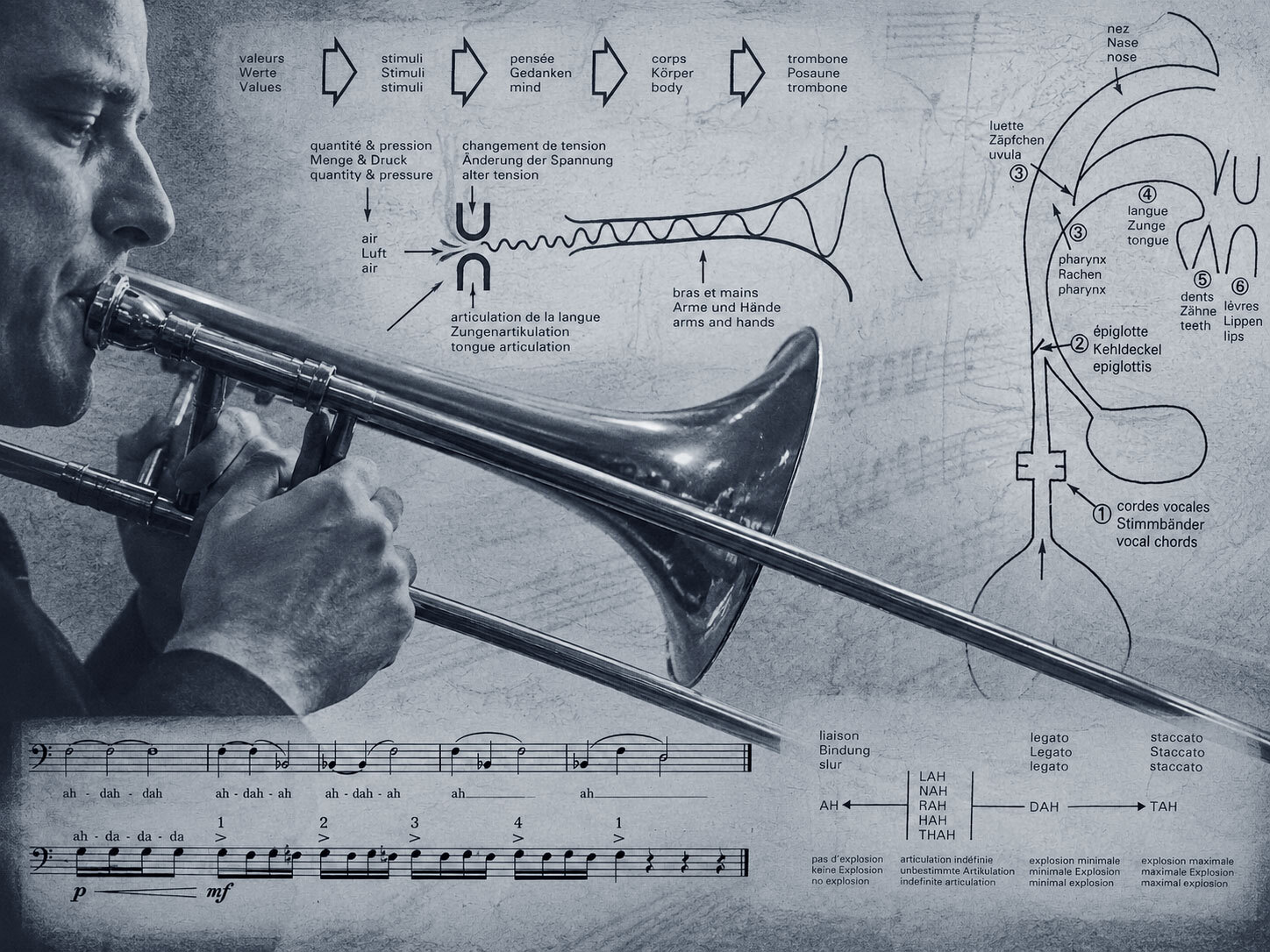
As we begin, let us picture in the studio a situation something like the following: At the one end is the trombone itself — totally inanimate, incapable of initiating a sound, serving only as a resonator and an amplifier of the sounds given to it. Next in line is the human body, a marvellous organism of bone and muscle, nerve and sinew, which must be called upon to initiate the sound and convey it to the inanimate instrument which should resonate and amplify that sound. In addition, a mind is required to initiate neuromuscular signals to activate the body in order to produce sound which is then resonated in and amplified by the instrument.
Finally, the mind constantly receives stimuli from the printed page, from the conductor, from the ensemble and from other sources. And even these stimuli, which could result in mechanical or robotic reactions, should be tempered by a reservoir of past experiences and judgments giving rise to that value system know as musicianship (1).

1
Five areas of instruction
Having been introduced, then, to the new student with his trombone, the studio teacher realizes that he is responsible for at least five different areas of instruction in directing the development of his student. These five areas are
- the acoustics of the trombone
- the function of the human body as it relates to the operation of the trombone
- the development of reading skills for the translation of musical symbolism into body action
- the development of reading skills needed for a thorough understanding of the composer’s intent, apart from actually sight-playing the composition, and
- the development of a value system that leads to good musicianship.
Three undergirding guidelines
Although each of these areas is important in the instruction of the trombone student, we will concentrate, for this study, on the second area, the function of the human body as it relates to the operation of the trombone. First, however, let us look at three continuing guidelines which should undergird all of our work as teachers. These guidelines are based on the assumption that the studio teacher wishes for his students the greatest success. To that end he will work together with them to obtain maximum results with minimum effort on their part. These guidelines are:
- the removal of all inhibiting tensions. (Tension is to be regarded as muscles working in conflict with each other inhibiting the accomplishment of a given task. This should not be confused with intensity which represents maximum effort when all muscles are working together correctly.)
- the development of a physical coordination pattern which will best achieve the desired results.
- the exercise of the musculature in the proper coordination pattern to encourage development of strength, suppleness and endurance.
Brass Bulletin 49, I / 1985 pagine 61–71
Tutti i contenuti sono protetti dal diritto d’autore © Brass Bulletin 1985–2026