13 min de lectura
Parte 1
Did Bach write the "corne da caccia" part in the B minor Mass for Gottfried Reiche?
Por Peter Damm
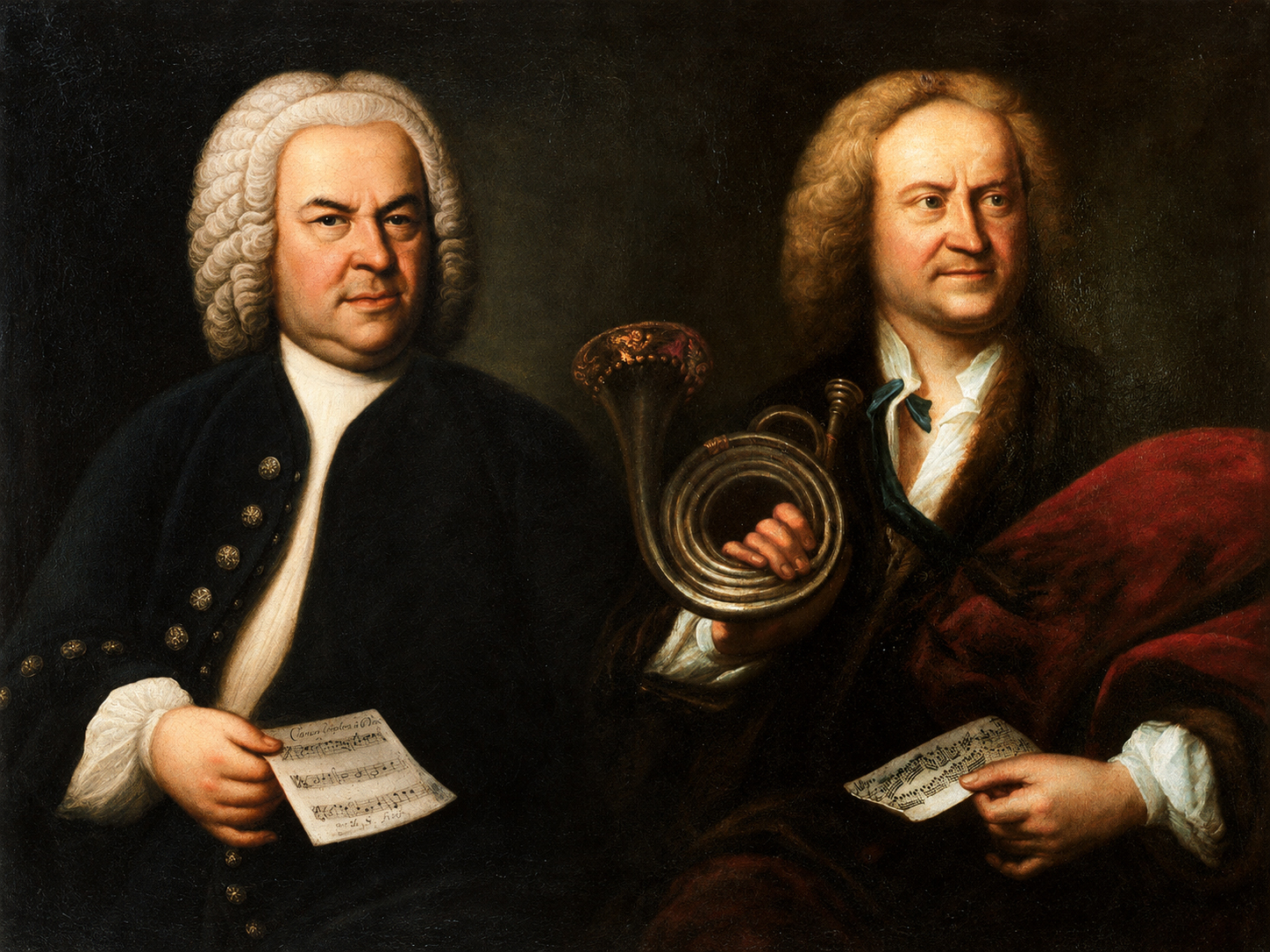
J. S. Bach, Gottfried Reiche
During preparations for a recording of Bach’s B minor Mass with the New Bach Collegium Musicum of Leipzig, conducted by Peter Schreier, the possibility arose that Bach wrote the obbligato corne da caccia part in the aria “Quoniam tu solus sanctus” (BWV 232¹/10) for the doyen of the Leipzig “Stadtpfeifer”, Gottfried Reiche (1667-1734). The aria was therefore recorded twice: once in the usual version, i.e. played on a descant horn in F alto, and once using a version for horn in D alto, played on a so-called piccolo horn by the trumpeter Ludwig Güttler.¹ This latter, substantially smaller in external measurements than the F alto, was developed by the master instrument maker Friedbert Syhre in Leipzig. Syhre surprised me with his prototype of a small-coiled descant horn as early as 1976. This answered many horn players’ wishes for a convenient “holiday horn” but this was not its main purpose. I welcomed this piccolo horn as it lightened the sound in my programmes for horn and organ.
It was originally built in the pitch of F alto, later in the combination F alto/B♭ descant (corresponding to B♭ trumpet). The sound of the instrument is a mixture of flugelhorn and descant horn. The first version was played with a horn mouthpiece with a normal rim but a small funnel and this is the combination I played in the recording “Music for Horn and Organ” (ETERNA 827 572). A further version in D alto has a wider mouthpipe and can be played with a trumpet mouthpiece; this version, with an eye to publicity, has been dubbed “corno da caccia” and has been received enthusiastically by the press as a “rediscovered” or “reconstructed corno da caccia”.
Horn players dispute
It is this point that horn players dispute. Syhre’s small-coiled piccolo horn and the early 18th-century corno da caccia have as little in common from the point of view of sound as modern piccolo trumpets and the long trumpets from the golden age of clarino playing. Anyone who would like to sample this latter sonority should listen to the disc “Baroque + Brass” (Teldec 6.429 77 AZ), which contains works for brass ensemble performed on original instruments. Also disputed is the old generalisation that only trumpeters could have played all the high horn parts on the horn. Proven historical facts argue against this sweeping statement. Equally tenuous is the constantly rehashed theory that before 1750 there were only cup-shapedces for the horn. Horace Fitzpatrick has supplied the proof of the existence of funnel-shaped mouthpieces in the first half of the 18th century.²
On the occasion of the 300th anniversary of the horn I reported in these pages on the horn players of the Dresden electoral court orchestra and their admirable clarino technique. But even in those early days other court orchestras too had employed corno da caccia specialists who were prohibited from changing to trumpet (by order of the Imperial Guild of Trumpeters!). Thus one cannot, and may not judge all early 18th-century compositions on the same basis; rather, one must consider the historical background. I will now do so as I answer the question which stands at the head of this article.
Gottfried Reiche?
The instrument in Reiche’s portrait has been adduced as evidence in favour of the high version of the “Quoniam” horn part. Neither this painting nor the manuscript “corne da caccia” part for the aria, however, says anything about performance in D alto.³ Even the text of the aria lends little support to such a view. All the circumstances indicate, on the contrary, that the “corne da caccia” part was not composed for Reiche and Leipzig but that, with the Kyrie and Gloria — the original Missa BWV 232¹, Bach was pursuing a very special goal: to please the Dresden court.⁴
After 1680 the horn underwent a transformation from functional to artistic instrument. Its introduction into the orchestra was not spontaneous; in many places huntsmen played when required while elsewhere, as in Dresden in 1710, specialist musicians were engaged.⁵
Tonal qualities
Hunting horns, whose tonal qualities in keeping with their original function were bright and sometimes sharp, had difficulty blending with the orchestral sound. As improvement was the type of hunting horn developed specially for the orchestra by the brothers Leichnambschneider in Vienna around 1700; this had interchangeable short and long bits and crooks to correct intonation and lower the basic pitch.⁶ With all its crooks this Jägerhorn (literally “huntsmen’s horn”), as Michael Leichnambschneider always called it on his invoices, could not be used in hunting.
Continue reading
Accede a la edición digital completa.
Brass Bulletin 56, IV / 1986 páginas 61–73
Todo el contenido está protegido por derechos de autor © Brass Bulletin 1986–2026