Ofrezca Brass Bulletin en su universidad, conservatorio o biblioteca Descubra el acceso institucional

9 min de lectura

Blowing as a body function
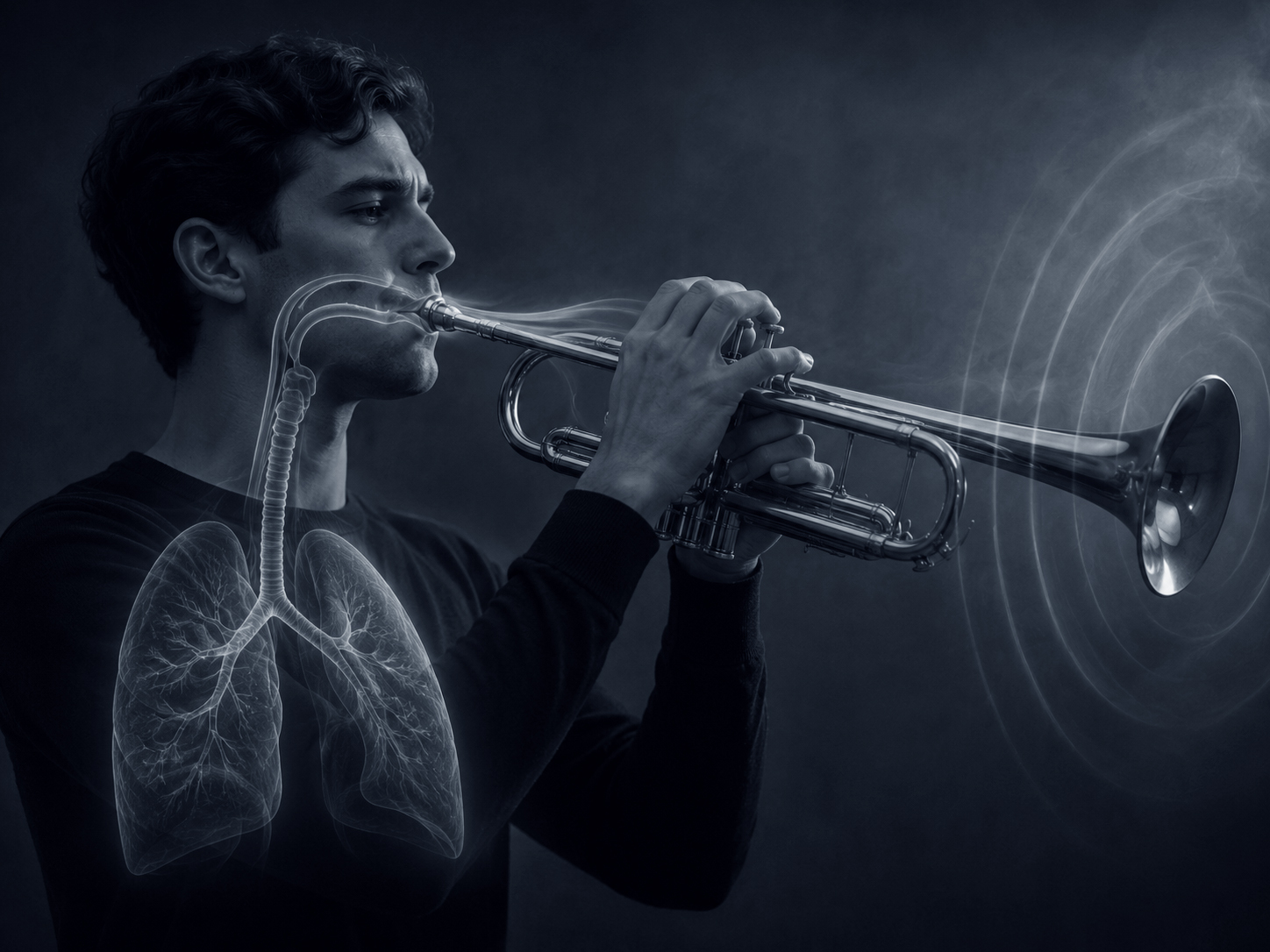
Breathing habits, posture and body mechanics converge in a practical view of tone production, where William F. Cramer questions prevailing assumptions.
Blowing as a body function

So much has been written on the topic of breathing and its control that apologies seem to be in order for adding to that literature. Nevertheless, the very existence of that much material seems to indicate that the question is not settled to everyone's satisfaction.

This article is therefore an attempt to draw together some ideas which will help teachers and students lay down a course of action which will result in a more satisfactory performance.

Breathing is, of course, a natural and involuntary action. As such, it is purely passive and serves only to supply the physical body with sufficient oxygen to keep it alive. Blowing, on the other hand, is a very purposeful activity, undertaken to set the vocal cords or the lips in vibration or to move some object outside the body by the force of the ejected air stream.

Contrary to popular opinion, the muscles which are used for breathing are not those which are used for blowing. If you examine any external motion of the body, you will observe that one muscle causes movement in one direction and another muscle reverses that direction. The raising and lowering of the arm employs opposing muscles, each of which acts as a control on the other. In a similar manner, the acts of breathing and blowing, if done purposefully, should employ opposing sets of muscles.

Inhaling is done for the purpose of taking in sufficient air to carry a full musical phrase, and the business of acquiring oxygen is purely secondary. Blowing is accomplished for the purpose of expelling that air and setting the vocal cords or the lips in vibration to produce sound.

Three different breathing and blowing techniques are possible, though it is doubtful that any one of the three is used to the complete exclusion of the other two. In any of these techniques the individual is attempting to enlarge the trunk of the body beyond its normal point of repose so that air will then rush in to occupy the space thus created.

The first of these techniques is that commonly known as diaphragmatic breath control. In this instance the diaphragm muscle, a convex dome-shaped muscle separating the rib cage from the abdominal region of the body, contracts with a downward motion, creating a space within the rib cage so that air may rush in to fill the lungs. The same downward motion of the diaphragm muscle also forces the viscera down and out, thus causing the abdominal wall to distend.

Continue reading

Accede a la edición digital completa.

Brass Bulletin 34, II / 1981 páginas 29–36

Todo el contenido está protegido por derechos de autor © Brass Bulletin 1981–2026

Compartir este artículo

Facebook LinkedIn
Cargando…

Preguntas y respuestas

Cómo funciona la edición digital

¿Qué incluye la edición digital?

La edición digital reúne los artículos ya digitalizados como textos legibles y consultables en línea —no simplemente como escaneos o archivos PDF— junto con sus ilustraciones originales, notas, autoría, información del número y traducciones disponibles. Las sugerencias de artículos relacionados incluyen actualmente solo este material digitalizado.

¿Los artículos digitales son idénticos a los originales?

Conservamos con la mayor fidelidad posible el texto original, el idioma, las ilustraciones, los pies de imagen, las notas y el contexto editorial. La presentación se adapta para facilitar la lectura en línea y pueden corregirse errores evidentes de transcripción o escaneado. El contenido y el carácter del artículo publicado permanecen inalterados.

¿Qué idiomas están disponibles?

Brass Bulletin se publicó en inglés, francés y alemán a lo largo de toda su historia. Las traducciones al italiano y al español se añadieron a partir del número 60. Por este motivo, en los sitios italiano y español los artículos de los números 1 a 59 se muestran en inglés de forma predeterminada.

¿Con qué frecuencia se añaden nuevos artículos?

Se añaden nuevos artículos casi a diario, con aproximadamente un número completo digitalizado cada semana. El ritmo puede variar según el trabajo de preparación, tratamiento de imágenes y revisión editorial necesario.

¿Por qué no están disponibles todos los artículos en formato digital?

La colección completa de Brass Bulletin contiene 1.246 artículos publicados entre 1971 y 2003. El índice completo ya está disponible en línea y permite descubrir todos los artículos de la colección, incluidos aquellos cuyo texto íntegro todavía no ha sido digitalizado.

La digitalización comenzó en febrero de 2026. Cada artículo se prepara cuidadosamente para la lectura en línea, se revisa y se vincula con su número, sus autores, sus temas y sus ilustraciones. Al ritmo actual de digitalización, se prevé que la colección completa esté disponible en línea en febrero de 2028.

¿Por qué algunas referencias mencionan artículos que todavía no están disponibles?

Las referencias de los artículos originales se conservan aunque el material al que remiten aún no haya sido digitalizado. De este modo se mantiene intacto el contexto histórico y editorial. A medida que se incorporen más números a la edición digital, un número creciente de estas referencias conducirá a artículos que podrán leerse en línea.

¿Puedo sugerir un artículo o informar de un error de transcripción?

Sí. Si hay algún artículo que le gustaría especialmente ver digitalizado, o si detecta un posible error de transcripción o algún dato que falta, póngase en contacto con nosotros. Los comentarios de los lectores nos ayudan a mejorar la edición digital y a establecer prioridades útiles dentro del archivo.

¿Cómo puedo apoyar a Brass Bulletin?

Su apoyo ayuda a financiar la preparación, verificación y publicación en línea de la colección completa.

Suscríbase a la Edición Digital

¿Prefiere apoyarnos sin suscribirse?

Haga una donación

¿Cómo avanza la digitalización?

Estamos poniendo Brass Bulletin a disposición de los lectores en línea, artículo por artículo. Pueden leer los artículos recién digitalizados en cuanto estén listos, incluso antes de que se complete un número entero.

Consulten nuestro calendario de digitalización para descubrir las últimas novedades y las fechas estimadas de disponibilidad de los próximos números. Estas estimaciones se basan en nuestro ritmo reciente y pueden cambiar.

Busca en Brass Bulletin.