9 min. read
Brass and Strings
A note on personality types among musicians
By John Davies
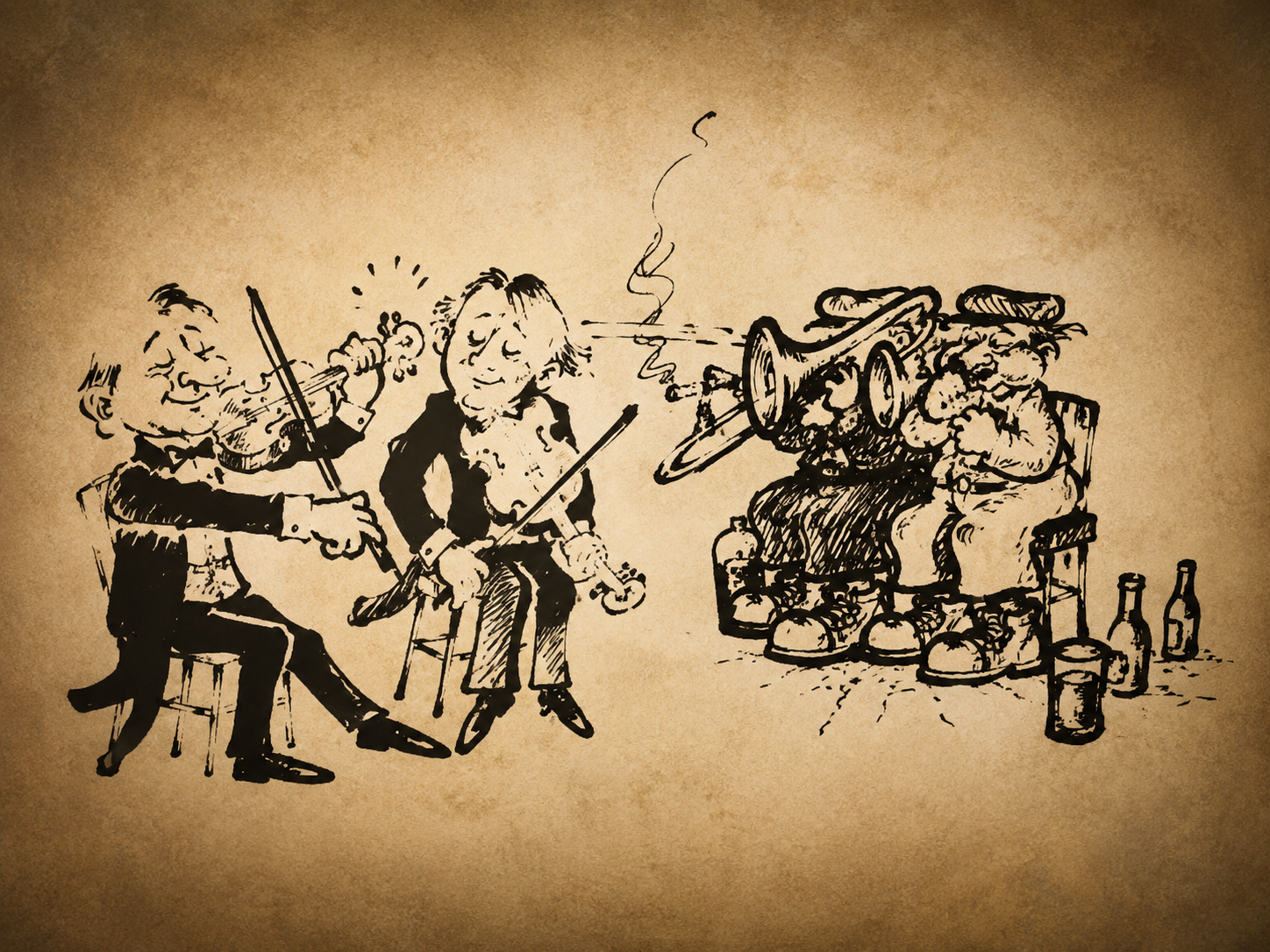
It might come as a slight surprise to some people to find that within a nationally famous symphony orchestra based in Glasgow, where on the surface all appears to be sweetness and harmony, different groups of musicians have strongly stereotyped ideas about each other. This "discovery" was made during some psychological experiments into how people remembered tonal sequences. At one point in the experiments, a control group was required which possessed high levels of skill in dealing with tonal material. It therefore seemed natural to recruit professional musicians from the symphony orchestra based nearby. In the course of discussions, the topic of the "musician’s life" often came up, and a number of musicians made half-serious, bantering comments about different sections of the orchestra. In particular, string players and brass players seemed to have very different views of each other.
The comments made were so consistent that we decided to have a series of informal discussions in the psychology department, to put these subjective impressions on a firmer basis. Altogether, 20 musicians (nine strings, seven brass, four woodwind) accepted the invitation — about one third of the total. We meant to tape-record the sessions, but some of the participants were inhibited by the idea of their remarks being put on permanent record. It later became evident why. Some of the comments were personally directed, and a few of them could only be described as insulting.
The most striking dichotomy to emerge was between the brass and string sections, which had very clear impressions of each other. For some reason, however, the double bass did not fit the string stereotype; and the horns also differed from the general stereotype of the brass. But in the main, the inter-group perceptions of brass and string sections were strikingly different. For example, the two lists below show some characteristics which these sections attributed to each other.
Brass (as seen by strings)
Slightly coarse and unrefined
Heavy drinkers
Less intelligent ("They're empty vessels. That’s why they make the most noise".)
Loud-mouthed
Play too loud ("They like to be in the limelight".)
The clowns of the orchestra
"Extraverts, big noises, that's why they play..." brass instruments
Don't practise sufficiently hard or conscientiously
Unable to take anything seriously.
Strings (as seen by brass)
Brass Bulletin 33, I / 1981 pages 33–40
All content is protected by copyright © Brass Bulletin 1981–2026