3 min di lettura
Jazz and the Horn
Julius Watkins
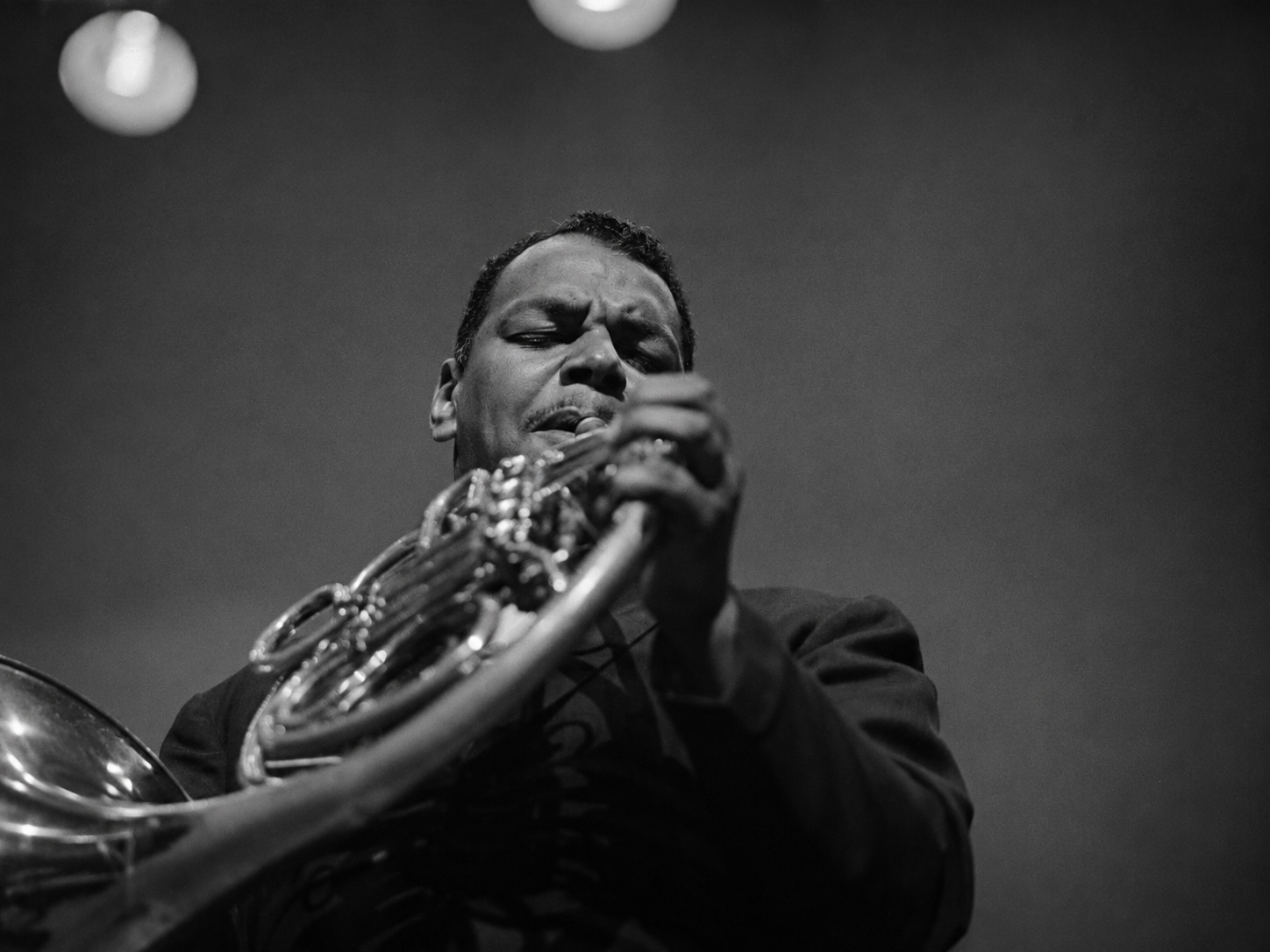
Julius Watkins performing with the Quincy Jones Orchestra at Kulttuuritalo, Helsinki, 29 August 1960. Photo: Finnish Heritage Agency / Press Photo Archive JOKA (Hufvudstadsbladet). Used under CC BY 4.0. Cropped from the original.
Making a living as a jazz musician has always been precarious at best, and for the player of an instrument atypical to jazz such as the horn, it can be virtually impossible. Julius Watkins was a horn player whose love of the horn was so strong that he stayed with the instrument for nearly his entire career as a jazz musician in the face of all adversity — meaning little work most of the time.
Watkins grew up in Detroit and began playing horn in 1930 when he was nine years old. Hearing his teacher Francis Hellstein (of the Detroit Symphony) play convinced him that this was the instrument for him. As he told John Wilson in Down Beat: “I liked the sound. I don’t know exactly why, and I still can’t explain is satisfactorily. But I fell in love with the sound and the instrument.” Why jazz? “I wanted to be a soloist, but there is very little repertoire for classical music for solo French horn. So I leaned to jazz.”
There were at this time no other jazz horn players to emulate, so he learned jazz from listening to trumpet and saxophone players and from playing trombone and third sax parts in local Detroit dance bands. His first stint as a pro came in 1943 when he had the chance to join Ernie Fields’ band — but as a trumpet player. He stuck it out for three years, but quit in 1946 in order to get back to the horn. He was able to play horn in a small group in Denver, Colo., where he stayed one year. When the group broke up, he went back to Detroit and happened to get an offer by Milt Buckner to play and record with his band.
Watkins acquired good experience and a chance to solo, but he was still having to play too much trumpet and was not happy with the way the horn was being used in the arrangements. So after two years, “I got disgusted with the whole business and went to school.”
School was the Manhattan School of Music in New York. There he studied music theory and composition and horn with Robert Schultze of the New York Philharmonic for three years.
There followed jobs with Pete Rugolo and with Oscar Pettiford’s Sextet. The saxophonist in Pettiford’s group was Charlie Rouse and in late 1955 Rouse and Watkins began playing together on the side. Their experiments with blending the sounds of horn and tenor sax inspired them to establish their own group by adding a rhythm section.
Rouse was impressed with Watkins’ ability to play not only slow ballads but also very fast and light in unison or harmony with the sax. Rouse told Gary Kramer in an interview:
“Most people associate a misterioso sound quality — that far away Alpine horn sound used by Wagner and Mahler — with the French horn. That is just one of the sounds that Julius gets from it. His horn [can also have] all the virility and hard masculine quality of the trumpet and trombone. There is so much more in the French horn than the symphony orchestra players ever realized, and Julius is the person who has made everybody aware of this. And don’t let him kid you, he can play plenty of notes, too.”
Brass Bulletin 41, I / 1983 pagine 20–23
Tutti i contenuti sono protetti dal diritto d’autore © Brass Bulletin 1983–2026